
 Search Articles


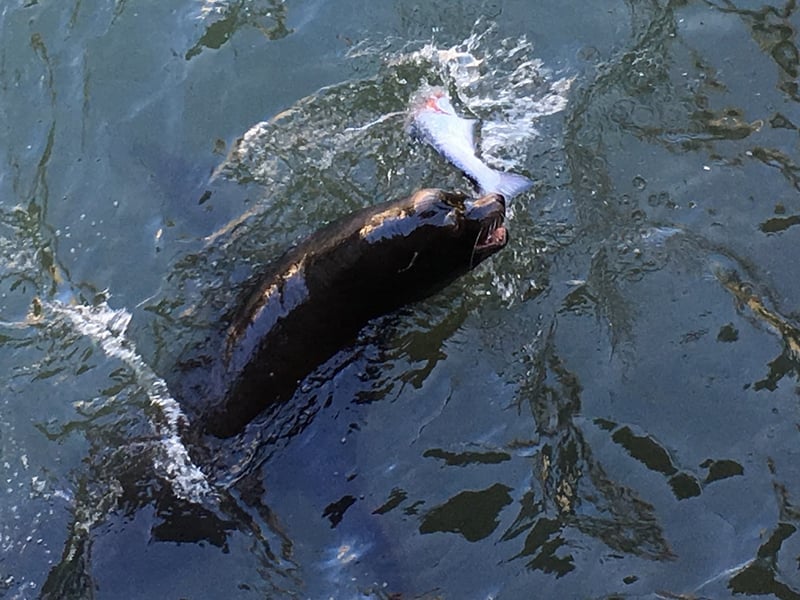
PORTLAND, Ore. (CN) — Don’t let their adorable faces and playful personalities fool you: California and Steller sea lions are capable of having disastrous impacts on nonnative ecosystems. In places like the Columbia River Gorge, these so-called dogs of the sea have been encroaching on native fish habitats for decades.
Making homes in the Pacific, in coastal areas like the beaches of California, Alaska and Japan, these sea lions especially thrive on the West Coast, where population numbers are estimated to have grown from 75,000 to 257,000 in the last 30 years. This population boom has meant increased nutritional needs, sending thousands of sea lions inland in search of prey.
One of the easiest targets for sea lions is the Columbia River, one of North America’s largest rivers and a key migration route for North American fish. The picturesque river valley abounds with seafood, including 13 federally protected species.
First documented at Oregon’s Bonneville Dam in 2003 with just three measly Steller sea lions, there are now around 75,000 Steller sea lions and 4,000 California sea lions in the Pacific Northwest, according to NOAA Fisheries. They’re moving in in search of one thing: food, including fragile and protected species like sturgeon, salmon and steelhead.
In recent years, officials have adopted increasingly dramatic measures to tamp down on sea lion populations. Nonlethal attempts included billion-dollar investments in redesigning fisheries and hatcheries and even attempting to physically chase off sea lions with boats.
Those efforts were “unsuccessful,” NOAA says on its website — and the agency pivoted to lethal means instead. In 2018, lawmakers amended the Marine Mammal Protection Act to allow removal anywhere in the Columbia River where sea lions threaten protected fish. Approved groups, including state officials and six local tribes, can remove up to 540 California sea lions and 176 Steller sea lions in a five-year period.
Bonneville Dam, Oregon’s largest, may be ground zero of the sea lion invasion. That’s because it’s a pinch point, said Michael Brown, a program leader at the Oregon Department of Fish and Wildlife.
“The fish pool up below those areas, and it attracts sea lions,” explained Brown, who has been with the agency’s Marine Mammal program since 2005 and now leads it. In early spring, sea lions begin tailing fish along migration paths up and down the river. Dams slow down the current, making hunting a whole lot easier.
At the Bonneville Dam, cameras and biologist counts track sea lion locations and numbers in preparation for the spring and fall trapping seasons. In fall 2023, the most recent year for which there is data, around four or five Steller sea lions were spotted every day. Researchers later trap the animals, Brown explained — though biologists are also experimenting with darts.
Once caught, the sea lions get health check-ups. Sick animals are killed, while healthy ones are candidates for zoos, aquariums and research. This year, 30 California sea lions and 36 adult Steller sea lions were killed, according to Washington state’s annual Sea Lion Management Report.
Diet analyses are performed on euthanized animals. Body parts are sometimes sent to universities or Indigenous tribes so that even dead sea lions don’t go to waste. This year, whiskers, fur and blubber were sent to the University of California in Los Angeles, Oregon State University and the Confederated Tribes of the Warm Springs Reservation in Oregon, among other destinations.
The efforts seem to be working. Since 2002, the U.S. Army Corps of Engineers has monitored sea lion numbers using a ‘sea lion days’ metric. The metric tracks the total number of sea lions over time, such that a single day with 20 sea lions counts the same as 20 days with a single sea lion.
The count shows that at Bonneville Dam, Steller sea lion days fell from a hefty 4,484 in fall 2020 to a much more manageable 802 in fall 2023 — an 82% decrease. Spring comparisons also saw a smaller but still notable decrease, at 36%.
As a result of the program, experts both hope and believe that fish consumption has also dropped drastically. Had sea lions not been removed this year, around 41,887 more salmonids would have been killed, the management report says. Meanwhile, nearly all Steller sea lions captured in fall 2023 had protected fish species in their digestive tracts.
Brown noted with pride that in 2017, the native Willamette River Winter Steelhead was estimated to face an 89% chance of extinction. After two seasons of the management program, the species has dropped to an 11% chance of extinction. “In my opinion, that’s a token of success.”
Subscribe to our free newsletters
Our weekly newsletter Closing Arguments offers the latest about ongoing trials, major litigation and rulings in courthouses around the U.S. and the world, while the monthly Under the Lights dishes the legal dirt from Hollywood, sports, Big Tech and the arts.