
 Search Articles


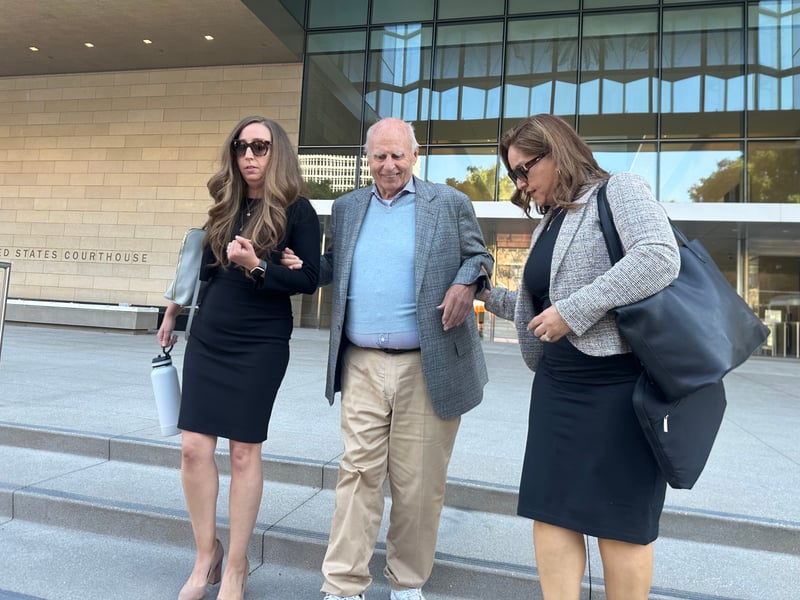
LOS ANGELES (CN) — Throughout his criminal trial, disbarred attorney Tom Girardi has sat quietly, sphinx-like, jotting down notes from time to time but barely registering a reaction as witnesses testify about his alleged crimes: the theft of more than $15 million of his clients’ money, and lying to them profusely.
Neither has he flinched when his own defense team’s witnesses have testified about how he began to show signs of dementia in 2019 and 2020 — so much so that his firm’s lawyers began to manage its operations behind Girardi’s back.
Girardi has never spoken publicly about the charges leveled against him. Criminal defendants are typically counseled by their lawyers to not testify, lest they further incriminate themselves. So it was a surprising twist when his attorney announced Thursday morning that Girardi himself would take the stand.
The former attorney smiled broadly as he shuffled over to witness stand. He sounded hoarse, coherent and affable, apologizing to the nearby jury every time he coughed or cleared his throat. He said he remembered founding his firm, Girardi & Keese, “about 45 years ago,” though in truth it was in 1965. He proudly told the jury about working on “the Erin Brockovitch case,” referring to the lawsuit filed against Pacific Gas & Electric on behalf of residents of Hinckley, California. “That became an award-winning movie,” he said.
Throughout the trial, his defense team’s argument has been two-fold: that Girardi didn’t purposely keep money from his clients, but was simply unable to manage his firm’s affairs because of his steep cognitive decline, and that the one to blame is Chris Kamon, Girardi’s co-defendant, who ran the firm’s accounting department and who prosecutors say stole millions of dollars from the firm’s coffers.
“He stole a lot of money,” Girardi testified. “Obviously, we didn’t know about it.” He later added, “I don’t know very much. But he was very clever in stealing millions of dollars.”
Had he known about the alleged embezzlement at the time, Girardi said, “I’d go crazy. I’d get him indicted.”
During cross examination, Girardi addressed the charges against him for the first time.
“The last thing I would do would be to take someone’s money,” Girardi said. “I wouldn’t think of it.”
Assistant U.S. Attorney Ali Moghaddas confronted Girardi with the accusation that he told his former clients the Ruigomez family that their settlement was for $5 million when it was really for $53 million.
“I wouldn’t have said that,” Girardi said. “I didn’t intentionally ever tell anyone the wrong thing.”
Throughout trial, Girardi’s former clients have testified that when they pressed Girardi for settlement money that was owed them, he would give a rotating set of excuses: the money was being held up by medical liens, or a former judge who was overseeing mediation.
In the case of Joe Ruigomez, a young man who was badly burned by an exploding gas line, Girardi said that he was afraid Ruigomez had a drug problem and wouldn’t be able to handle receiving all the settlement money at once, Ruigomez testified. He said he developed a dependency on painkillers after the accident, but denied having a drug problem. Defense attorneys never presented any evidence to the contrary.
Under oath, Girardi doubled down on many of his old excuses.
“Ruigomez’s mother told me he had a really bad drug problem,” Girardi said. “I declare under penalty of perjury that that’s what was going on.” Again, he blamed the retired judge who supervised mediation, saying, “He was very careful … very strict to say, you gotta space the money out.”
Prosecutors presented evidence collected by an Internal Revenue Service investigator showing that money coming in from Pacific Gas & Electric for the Ruigomez’s settlement was almost immediately spent on paying back older clients. When asked if that was true, Girardi replied, “I don’t think so. I wasn’t about to go, quote, stealing money.”
“I don’t take a salary,” Girardi insisted, a phrase he would repeat at least five more times during his roughly 45-minute testimony. “I don’t take a percentage. I work very hard. It’s not like I took the money.”
Asked about another alleged victim, Judy Selberg, whose husband died in a boating accident on Lake Havasu, Girardi answered, “On Selberg, I remember some of that. There was the drug issue.” No evidence has been presented to back up the claim.
Toward the end of the cross examination, Moghaddas asked Girardi, “You’ve had a career persuading people?”
“I don’t know,” Girardi said, smiling again at the jury. “We’ll find out.”
Questioned again by his own lawyer, Girardi revealed the extent to which his short term memory has deteriorated.
“Do you remember Joseph Ruigomez testifying?” his attorney, Samuel Cross, asked.
“No,” Girardi said.
“Do you remember Shirleen Fujimoto testifying?” Cross asked, referring to Girardi’s longtime assistant, who took the stand earlier this week.
“No, I didn’t see that,” said Girardi, who has been present in court for the entire trial and seen all the witnesses, including Fujimoto. Asked about other witnesses, his answer was the same.
“Is your law firm still open?” Cross asked.
“Yes,” Girardi answered. The firm closed in 2021.
“Just one more question,” Cross said, “What’s my name, Tom?”
“I don’t know,” said Girardi, almost chuckling. “Bad? Mean? Terrible? It’s one of those.”
It was a bizarre and confounding end to the most dramatic moment of the 10-day trial. The courtroom by then had become packed with onlookers, many of them staffers from the U.S. Attorney’s Office who’d heard that Girardi would be testifying and rushed upstairs to see the spectacle. They did not leave disappointed.
Lawyers for both sides will make their closing statements on Monday. Then the case will go to the jury. Each of the four counts of fraud carries a maximum sentence of 20 years in federal prison.
 Follow @hillelaron
Subscribe to our free newsletters
Our weekly newsletter Closing Arguments offers the latest about ongoing trials, major litigation and rulings in courthouses around the U.S. and the world, while the monthly Under the Lights dishes the legal dirt from Hollywood, sports, Big Tech and the arts.