
 Search Articles


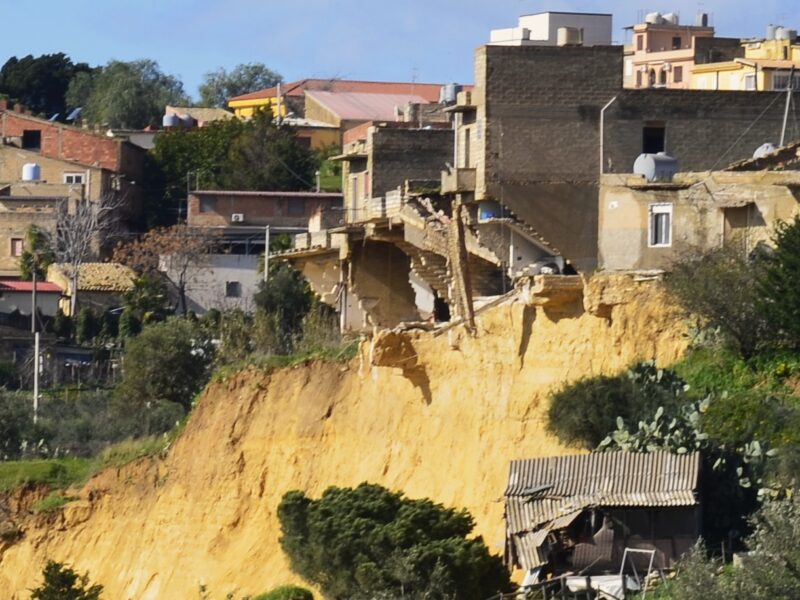
NISCEMI, Sicily (CN) — Francesca Aparo was in bed with a fever when her world was devoured for a second time last Sunday by this town’s hillside, giving way for the second time in her lifetime.
This town’s typical midday Sunday — a ritual when Sicilian families gather to eat — was shattered when menfolk tending to animals, groves and gardens below Niscemi were shocked by the appearance of cracks opening in their fields and along roads.
It didn’t take long before their warnings reached Niscemi and quiet Sunday streets filled with panicked residents: A disaster was slowly unfolding in front of their eyes.
“I looked down from my window and I saw lots of commotion and people,” Aparo said. “I realized they were looking toward the hillside and watching something going down.”
From that moment, Aparo was forced to repeat a dreadful drama she’d already lived through when a chunk of Niscemi’s hillside suddenly crashed into the plain below on Oct. 12, 1997. That landslide also took place on a Sunday afternoon.

Aparo’s family’s home, a large house built by her father, survived the earlier disaster but was later demolished, along with nearby buildings and a church, for safety reasons.
The family relocated to Niscemi’s historic center near a belvedere overlooking the fertile plain and the Mediterranean.
More than 28 years later, her home now stands near another landslide zone and, as in 1997, faces possible demolition over safety concerns.
“The house is perfect, but it is only 40, 50 meters from the ravine,” Aparo, a 55-year-old natural medicine therapist, said. “I don’t want to despair, we must stay strong, but I have to be realistic. I know I’ll never go back to my house.”

An unfolding, slow-motion disaster
Between Sunday and Monday, massive sections of hillside stretching about 2.8 miles around Niscemi collapsed, destroying several homes and leaving others perched along a newly formed precipice.
Authorities evacuated more than 1,300 people and sealed off a danger zone extending about 150 meters, or 500 feet, from the landslide’s edge.
According to authorities, the slide remains active but largely stabilized. No one was killed or injured. About 350 million cubic meters of earth collapsed, making it one of Italy’s largest recorded landslides, according to Italian officials.
“We watched the landslide happen under our feet,” said Francesco Militello, a 40-year-old mechanic with a house along the hillside. “It happened very slowly. We saw houses collapse, roads collapse, cracks in the ground get bigger.”
Still in shock, he said a rich area of countryside with gardens, farms and orange and olive groves under the town was buried.
“Nothing’s left,” he said. He could not even pick out a small piece of land his family owns in aerial videos and images he’s seen. “It’s disappeared, just like so much else has disappeared.”

A disaster waiting to happen
Among residents, there’s anger and dismay over how little was done to prevent Sunday’s landslide.
Geologists say Niscemi sits on thick clay soils that retain water, making the area especially prone to landslides.
Several experts told Italian media the collapse was to be expected, and prosecutors in nearby Gela have opened a probe into the disaster.
Heavy rains from a cyclone that struck Sicily between Jan. 19 and Jan. 21 may have helped trigger the slide, though authorities have not confirmed a cause.
Still, residents said years of negligence since the 1997 landslide seemed to have played the biggest part in the disaster.
“They knew this was a fragile spot,” said Gioachino Crescimone, a 38-year-old biologist and bar owner. His home and bar were both in the danger zone and at risk of being demolished. “They needed to do something.”
He said local and regional officials were aware of the landslide risk, yet no work was done to prevent another.
The recent heavy rains, persistent problems with leaky water lines, a lack of water management measures and other problems likely all contributed to causing the disaster, he said.
Aparo shook her head at the lack of urgency.
“Over the course of 28 years, someone must have been responsible for this,” she said. “All this work wasn’t done. Someone could have done it, should have done it and didn’t do it.”
Pietro Stimolo, Niscemi’s deputy mayor, said water in the subsoil was the principal cause of the landslide, adding it was too early to say whether the cyclone’s heavy rains triggered the disaster. He said water in the subsoil built up over years.
He declined to speculate about what work should have been done to prevent the landslide.
“It’s not the moment for that,” he said. “Later on, there will be plenty of time for anger and figuring out why things weren’t done.”
An uncertain future
With the ground still shifting and geologists warning of further landslides, uncertainty hangs over Niscemi’s future.
Still, residents say they are determined to rebuild and believe the town’s historic center, despite its proximity to the edge, can be preserved.
“Sicilians are known for getting back up,” said Damiano Schembri. He owned a store on the belvedere that specialized in American goods, including hamburgers.
He was confident about the future. “I’m not the type who’s defeated easily.”
During a visit to Niscemi on Wednesday, Italian Prime Minister Giorgia Meloni promised to rebuild the town and allocated an initial 100 million euros ($119 million) in disaster funds. On Friday, Sicilian authorities estimated the damage at 2 billion euros ($2.4 billion).
“We have to have trust in our institutions as we wait for help from the Italian government, which must show up,” Aparo said. “I trust our local leaders and I’m sure we’ve got a leader who’s even bigger, our heavenly father.”

Courthouse News reporter Cain Burdeau is based in the European Union.
 Follow @cainburdeau
Subscribe to our free newsletters
Our weekly newsletter Closing Arguments offers the latest about ongoing trials, major litigation and rulings in courthouses around the U.S. and the world, while the monthly Under the Lights dishes the legal dirt from Hollywood, sports, Big Tech and the arts.