Search Articles


RIO DE JANEIRO (CN) — One of Ilma Dias’ strongest memories after moving from Bahia, in northeastern Brazil, to Rio de Janeiro was of a street decorated for the World Cup.
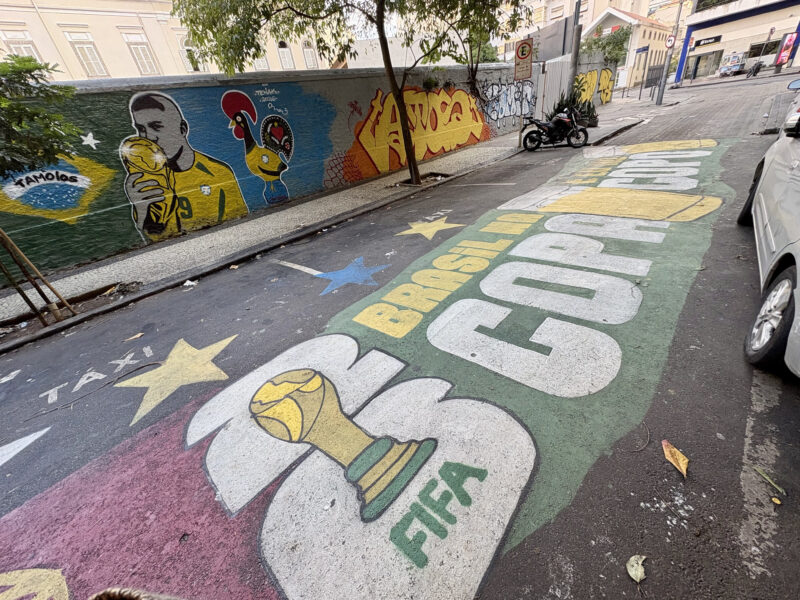
It was 2002, and Brazil was chasing its fifth World Cup title. People gathered on a street painted green and yellow and decorated with small flags to watch the national team in a neighborhood in Rio’s North Zone.
“I was taken by it. That made me feel like I belonged to Rio,” Dias, now 50, said.
Almost 25 years later, the memory returned when she began planning World Cup events for Deza Botequim, a bar she co-owns in Flamengo, a neighborhood in Rio’s South Zone.
The 2026 FIFA World Cup, soccer’s biggest tournament, begins Thursday. For the first time, the tournament, held every four years, will include 48 teams and be played in the United States, Mexico and Canada. Brazil opens Saturday against Morocco in New Jersey, seeking its sixth title — and its first since 2002.

“The first thing I thought was: I want to bring back street painting,” Dias said. “Here in the South Zone, initiatives like this happen less often. People live more in their little boxes, more closed off. I wanted to turn this corner into a community gathering, to bring people into the street.”
Dias asked City Hall for authorization, commissioned artist Rafael Meggetto — who came from São Paulo just for the project — and set the painting for May 30.
“It was beautiful to see. I think more than 200 people participated, including more than 100 children,” she said.

In all, she estimates she invested about 6,000 reais, or about $1,200, in paint and in paying the six artists who worked with Meggetto.
After years in which the tradition seemed to fade, decorating streets for the World Cup has gained strength again in Rio — enough for City Hall to turn it into an official contest for the first time.
The city will distribute about $20,000 to the three streets considered the most beautiful: about $10,000 for first place, $6,000) for second and $4,000 for third.
Created by municipal decree on May 27, the contest was presented by the Municipal Culture Department as a way to “reward streets, alleys and lanes in the city of Rio de Janeiro that carry out thematic decorations related to the 2026 FIFA World Cup, in recognition of their cultural relevance, in order to foster sporting spirit, strengthen community life and promote the cultural occupation of public space.”
Registration, initially set to close June 10, was extended to June 20.

Bernardo Buarque de Hollanda, a professor at Fundação Getulio Vargas and a researcher of the social history of soccer, said the tradition of decorating streets for the World Cup gained strength in the 1970s, after Brazil won its third World Cup title and as live color television broadcasts expanded.
Television helped turn the tournament into a collective experience, he said, allowing neighbors to gather around the same broadcasts and watch the national team together.
That street ritual consolidated a relationship that had been built since the first half of the 20th century, when soccer began to occupy a central place in Brazilian mass culture. Between the 1930s and the 1980s, Buarque de Hollanda said, the national team became almost synonymous with the country itself.
That identification has weakened in recent decades. Buarque de Hollanda said the new economic structure of soccer, with Brazilian players moving earlier to foreign clubs, weakens the link between the national team and fans who once built attachment around local club idols. The World Cup also began to share attention with other tournaments, including international club competitions and women’s soccer.
Still, he said, street decorations continue a connection with older forms of popular celebration. Because the World Cup usually takes place in the middle of the year, it overlaps with Brazil’s June festivals, when streets are decorated with small flags and other ornaments.
“Soccer was inscribed into this festive and carnivalesque tradition,” Buarque de Hollanda said. “Hence this decoration, this competition, this way of standing out through neighborhood community ties.”

Marcelo Resende, a media and sports researcher at Rio de Janeiro State University, said Brazilians’ relationship with the national team has changed, but the World Cup continues to mobilize the country.
“In the past, Brazil’s victories or defeats in World Cups were often treated as signs of the nation’s success or failure,” he said.
A long title drought, the lack of undisputed idols and the distance between fans and Brazilian players at foreign clubs have weakened that identification. In recent years, it has also become political.
Resende said green and yellow, the national flag and the national team jersey became associated with Brazil’s far right during the rise of Bolsonarism, making those symbols more ambiguous for some Brazilians.

The World Cup opens space for a different dispute over those images, Resende said. Street painting places green and yellow back in a community context, tied to soccer, neighborhood life and the occupation of public space — part of what Resende describes as an attempt to take national symbols back from partisan use.
In 2026, he said, the return of painted streets is also tied to nostalgia. Adults who joined parents, grandparents and neighbors in painting them are now trying to recreate that experience with their children.
“What I have noticed on social media and in the press is not only the desire to cheer for a sixth title,” Resende said. “It is also the desire to continue a mission from decades ago.”
In Vila Isabel, a neighborhood in Rio’s North Zone, Celso Mendes treats that mission as a four-year commitment.
Mendes, 48, was born two months before the 1978 World Cup, around the time residents began painting Pereira Nunes Street for the tournament. He has taken part in the decoration since childhood.

“I want children to have the same experience I had,” he said. “The emotion of being out in the street, painting, participating, not just staring at a cellphone screen.”
He now coordinates a team of about 30 people who plan themes, raise money and carry out paintings that can cost about about $4,000.
“I keep that flame burning for three and a half years,” he said. “Six months before the World Cup, we pour gasoline on it and it explodes.”
This year, Mendes and his neighbors focused on inclusion. The first painting was done shortly after World Autism Awareness Day, with 40 autistic people taking part. The street also received a sensory flag for people with visual impairments.
Mendes’ street has already won private contests run by newspapers, TV stations and beverage brands. This year, it is competing for City Hall’s prize.

He said residents do not paint the street because of contests — but when there is a competition, they want to win.
“It is no joke. It is like a samba school. There is a storyline, there is history, there is a carnavalesco,” he said, using the Portuguese term for the creative director behind a Carnival samba school’s parade.
Brazil’s prospects on the field also do not define the work — but Mendes does not hide his optimism.
“In 1994, Brazil went to the World Cup with no expectations at all and won the title,” he said. “Regardless of what happens on the field, we keep the tradition.”
Courthouse News reporter Marília Marasciulo is based in Brazil.
Subscribe to our free newsletters
Our weekly newsletter Closing Arguments offers the latest about ongoing trials, major litigation and rulings in courthouses around the U.S. and the world, while the monthly Under the Lights dishes the legal dirt from Hollywood, sports, Big Tech and the arts.