
 Search Articles


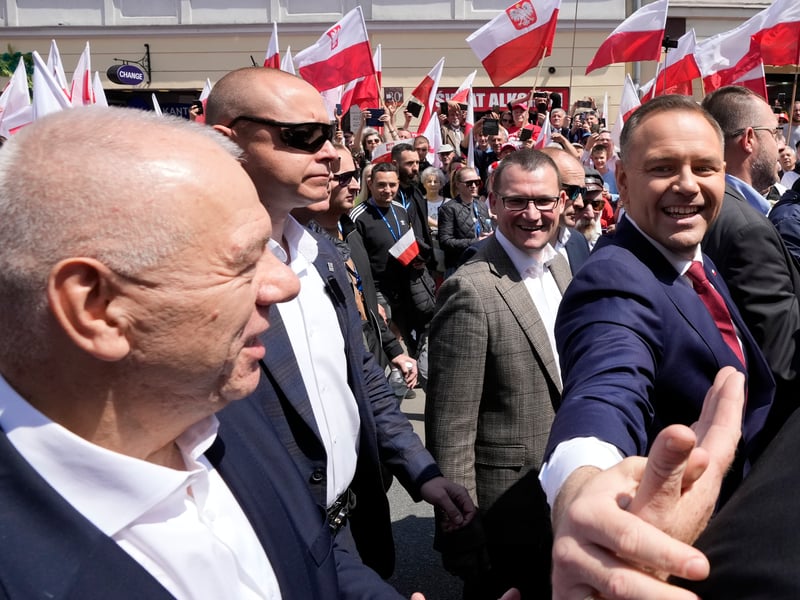
(CN) — Polish voters on Sunday delivered a blow to Polish Prime Minister Donald Tusk and his pro-European Union allies in Europe by narrowly electing a Trump-backed conservative for president.
Karol Nawrocki, a 42-year-old political novice and nationalist historian supported by Poland’s far-right Law and Justice party, defeated Warsaw Mayor Rafal Trzaskowski, the liberal candidate from Tusk’s Civic Coalition, in a highly contested runoff that saw a record turnout of 71.6%.
Trzaskowski conceded the race on Monday after final election results showed Nawrocki taking 51% of the vote. Trzaskowski, a seasoned politician who has long eyed the presidency, led most polls throughout the campaign.
Nawrocki’s win seriously damages Tusk and leaves his coalition government greatly weakened. Following the defeat, Tusk reportedly was looking at a government reshuffle and even considered holding snap elections. In a speech on Monday night, Tusk acknowledged that it would be hard to work with the new president, but he promised to carry on with his agenda. He said he would ask the parliament to hold a vote of confidence in his government, a move meant to shore up his coalition.
“The election outcome represents a major setback for Prime Minister Tusk and the entire governing coalition, reflecting growing voter dissatisfaction with the government’s performance and its failure to ease deep public polarization,” said Andrius Tursa, an analyst with Teneo, a political risk firm, in a briefing note.
With his veto powers, Nawrocki will undoubtedly attempt to block Tusk from fulfilling his agenda to undo judicial changes carried out by the former Law and Justice government that were deemed illegal by European courts.
The new president also will oppose Tusk’s efforts to liberalize abortion rights and lift a ban on same-sex couples. Nawrocki also will do what he can to impede the EU’s drive for deeper integration of the bloc’s 27 member states.
This election was seen as a referendum on Tusk, who came into power after winning December 2023 elections that brought an end to eight years of contentious rule by Law and Justice. Tusk’s popularity, though, has dropped since he took power.
Tusk and his coalition partners have been stymied from carrying out election pledges and judicial reforms by the veto powers of outgoing Polish President Andrzej Duda, a Law and Justice ally. Polish presidents can veto legislation or have it reviewed by the constitutional court, a body controlled by Law and Justice-appointed judges. It takes a three-fifths majority in parliament to override a veto and Tusk does not command that many votes.
Following Sunday’s election, Tusk finds himself again foiled by the opposition and needing to navigate the challenges of a deeply polarized Polish society.
The divisions in Poland expressed themselves in this election with Nawrocki drawing sweeping support in rural and working-class areas and in the more conservative eastern and southeastern parts of Poland.
Trzaskowski won most of his votes among well-educated voters in cities and the western parts of Poland. He also did very well among women.
For years, Poland has been riven by the competing visions of Tusk, a socially liberal yet center-right politician, and the country’s ultranationalists.
Tusk has portrayed his government as saving Poland from Law and Justice’s illiberal agenda and the former European Council president gets most of his support from urban voters.
But rural and working-class Poland sees its interests represented by Law and Justice. Often, these voters feel they were shunted aside and forgotten about during Poland’s rapid modernization and advancement following the fall of communism in 1989.
During its reign, Law and Justice solidified its support by backing social welfare programs and taking a harsh line against immigration, LGBTQ rights and the EU’s green deal. Law and Justice opposes the goal of making the 27-member EU bloc an ever-closer supranational union where EU laws and rules are supreme.
Sunday, then, was a big win for Europe’s populist far right and also for U.S. President Donald Trump.
Trump welcomed Nawrocki to the Oval Office at the start of May ahead of the first round of voting. With days to go before the runoff, U.S. Homeland Security Secretary Kristi Noem visited Poland and endorsed Nawrocki. In doing so, she said a Nawrocki win would secure the continued presence of American troops in Poland. She called Trzaskowski a “train wreck” of a “socialist” politician who uses “fear to promote an agenda.”
On Monday, far-right Hungarian Prime Minister Viktor Orbán and Marine Le Pen, France’s far-right leader, were among those celebrating Nawrocki.
Le Pen described his victory on social media as “welcome news” and a rebuff to “the Brussels oligarchy” intent on imposing its laws “without any democratic will.”
Nawrocki ran as an independent candidate, but his views closely align with Law and Justice.
His win poses potential trouble for Ukraine because he opposes allowing it to join NATO. Nawrocki has also blasted Ukraine for not dealing with the legacy of World War II massacres of ethnic Poles by Ukrainian nationalists.
Courthouse News reporter Cain Burdeau is based in the European Union.
 Follow @cainburdeau
Subscribe to our free newsletters
Our weekly newsletter Closing Arguments offers the latest about ongoing trials, major litigation and rulings in courthouses around the U.S. and the world, while the monthly Under the Lights dishes the legal dirt from Hollywood, sports, Big Tech and the arts.