
 Search Articles


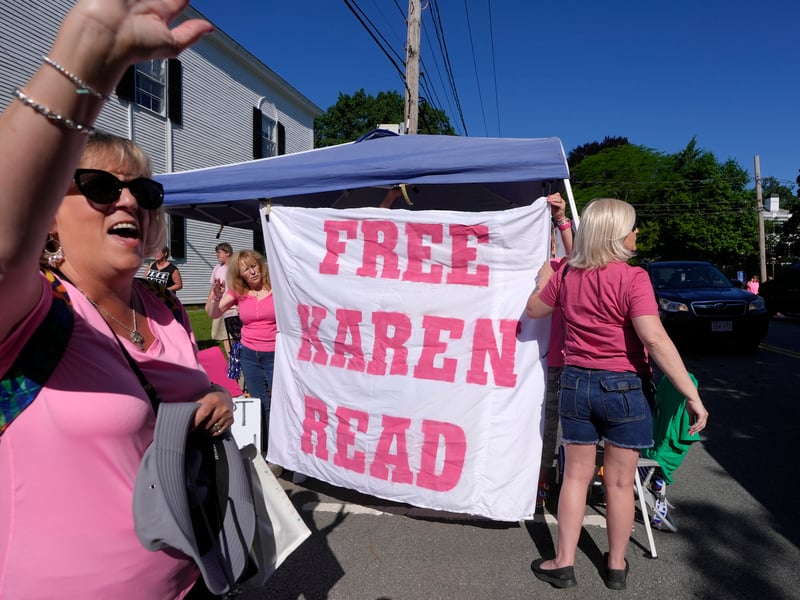
BOSTON (CN) — Police in Canton, Massachusetts — already under fire for supposedly framing Karen Read for the death of her police officer boyfriend — came under further attack in the First Circuit Wednesday for arresting citizens who peacefully protested about the case. But the judges seemed disinclined to rule on the issue and instead used the oral argument to urge the parties to resolve their dispute out of court.
“In Puerto Rico, where I’m from, there are a lot of protests,” U.S. Circuit Judge Gustavo Gelpí told the protesters’ lawyer, Marc Randazza. “It gets chaotic. There are a lot of First Amendment issues. Often, the protesters meet with the chief of police and reach an agreement.”
Gelpí, a Joe Biden appointee, then turned to the town’s lawyer, Douglas Louison of Boston’s Louison, Costello, Condon & Pfaff, and suggested, “You could say, let’s meet and maybe have a happy ending. What would happen back home is, we’d end up having the police protecting the protesters and protecting other people too.”
Read was charged with hitting her boyfriend, John O’Keefe, with her SUV and leaving him to die in a snowbank after a night of drinking. The case made national headlines because many local residents believe that O’Keefe died after a fight with another cop and the police covered it up by framing Read — leading to what Louison described as “an extraordinary amount of protesting in the streets of Canton.”
Text messages from the lead police investigator in the case, Michael Proctor, revealed not only that he was biased but that he searched Read’s phone for nude photos of her, called her a “whackjob cunt,” ridiculed her for having a chronic illness, made disparaging comments about her rear end and said that he hoped she would kill herself. He has been suspended without pay.
A trial began in April and ended with a mistrialin July when jurors were unable to reach a verdict. Prosecutors plan to retry the case.
Last November, a group of local citizens organized a peaceful protest on the sidewalk across the street from a pizza parlor owned by one of the prosecution’s witnesses, Chris Albert. Protestors displayed signs saying “Free Karen Read” and “Justice.”
Police tried to break up the protest by threatening to arrest the protesters for “witness intimidation.” The protesters went to federal court seeking a preliminary injunction authorizing their protests, but a trial judge denied it. Once the injunction was denied, the police charged the protesters under a statute that carries a lengthy prison sentence, although those charges were dismissed.
On appeal, the protesters claimed the witness intimidation statute is unconstitutional as applied to them and that the police unlawfully retaliated against them for exercising their First Amendment rights. But all three judges seemed convinced that the claim for an injunction is moot.
“You’re asking us to enjoin what?” asked U.S. Circuit Judge Sandra Lynch. “All we’re left with is your clients’ statement that they intend to engage in some form of undefined protest with undefined facts which may or may not occur before or during the retrial.”
Randazza said the protest would be essentially the same as last time, but Lynch was unpersuaded.
“You want us to decide that without any facts about the future circumstances. You know we can’t do that,” the Bill Clinton appointee said. “They might protest in a slightly different way. We don’t know.”
U.S. Circuit Judge Lara Montecalvo, also a Biden appointee, said an injunction might be possible “if the conduct is exactly the same as in the past.” But, she added, “what do we do with that ‘if’?”
The judges then went back to chastising the lawyers for not putting aside their bad blood and simply settling the case.
“Has the police chief met with these protesters?” Lynch asked Louison.
“I don’t know,” he answered.
“Why don’t you know?” Lynch demanded. “You’re her lawyer. You should know that.”
“There have been so many protests,” Louison explained.
“Yes,” said Lynch, “but this is the only one that has resulted in a federal case.”
Randazza — a colorful Las Vegas attorney whose work has involved Satanists, neo-Nazis, porn websites and rights to the Klingon language — complained that First Amendment rights are nonnegotiable. “We don’t ask the government where we can speak or assemble. We presumptively can, and it’s up to the government to show why we can’t.”
“Are you flatly saying that you’re unwilling to have any discussion with Canton?” Lynch asked.
“I can’t think of anything more constitutionally uncomfortable than saying you have to have a discussion with the government before having a protest,” he answered.
Randazza then offered that his clients would be willing to negotiate if the police backed down from their position that any public protest is illegal if any potential witness happens to be in any place where they might potentially see it. But the police still take that position, and in fact are appealing the dismissal of the charges in an effort to jail his clients, he said.
“When a government entity so blatantly violates the First Amendment, I don’t think we should take them at their word that they won’t,” Randazza declared. He then gestured at Louison and said to the judges, “Ask him if he’s willing to say otherwise.”
But time ran out at that point, and the judges moved on to the next case.
Subscribe to our free newsletters
Our weekly newsletter Closing Arguments offers the latest about ongoing trials, major litigation and rulings in courthouses around the U.S. and the world, while the monthly Under the Lights dishes the legal dirt from Hollywood, sports, Big Tech and the arts.