
 Search Articles


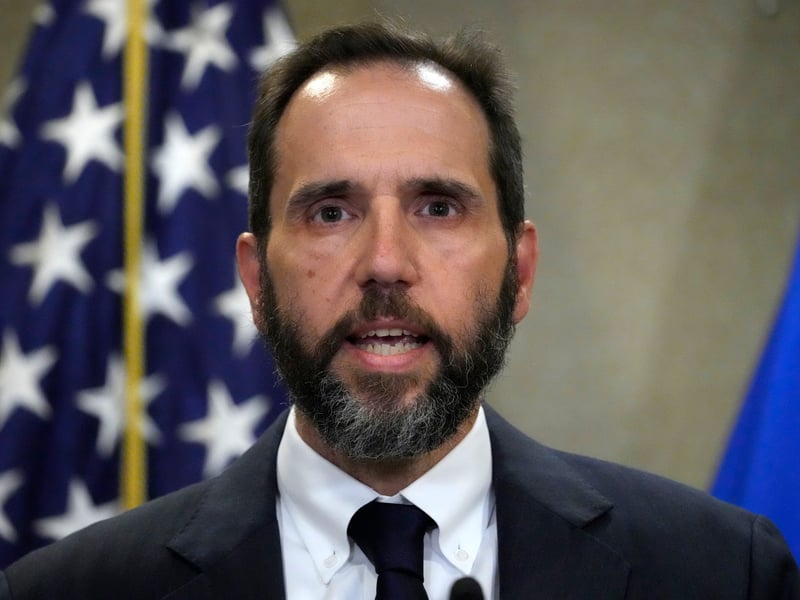
WASHINGTON (CN) — Following a recent victory in his classified documents case, Donald Trump is citing a fringe legal argument that special counsel Jack Smith was unconstitutionally appointed in an effort to also get his election subversion case dismissed.
But special counsel Jack Smith fired back on Thursday, saying this legal argument should already be considered dead in the water.
The kerfuffle comes after Trump in July successfully used this same argument to have his classified documents case dismissed in Florida. There, U.S. District Judge Aileen Cannon, a Trump appointee, sided with the former president that Smith’s appointment violated the Appointments Clause of the Constitution.
Trump tried the same tack in D.C. last Thursday, asserting that four criminal charges related to efforts to overturn his 2020 electoral defeat should be thrown out because the case itself is ultimately unjust.
The essence of Trump’s argument centers on whether the office of special counsel has any authority to prosecute a case like this.
If the role is considered a principal officer, as is the case for federal judges or cabinet members, Smith should have been nominated by the president and confirmed by the Senate, Trump has argued. And even if the role is an inferior officer, he argues Attorney General Merrick Garland did not have authority to appoint Smith.
Smith has urged U.S. District Judge Tanya Chutkan, the Barack Obama appointee overseeing Trump’s Jan. 6 case, to disregard this legal argument.
He argues Trump did not provide a good reason for filing this dismissal motion more than a year after the deadline. And even if Chutkan does allow Trump to raise the argument, he says she should still ultimately reject it, as Trump’s claims are “faulty” and “meritless."
So far, Trump has not raised this argument at immunity hearings before the D.C. Circuit or the Supreme Court. Instead, he first raised it at a Sept. 5 hearing in Washington — the first hearing in the election case since it was paused over Trump’s immunity appeals.
At first, Chuktan pushed back against allowing the filing, citing the long-passed deadlines. In the end, though, she did greenlight the request.
Even still, Chutkan noted that she did not find Cannon’s ruling on the unconstitutionality of Smith’s appointment to be “particularly persuasive.”
Smith has argued that D.C. Circuit precedent provides good reason to reject it.
That specific precedent dates back to 1987, where the appellate court upheld the then-U.S. attorney general’s authority to appoint Lawrence Walsh as independent counsel — the precursor office to the special counsel — to investigate the Iran-Contra scandal. Similarly, a 2019 decision upheld the constitutionality of the special counsel in a nearly identical argument challenging the appointment of Robert Mueller.
Supreme Court precedent in United States v. Nixon also reinforces the U.S. attorney general’s statutory authority, Smith said. Thus, he said, relying on Cannon’s ruling — as well as on an opinion by Justice Clarence Thomas that also questioned the constitutionality of special counsels — leaves Trump’s argument “deeply flawed."
In addition to challenging the office’s constitutionality, Trump has also targeted its independence. On that front, he reasserted his claims that Smith’s cases against him are politically motivated and violate the DOJ’s apparent election-interference policies.
Pushing back on this, Smith emphasized that while he was appointed by Attorney General Merrick Garland, he is not part of the Justice Department’s chain-of-command and retains a “substantial degree of independent decision making.”
Chutkan has scheduled a Nov. 21 deadline for Trump to file a reply brief in support of his proposed motion. The timing indicates she may not issue a ruling on this issue before the end of the year.
Separately and also on Nov. 21, Trump is slated to push for dismissal on the grounds of the Supreme Court’s immunity decision. Smith has appealed Cannon’s decision to dismiss the classified documents case to the 11th Circuit Court of Appeals, but arguments in the case have not yet been scheduled.
Looming over both cases is the Nov. 5 election. Trump and Vice President Kamala Harris are currently neck-and-neck in polls. If Trump manages to successfully win back the presidency, he could order his new attorney general to drop both the Washington case as well as Smith’s 11th Circuit appeal.
Even if Trump’s bid is unsuccessful, it would likely be years until a trial in his Washington case begins. That’s because he can and likely will appeal any potential immunity decision that Chutkan makes back to the U.S. Supreme Court.
 Follow @Ryan_Knappy
Subscribe to our free newsletters
Our weekly newsletter Closing Arguments offers the latest about ongoing trials, major litigation and rulings in courthouses around the U.S. and the world, while the monthly Under the Lights dishes the legal dirt from Hollywood, sports, Big Tech and the arts.