
 Search Articles


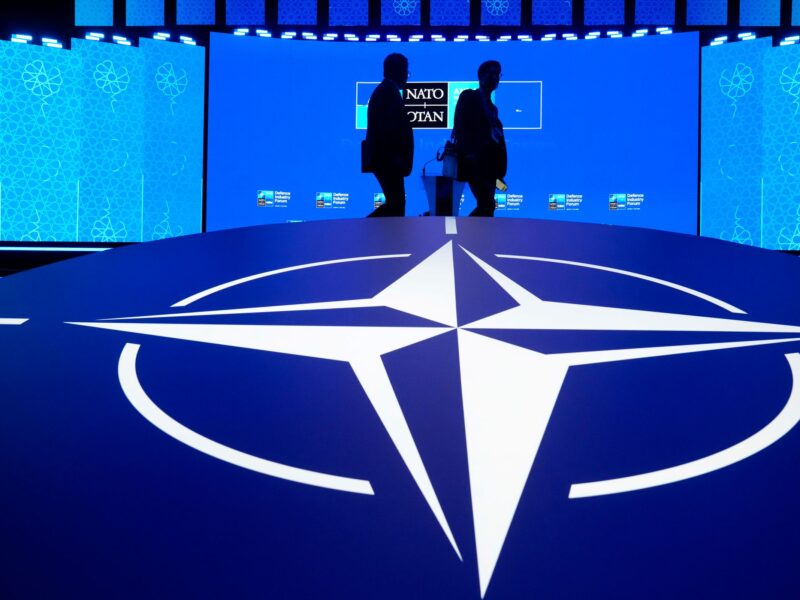
(CN) — U.S. President Donald Trump landed Tuesday in Turkey for a two-day NATO summit where transatlantic relations were put to the test once more amid global instability.
The backdrop to the summit only reinforced this sense of global chaos: Bombs exploded Tuesday in Damascus during a visit by French President Emmanuel Macron, Kyiv reeled from another night of massive Russian bombardment, and China flexed its muscles on the eve of the NATO summit with a provocative long-range missile test from a nuclear submarine in the Pacific Ocean.
Meanwhile, Ukraine said its drones struck eight Russian tankers overnight as they delivered fuel to Crimea, and Iran was accused of hitting at least three tankers in the Strait of Hormuz.
Amid so much volatility, the Ankara summit added even more uncertainty as it shone a spotlight on major strains inside NATO, which is regarded as the wealthiest and largest military alliance ever in history but whose purpose and solidity have been shaken by a series of humiliations and setbacks, including the retreat of NATO troops from Afghanistan, Russia’s grinding advance against NATO-armed Ukraine and accusations of Western hypocrisy over Gaza, Israel and Iran.
NATO’s 32 member states collectively command more than $58 trillion in gross domestic product, account for more than 55% of global military spending and field more than 3.3 million active duty soldiers.
But tensions are rife — especially between Trump and his European allies.
Before and after arriving in Ankara, Trump maintained a hostile attitude toward European nations, portraying them as weak and unreliable allies.
He has rattled allies’ nerves with talk of withdrawing troops from Europe and seeking to take control of Greenland, a semiautonomous Arctic territory of Denmark. Last month, U.S. Defense Secretary Pete Hegseth further spooked European leaders by ordering a review of U.S. troop levels in Europe.
“Ridiculous for the U.S.A. to continue along this one sided path when the relationship is not reciprocal. They were not there for us,” Trump wrote last Thursday on his social media platform, referring to the refusal of European allies to join the U.S. in attacking Iran and forcing Tehran to reopen the Strait of Hormuz.
“The United States spends more money on NATO than any other country, by far, to protect them, without getting any benefit from so doing,” Trump added.
In Ankara, European allies sought to quiet Trump’s displeasure by proving they are spending massively on their armies and preparing to take the lead in defending Europe.
Under pressure from Trump, at last summer’s annual summit in The Hague, the NATO allies pledged to raise military spending from 2% to 5% of national budgets by 2035.
Since then, defense spending has increased across Europe with many governments, most notably Germany, making rearmament a central focus. Still, ramping up spending has proven difficult as cash-strapped European treasuries are forced to cut public spending or raise taxes to pay for higher military budgets.
On Tuesday, Trump said he remained “very disappointed” by NATO members and suggested he attended the summit only because it was hosted by Turkish President Recep Tayyip Erdogan. He praised Erdogan as a “friend” and “a very strong leader, a very strong person.”

In the lead-up to the summit, Erdogan has overseen a wave of arrests and banned protests in Ankara. Journalists, activists, opposition figures and lawyers have been among those arrested. Leaders attending the summit have not spoken out against the crackdown.
Since 2003, Erdogan has ruled Turkey, a key NATO member, in an increasingly authoritarian fashion. In recent years, he’s sought to dismantle his opposition through arrests, prosecutions and court orders. Meanwhile, his government has jailed thousands of people for opposing his rule.
White House officials have characterized Trump’s outbursts against Europe as part of a broader shift that needs to take place in NATO — a strategy dubbed “NATO 3.0.”
NATO was founded in 1949 to counter the Soviet Union’s reach and expansion in Europe, but after the end of the Cold War, the alliance morphed into more of a crisis management role.
During this post-Cold War or “NATO 2.0” phase, the alliance switched its focus away from defending Europe and building up military capabilities to a stance where it acted as a force expanding liberal democratic values and maintaining order outside the NATO bloc through peacekeeping missions.
However, Western experts and officials say that phase ended after Russia’s invasion of Ukraine in February 2022. Ukraine is a prospective NATO member.
The Russia-Ukraine war compelled NATO to return to territorial defense, but the U.S. believes Europeans must take the lead in carrying out conventional warfare in Europe. In this new rubric, the U.S. provides nuclear deterrence and other strengths, such as satellite intelligence, to Europe but shifts its attention to other parts of the world.
U.S. Under Secretary of Defense Elbridge Colby introduced the “NATO 3.0” concept in a speech in February to NATO ministers.
“What is needed is a ‘NATO 3.0’ — something much closer to ‘NATO 1.0’ than the approach of the last 35 years,” he said. “This ‘NATO 3.0’ requires much greater efforts by our allies to step up and assume primary responsibility for the conventional defense of Europe.”
He advocated a return to the “hard-nosed, flexible realism of the Cold War.”
“The times are changing, and we must adapt — in terms of how we think about the world and the alliance’s role in it and how we posture to meet it in practical terms,” he said. “Power politics has returned, and military force is again being employed at a large scale.”
Colby said the U.S. needed to focus on “threats to Americans’ interests” and beef up its defense of the Western Hemisphere and the Western Pacific.
He also laid out a scenario where NATO would fight a massive war against its adversaries.
“The United States and its allies must be prepared for the possibility that potential opponents will act simultaneously across multiple theaters, whether in a coordinated fashion or opportunistically,” he said.
“Times have changed, and it is only prudent that we adapt to meet them,” he said. “This is not an abandonment of NATO. To the contrary, it is a return to and validation of its foundational purpose.”
Niklas Helwig, leading researcher at the Finnish Institute of International Affairs, called this shift in NATO “a positive development.”
“NATO 3.0 is the NATO of burden-shifting,” he said in an email. “However, investing in defense is also in the own interest of European NATO allies and hence a positive development.”
He added that Europeans want to “keep the U.S. involved in European security for as long as it takes to develop its own defense capacities.”
European leaders appear prepared to take up this new call to arms and don the mantle of leadership.
In Ankara, European Commission President Ursula von der Leyen and Mark Rutte, the NATO secretary general and former Dutch prime minister, emphasized the need for Europe to step up defense spending and make NATO stronger.
“We cannot continue, as we did, being over-reliant on the United States,” Rutte said. “We need a much stronger Europe within a stronger NATO.”
But Europeans harbor misgivings about U.S. intentions — and Trump gave them fresh reasons for distrust Tuesday when he repeated his desire for the U.S. to seize control of Greenland.
“Greenland doesn’t help Denmark,” Trump said. “Denmark doesn’t spend money to really help Greenland, but it’s an important part for the United States, and it’s surrounded by China’s ships and Russian ships.”
Helwig said Europe needs to remain focused on ramping up its military capacities and stay “unfazed by the noise coming from the White House.”
“Only Trump himself knows whether he is satisfied,” he said. “He could pull out of the hat another defense spending target on a whim. That should not be the primary concern of Europeans.”
But during this rearmament push, Helwig said European nations were at risk of relying too much on American arms manufacturers.
“There is a strong incentive for European states to buy nationally or to focus on off-the-shelf defense capabilities from U.S. providers,” he said. “The long-term goal should be to buy more in Europe and collectively.”
Courthouse News reporter Cain Burdeau is based in the European Union.
 Follow @cainburdeau
Subscribe to our free newsletters
Our weekly newsletter Closing Arguments offers the latest about ongoing trials, major litigation and rulings in courthouses around the U.S. and the world, while the monthly Under the Lights dishes the legal dirt from Hollywood, sports, Big Tech and the arts.
Additional Reads

 Feds face suit over outing asylum seekers to Iran July 7, 2026
 Feds face tort claim over CBP car collision July 7, 2026