
 Search Articles


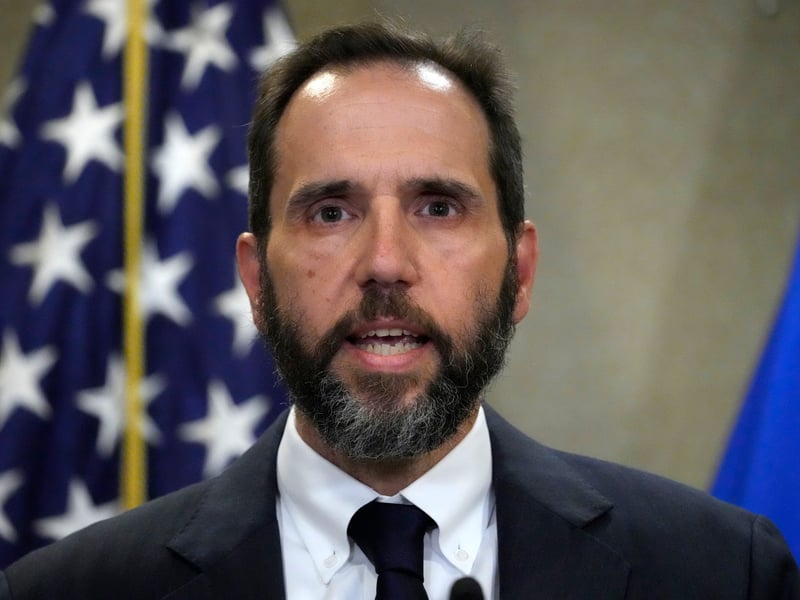
WASHINGTON (CN) — A new 165-page immunity brief from special counsel Jack Smith, unsealed in federal court Wednesday, lays out nearly 90 pages of evidence detailing Donald Trump’s efforts to overturn his 2020 electoral defeat.
But following a sweeping immunity decision from the Supreme Court, and as a presidential election looms, Smith’s case against the former president nonetheless faces an uncertain future.
In a 6-3 ruling in July, the high court determined that former presidents have at least the presumption of immunity for official actions taken in office. In his new brief, Smith argues he can prove at trial that Trump was acting in his personal capacity as a political candidate.
“At its core, the defendant’s scheme was a private one," Smith wrote. “He extensively used private actors and his campaign infrastructure to attempt to overturn the election results.”
That framing is an important distinction by Smith, as he attempts to shield four criminal charges brought against Trump in a recent superseding indictment from the high court’s ruling that such a prosecution cannot infringe on the office of the presidency.
Smith asserts he has a mountain of evidence a jury could consider — even if U.S. District Judge Tanya Chutkan, or eventually the justices, find certain alleged conduct cuts too closely to his duties of the president.
Whether Trump faces a jury — at earliest in 2026 — is likely entirely dependent on the results of the looming Nov. 5 election.
Trump, after all, could order his new Justice Department to drop Smith’s charges entirely if he wins. If he loses, though, he’s expected to appeal any immunity decision that Chutkan, a Barack Obama appointee, makes.
David Super, a professor of law and economics at Georgetown University, said in an interview with Courthouse News that Smith’s brief is tailored specifically to survive a second trip to the Supreme Court. He said it would give the justices a chance to clarify their initial decision.
How they might choose to clarify it, however, remains unclear.
“They could either say that the test they wrote this summer was unworkable and provide a different test," Super said. “Or, they could go and say that the president has absolute immunity, the same way the King of England did before the revolution” in the 1200s, when a revolt by landholders forced the king to accept some limits on his power.
Now that Smith has provided an extensive accounting of Trump’s alleged conduct, the Supreme Court will have the opportunity to be more specific as to what counts as official or unofficial conduct, Super said.
He said it was unlikely they would fully scrap the first immunity decision altogether. But they could create a new test, including one where anything related to politics are indistinguishable from official acts. That could leave the president still criminally immune from most conduct, except in exceptional cases like him “shooting somebody over a gambling debt," Super quipped.
For his part, Smith has strictly adhered to the high court’s ruling, for example by cutting out any mention of Trump’s communications with the Justice Department to further his election fraud claims.
Chief Justice John Roberts, after all, has said those conversations were clearly within the President’s duties. Smith has also tailored his remaining evidence to conform with the July ruling.
One major change is in how Trump’s interactions with former Vice President Mike Pence are characterized. Roberts previously said that such interactions were likely at the core of a president’s duties.
Smith, however, argued that the conversations — in which Trump tried to pressure Pence to certify a false slate of electors on Jan. 6, 2021 — centered on Pence’s role as president of the Senate during the certification, a process Trump would have no role in.
If justices buy this characterization, Super said it would be difficult to not view these as strictly personal conversations and therefore valid evidence in the case.
Smith also laid out reams of evidence regarding Trump’s efforts to pressure election officials and local lawmakers in swing states like Arizona, Pennsylvania, Georgia and Wisconsin to overturn the election and support his fake elector scheme to hand over their states’ electoral votes.
He quoted Justice Amy Coney Barrett’s concurring opinion, in which the Trump appointee said the former president clearly had no authority over the states’ legislatures or their electoral process. Thus, prosecution for such crimes would not intrude on executive power.
Such arguments put Smith’s case in a strong position, Super said. Unless there is any evidence of Trump mixing his efforts to pressure the officials with conversations about something within his official purview — federal funding for highways, for example — there would be no reason to deem the acts as official.
The record is less clear om Trump’s tweets and public statements between the 2020 election and the Jan. 6 riots.
That’s another issue that Roberts suggested could swing either way, as he said the president has the right to discuss matters of public concern. But Smith argues that the overwhelming majority of Trump’s comments were personal or clearly made as a political candidate — including those in which he spurred violence at the Capitol riot after Pence refused to hand Trump the election.
Chutkan now must balance Smith’s refined legal case with a 180-page opposition brief she ordered Trump to file by Nov. 7.
She set two more deadlines, ordering Smith to reply by Nov. 21, and Trump to reply again by Dec. 5. While it’s unclear how quickly Chutkan will take to issue her final ruling on what conduct is official or unofficial, she will have a narrow time window. From Dec. 5, it will be less than a month until a new president is inaugurated on Jan. 20, 2025.
 Follow @Ryan_Knappy
Subscribe to our free newsletters
Our weekly newsletter Closing Arguments offers the latest about ongoing trials, major litigation and rulings in courthouses around the U.S. and the world, while the monthly Under the Lights dishes the legal dirt from Hollywood, sports, Big Tech and the arts.