
 Search Articles


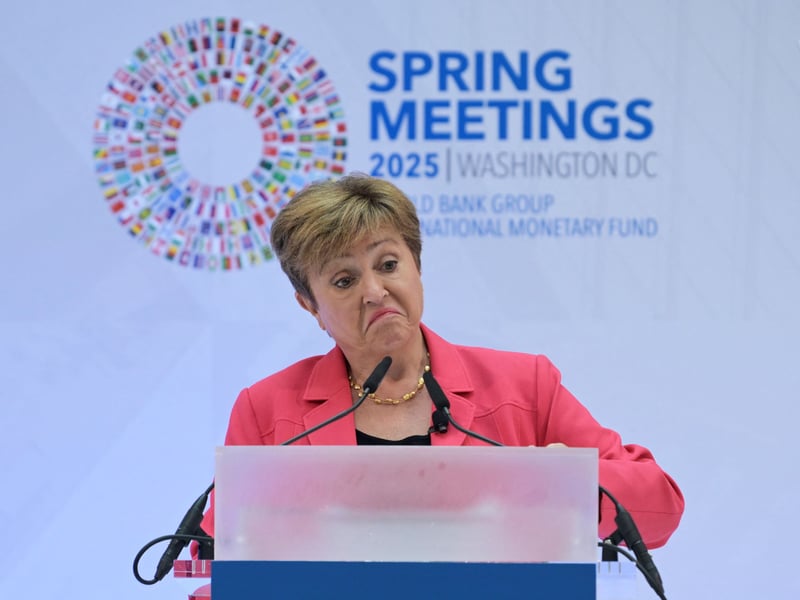
WASHINGTON (AFP) — The International Monetary Fund on Tuesday slashed its forecast for global growth this year, citing the effect of U.S. President Donald Trump’s new tariff policies on the world economy.
The IMF’s projections, which incorporate some but not all tariff measures introduced this year, see the global economy growing by 2.8% this year, 0.5 percentage points lower than the previous World Economic Outlook forecast in January.
Global growth is then forecast to hit 3.0% next year, down 0.3 percentage points from January.
“We are entering a new era as the global economic system that has operated for the last 80 years is being reset,” IMF chief economist Pierre-Olivier Gourinchas told reporters in Washington on Tuesday.
“If sustained, increasing trade tensions and uncertainty will slow global growth,” he added, noting that the recent U.S. tariff announcements had more than halved the fund’s outlook for global trade growth this year.
The World Economic Outlook was published as global financial leaders gathered in Washington for the World Bank and IMF Spring Meetings, which are hosted by the two international financial institutions at their headquarters a stone’s throw from the White House.
Given the stop-start nature to Trump’s tariff rollout, the IMF introduced a cutoff date of April 4, meaning they do not include the administration’s latest salvos, which have hiked the level of new levies against China to 145%.
If these policies were to be taken into account and sustained, this could significantly slow global growth, the IMF said.
Cooler US growth
The IMF slashed its outlook for U.S. growth to 1.8% this year — down 0.9 percentage points from January’s forecast.
Growth in the world’s largest economy is then expected to cool further to 1.7% in 2026.
This slowdown was due to “greater policy uncertainty, trade tensions, and softer demand momentum,” the IMF said in the World Economic Outlook report.
The Fund hiked its inflation forecast for the United States this year to 3.0% , and to 2.5% next year.
It expects tariffs will cause a broader increase in global prices, slightly raising its outlook for world consumer prices to 4.3% for 2025, and to 3.6% in 2026.
Top trading partners suffer
Top U.S. trading partners Mexico, Canada, and China are all predicted to be negatively impacted by the Trump administration’s tariffs.
The IMF expects China, the world’s second-largest economy, to see growth slump to 4.0% this year, down from 5.0% in 2024, with increased government spending failing to counteract the effect of the new levies.
The Mexican economy is now projected to contract by 0.3% this year, a 1.7 percentage-point reduction from January, while Canada’s growth outlook has also been sharply reduced.
Japan, the world’s third-largest economy, is expected to grow by just 0.6% this year and next, a sharp cut from January.
Europe’s slowdown deepens
The IMF expects the tariffs to act as a drag on growth in most European countries, with the growth outlook for the euro area cut to 0.8% in 2025, and 1.2% next year.
Germany is now projected to see no growth this year, while the outlooks for France, Britain and Italy have also been pared back.
The one bright spot among the major European economies was Spain, which the fund upgraded, and now sees 2.5% growth this year.
“This is partly because the Spanish economy just had such strong momentum in 2024, coming into 2025,” Petya Koeva Brooks, the deputy director of the IMF’s Research Department told reporters on Tuesday.
The Fund sharply downgraded the outlook for the Middle East but still expects economic activity to pick up from 2024, as disruptions to oil production and shipping ease, “and the impact of ongoing conflicts lessens.”
In sub-Saharan Africa, growth is projected to decline slightly to 3.8% this year, before recovering next year.
—
By DANIEL AVIS Agence France-Presse
Subscribe to our free newsletters
Our weekly newsletter Closing Arguments offers the latest about ongoing trials, major litigation and rulings in courthouses around the U.S. and the world, while the monthly Under the Lights dishes the legal dirt from Hollywood, sports, Big Tech and the arts.