
 Search Articles


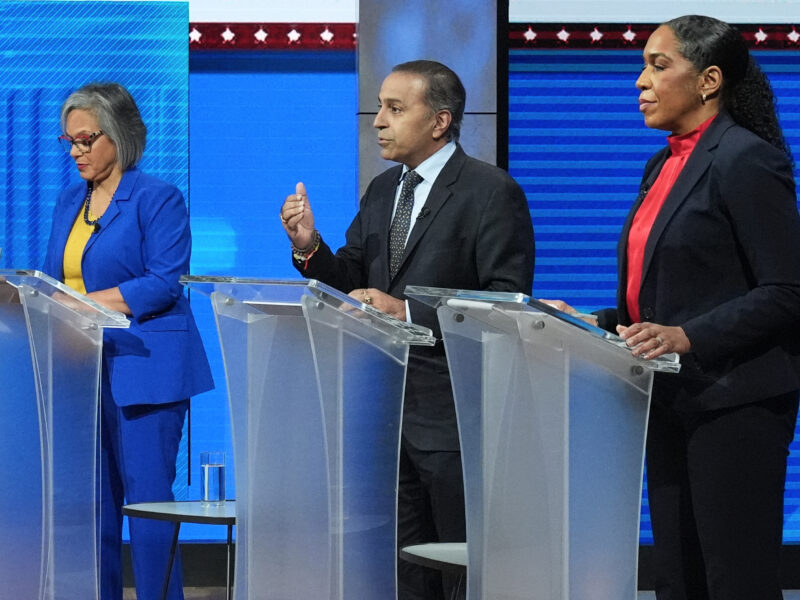
CHICAGO (CN) — When longtime U.S. Senator Dick Durbin announced his retirement, 11 candidates entered the Democratic primary for the Illinois seat. Lieutenant Governor Juliana Stratton, U.S. Representative Raja Krishnamoorthi, and U.S. Representative Robin Kelly quickly emerged as the front-runners, but it was Stratton who triumphed Tuesday.
As of 10:30 p.m. Central Time, with 90% of the votes counted, Stratton had 39% of the vote. Krishnamoorthi was in second place with 33% of the vote, and Kelly in third with 18%.
If she wins in November — and she is likely to, given that the state is solidly blue — she will be the sixth Black woman elected to the U.S. Senate and second Black female U.S. senator from Illinois.
“Tonight’s message is clear. We’re ready to take our democracy back into our hands,” Stratton told a crowd of supporters Tuesday night. “It’s the same message I’ve heard as I’ve campaigned from Chicago to Carbondale, from Rockford to Springfield, and everywhere in between.”
Despite Stratton’s runaway victory, the crowded Democratic primary field highlighted tensions within Illinois’ Democratic Party.
For months before the election, polls showed veteran Congressman Krishnamoorthi, in office since 2017, narrowly leading the race, with Stratton just behind.
Krishnamoorthi, born in New Delhi and raised in Peoria, campaigned on being anti-Trump. But he accepted more than $90,000 in contributions from donors affiliated with Trump and MAGA, including Palantir executive and Defense Department adviser Shyam Sankar. When asked about the donations, Krishnamoorthi’s campaign told the Chicago Sun-Times that MAGA donors accounted for less than 1% of campaign contributions.
Campaign contributions have been a hotbed of discussion for the Illinois Senate race. The American Israel Public Affairs Committee, which routinely shells out millions for various state and national elections and donated to Illinois congressional races in this election, stayed out of the Senate race. Cryptocurrency and artificial intelligence PACs, on the other hand, did throw their money into the Senate race, as well as other congressional races in the state.
Democratic Illinois Governor JB Pritzker has staunchly supported his lieutenant governor since she announced her Senate bid. He donated $5 million to a super PAC backing Stratton’s campaign, which helped fund an ad in which Stratton and her supporters say “fuck Trump.”
Pritzker’s involvement drew criticism from some politicians, including members of the Congressional Black Caucus, which endorsed its former chair, Kelly.
“Governor Pritzker’s effort to tip the scales in Illinois’ U.S. Senate race is beyond frustrating for the Congressional Black Caucus," U.S. Representative Yvette Clarke from New York, the current chair of the Congressional Black Caucus, wrote in a letter. “A sitting governor shouldn’t be heavy-handing the race. Quite frankly, his behavior in this race won’t soon be forgotten by any of us.”
A radio ad for Stratton’s campaign appeared to imply that former President Barack Obama endorsed her for the Senate race. Similarly, a digital ad for Kelly featured the former president lauding her as “outstanding.” While Obama has longstanding ties to Chicago, he did not endorse any of the candidates for the Illinois Senate seat.
The weekend before the election, the Stratton campaign announced an endorsement from recently deceased civil rights leader Jesse Jackson Sr., only for his family to revoke the endorsement by Monday morning. Jackson’s widow Jacqueline Jackson reportedly called Kelly on Monday and apologized for the endorsement confusion.
Many voters, however, weren’t swayed by that pre-election hubbub. Roscoe Village residents Art and Jennifer Wolf said the endorsement fiasco had no effect on how they voted.
Jennifer Wolf said Pritzker’s endorsement, among others, did affect her vote. But ultimately, she said she voted for Stratton because she’s “interested in seeing somebody new in there.”
Art Wolf said the endorsement would typically be enough to sway him, but experience in Washington outweighed that in this election. He opted for Krishnamoorthi, but said he would have no problem with Stratton prevailing in Tuesday’s election.
On the other side of the aisle, Don Tracy won the Republican primary for the U.S. Senate seat Tuesday with 40% of the vote. The former chair of the Illinois Republican Party, Tracy has positioned himself as a centrist who wants to go to the Senate to address what he views as an affordability crisis in America.
The election to replace Kelly in the U.S. House of Representatives also saw a packed field of candidates. Kelly vacated Illinois’ 2nd Congressional District seat, which stretches from South Shore to Danville, to run for Durbin’s Senate seat. Ultimately, Cook County Commissioner Donna Miller prevailed in that race with 40% of the vote.
She led the field in fundraising but faced some criticism because much of that money came from AIPAC. U.S. Representative Jan Schakowsky, a Democrat from Illinois’ 9th District, initially endorsed Miller but withdrew her support after learning she had accepted AIPAC donations.
Jesse Jackson Jr. was considered the frontrunner for much of the race because of his name recognition and experience. He represented the district for nine terms before resigning in 2012, citing mental health concerns amid a federal corruption investigation. Ultimately, Jackson Jr. garnered 28% of the votes Tuesday.
In the state’s Republican primary for the gubernatorial race, former state Senator Darren Bailey prevailed with 48% of the vote.
When Pritzker announced that he would run for a third term as governor, something that is barred in 37 other states, Republican candidates lined up for the chance to challenge him. (Pritzker was unopposed by fellow Democrats).
Bailey ran against Pritzker in the last gubernatorial election in the state, but Pritzker beat him by 13 points.
Chicago saw record numbers of early voters during this primary with 188,000 residents opting to vote early or mail in their ballot. Comparatively, 115,000 people in the city voted early or by mail in the 2022 primary. Turnout was a bit sluggish on Election Day, due in part to Chicago experiencing its coldest St. Patrick’s Day in over eight decades. At around 8 p.m. Tuesday night, data from the Chicago Board of Elections indicated that 25% of the city’s population voted in the primaries.
Statewide voter turnout date was not immediately available.
 Follow @RosenCaitlyn
Subscribe to our free newsletters
Our weekly newsletter Closing Arguments offers the latest about ongoing trials, major litigation and rulings in courthouses around the U.S. and the world, while the monthly Under the Lights dishes the legal dirt from Hollywood, sports, Big Tech and the arts.