
 Search Articles


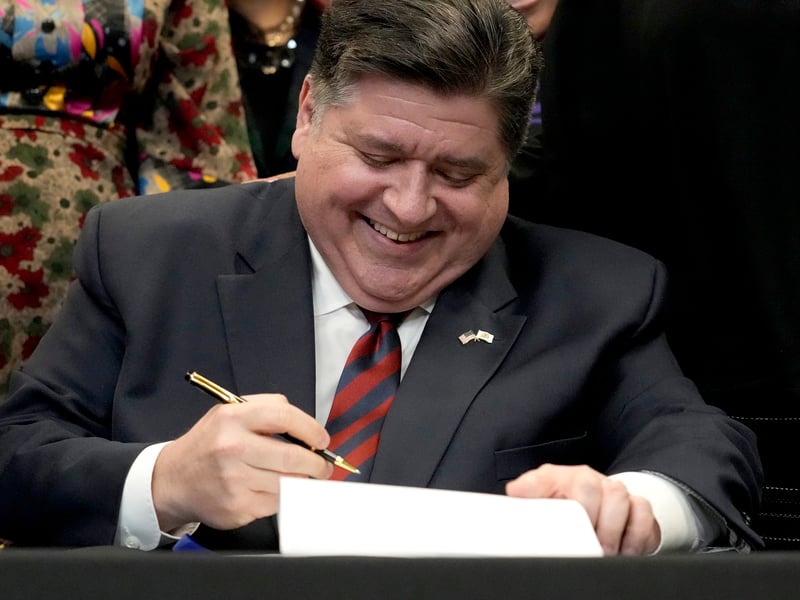
CHICAGO (CN) — Illinois Governor J.B. Pritzker signed a bill Tuesday that aims to protect immigrant families in the state from what he’s described as unlawful and aggressive federal immigration enforcement efforts.
The legislation, which the Illinois General Assembly passed during its veto session at the end of October, restricts how federal immigration authorities can conduct their operations outside of courthouses and offers an avenue of legal recourse for people who believe federal agents might have violated their constitutional rights.
Pritzker has been a longtime critic of the operation since President Donald Trump initially indicated that he intended to send agents to Chicago with a Truth Social post that read, “I love the smell of deportations in the morning. Chicago about to find out why it’s called the DEPARTMENT OF WAR,” as a nod to the 1979 film “Apocalypse Now.”
“With my signature today, we are protecting people and institutions that belong here in Illinois. Dropping your kid off at day care, going to the doctor, or attending your classes should not be a life-altering task,” Pritzker said in an emailed news release. “Illinois — in the face of cruelty and intimidation — has chosen solidarity and support. Donald Trump, Kristi Noem, and Gregory Bovino have tried to appeal to our lesser instincts. But the best of us are standing up to the worst of them.”
Along with courthouse protections, the measure also requires area hospitals to implement some sort of policy regarding interactions with law enforcement officers. Acute care hospitals have until Jan. 1, 2026, to implement a policy, and all other hospitals have until March 1, 2026.
The legislature’s passage of the bill came after a tense autumn of immigration enforcement efforts throughout Chicagoland as part of Trump’s immigration crackdown that he dubbed “Operation Midway Blitz,” which has been the subject of controversy since officers landed in Chicago at the end of September. They’ve repeatedly used excessive force toward peaceful protesters, priests and journalists, which has met the ire of local politicians and activists.
In particular, Alderperson Jessie Fuentes from the 26th ward was briefly and roughly detained by federal agents at the beginning of October when she went to a Humboldt Park hospital to check on an immigration detainee and ask whether agents had a warrant. After the incident, Fuentes filed a claim under the Federal Tort Claims Act seeking $100,000 in damages in response to her treatment from agents at the hospital.
Fuentes told Courthouse News in a phone interview that she’s extremely proud of the newly enacted law, and had it been in effect when she was detained at the hospital, she could’ve sued the officers who detained her as opposed to having to file a tort claim.
Some Republican lawmakers pushed back on the legislation that Fuentes and others worked to get across the finish line before the end of the veto session. Several said it would open the already financially underwater state up to even more lawsuits.
“What we were seeing for the last few months weren’t just constitutional violations on individuals in our city, that they were violating cities, state, and in many instances, even federal law was with very little accountability,” Fuentes said. “And I think that the more that you put parameters in place in which we are restricting the type of immigration enforcement that can be conducted in our city and that you increase measures of accountability, the federal government is going to have a real problem with that. Look, I think we’ve had a lot of lawyers look at the bill. We have legislators who are lawyers and who are confident that they will win in court if there’s any sort of appeal or a lawsuit as it relates to the bill.”
Fuentes isn’t the only legal challenge born out of Operation Midway Blitz. In November, U.S. District Judge Sara Ellis granted an injunction to a group of protesters, religious leaders and journalists after determining the force used by federal immigration authorities was improper and excessive.
The Seventh Circuit blocked the Barack Obama-appointed judge’s order. The panel of two Trump appointees and one Ronald Reagan appointee called Ellis’ order overbroad and said it teeters on an infringement of the separation of powers. In a surprising legal maneuver, the attorneys for the group of protesters, religious leaders and journalists moved to dismiss the excessive force lawsuit against federal immigration authorities on Dec. 2. Ellis didn’t immediately grant the motion and instead gave any class members the option to object to it by Dec. 19.
“We won our case the day they left town,” David Owens, an attorney with Loevy + Loevy, said in a news release the day the motion to dismiss was announced. “The people of Chicago stood up to the Trump administration’s bullying and intimidation, and showed them they were messing with the wrong city.”
Justice Department attorneys argued that the plaintiffs’ motion to dismiss should bar others from filing similar claims of excessive force from federal agents, although the newly signed bill enshrines those legal protections in state law.
“At a moment when the Trump Administration attacks immigrants on a daily basis, everyday people in Illinois stepped up to look out for their neighbors and demand real protections that re-establish our state as a national leader in protecting all communities,” Lawrence Benito, the executive director of the Illinois Coalition for Immigrant and Refugee Rights, said in an emailed news release. “We thank Governor Pritzker and members of the General Assembly for showing the leadership needed to meet the moment, listening to immigrant communities, and making HB 1312 law in Illinois.”
The Illinois Coalition for Immigrant and Refugee Rights is just one group in Chicago that has functioned as a watchdog for immigrant communities with its hotline for spotting federal agents. The organization also led the charge in passing out know your rights pamphlets and posters, which schools and day cares are now required to provide, per the newly passed bill. The measure goes into effect immediately.
 Follow @RosenCaitlyn
Subscribe to our free newsletters
Our weekly newsletter Closing Arguments offers the latest about ongoing trials, major litigation and rulings in courthouses around the U.S. and the world, while the monthly Under the Lights dishes the legal dirt from Hollywood, sports, Big Tech and the arts.