
 Search Articles


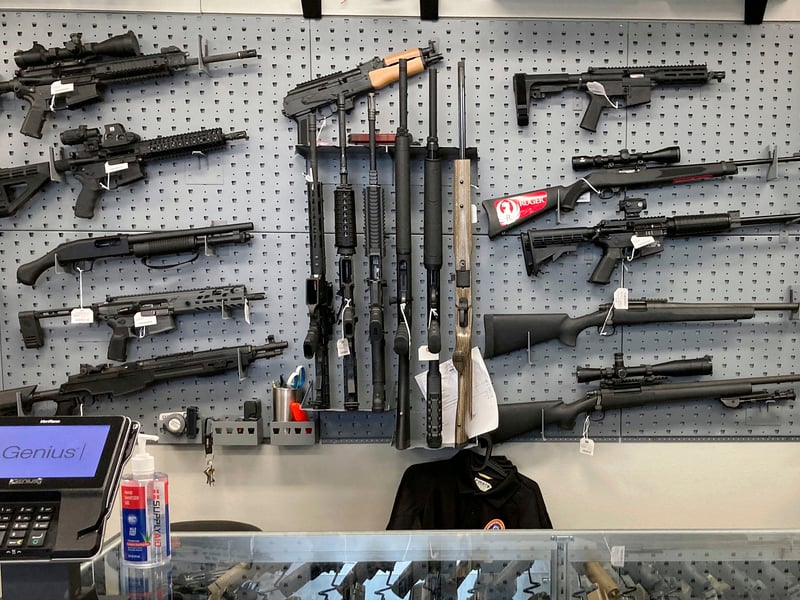
CHICAGO (CN) — Illinois reiterated that its ban on assault weapons doesn’t run afoul to the Second Amendment before a dubious Seventh Circuit panel Monday afternoon.
The contentious Protect Illinois Communities Act was brought back to the Seventh Circuit for debate after a federal judge blocked its enforcement following a September bench trial, which effectively overturned previous rulings from the state Supreme Court and the Seventh Circuit.
Given the number of legal challenges the assault weapons ban has faced, the three-judge pressed the respective attorneys on the appropriate standard of review for the case. Standard of review is the amount of deference a federal appellate court gives to lower courts.
“Isn’t it an uphill battle, though, for the state?” U.S. Circuit Court Judge Michael Brennan, a Donald Trump appointee, asked. “Here, we’ve got a clearly erroneous standard of review. We’ve got a district court who held a four day trial [with] 16 to 18 expert witnesses, 250 exhibits. I think this is the first time we’ve had a full trial record — any federal appellate court in the country — has had a full trial record.”
Sarah Hunger, a deputy solicitor general with the Illinois Attorney General’s office, said it wouldn’t necessarily be an uphill battle because de novo review applies in this case, as it is the standard for Second Amendment claims. De novo review would mean that the Seventh Circuit would review the case without deference to the lower federal court’s findings.
She said even if the Seventh Circuit were to grant deference to the lower federal court, some of the underlying legal questions still remain up in the air.
“My view would be, even if this court were to afford deference to the findings of facts, something like, ‘is this suitable for individual self-defense?’ is a legal question,” Hunger said. “You know, ‘is this weapon militaristic?’ would be a question of law. I mean, I think that what’s interesting here under Bevis and under Bruen , is there are kind of subquestions before you get to the bigger question, and I do think some of those are legal questions, even if there are at the base level, some factual determinations.”
Bevis v. City of Naperville was a 2023 case before the Seventh Circuit where the panel determined that the assault weapons ban was constitutional.
Also referencing landmark 2022 Supreme Court case New York State Rifle and Pistol Association v. Bruen — which required that modern firearm regulations comply with historical tradition — Hunger likened the current Illinois restrictions on firearms to past restrictions on Bowie knives.
“The Founders may have dealt with riots, but they could not have contemplated the problem of individual mass shooters,” the state wrote in the appellant’s brief. Hunger said that because of the advanced technological changes in weapons, a more nuanced application of Bruen is required.
Erin Murphy, an attorney representing the gun owner plaintiffs, said Hunger mischaracterized the law.
“The bans on carry as to bowie knives were concealed carry restrictions. So the laws of dealing with bowie knives were generally concealed carry restrictions, or things that enhance the penalty if you misused a bowie knife in a criminal way, and that’s really critical when it comes to historical tradition, because Bruen specifically considered concealed carry restrictions in the context of asking whether they were sufficient to justify a ban on carrying particular arms, and said that they are not,” Murphy, an attorney with Clement and Murphy, said. “So, a ban on concealed carry of particular types of arms cannot support a ban on possession of arms.”
Alongside Brennan on the panel was U.S. Circuit Court Judge Frank Easterbrook, a Ronald Reagan appointee, and Amy J. St. Eve, a Trump appointee. The panel did not indicate when it might rule on the matter.
Illinois is one of nine states with a ban on assault weapons, according to Everytown Research. The ban was enacted after a lone gunman, who was armed with a legally purchased AR-15, shot 83 rounds into a crowded 2022 Fourth of July parade in Highland Park, an affluent suburb outside of Chicago, killing seven and wounding 48 others.
The gunman, 24-year-old Robert Crimo III, pleaded guilty and was sentenced to seven consecutive life sentences in prison in April.
Governor J.B. Pritzker signed the Protect Illinois Communities Act in 2023, outright banning the sale and purchase of assault weapons, assault weapon attachments and accessories that increase the rate of fire for semiautomatic weapons.
The legislation was quickly mired in legal challenges. Republican Illinois lawmaker Dan Caulkins and an Illinois gun rights group sued the state soon after. They claimed the ban infringes on their Second Amendment rights and violates Illinois due process and equal protection laws.
The Illinois State Supreme Court issued a 4-3 ruling upholding the assault weapon ban in 2023.
Concurrently, the law also faced challenges in federal court. East St. Louis U.S. District Judge Stephen McGlynn, a Trump appointee, blocked the ban in April 2023 — just days after U.S. District Judge Lindsay Jenkins, a Chicago-based Joe Biden appointee, ruled inversely in a separate lawsuit brought by a Chicagoland doctor.
The Seventh Circuit temporarily lifted McGlynn’s injunction in 2023 before it decided later that November to leave the ban in place.
“The absence of support in other circuits for the district court’s disposition lends strength to a conclusion that the Illinois statutes should remain in force until final appellate resolution,” the Seventh Circuit panel wrote in its order.
The September bench trial was also overseen by McGlynn, and his order ruling effectively overruled a previous order by the Seventh Circuit.
 Follow @RosenCaitlyn
Subscribe to our free newsletters
Our weekly newsletter Closing Arguments offers the latest about ongoing trials, major litigation and rulings in courthouses around the U.S. and the world, while the monthly Under the Lights dishes the legal dirt from Hollywood, sports, Big Tech and the arts.