
 Search Articles


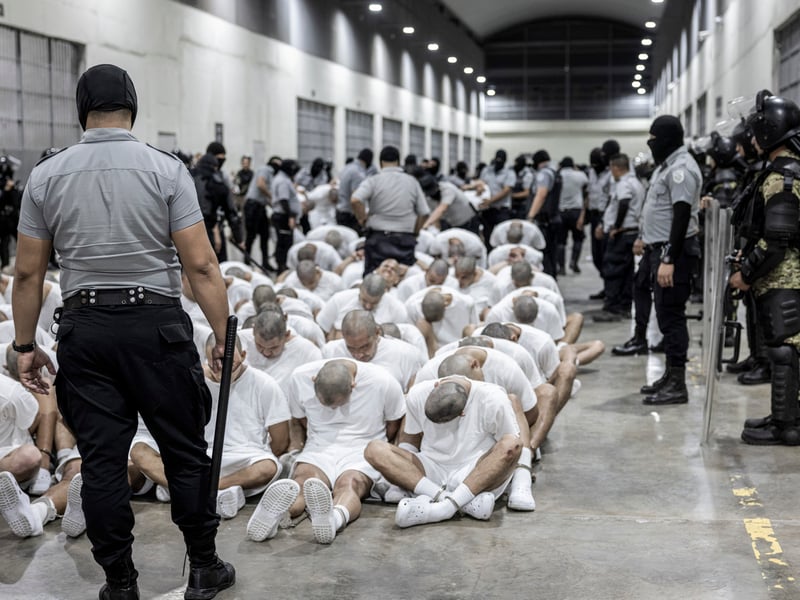
WASHINGTON (CN) — For the second time in as many months, a federal judge in Maryland ordered the Trump administration on Tuesday to return a Venezuelan man deported and imprisoned in a notorious prison in El Salvador.
U.S. District Judge Stephanie Gallagher, a Donald Trump appointee, refused to retract her April ruling requiring a man referred to in court as “Cristian” to be returned to the U.S. The case mirrors that of Kilmar Abrego Garcia, who was also wrongfully deported, imprisoned and ordered returned home.
Politico used metadata from the Trump administration’s court filings to identify the man as Daniel Lozano-Camargo. Gallagher ruled that the 20-year-old was sent to El Salvador’s notoriously brutal Centro de Confinamiento del Terrorismo, or CECOT, in violation of a court order.
Lozano-Camargo is part of a class action over the treatment of unaccompanied minors in asylum proceedings during Trump’s first term. The Biden administration settled with the migrants last year, agreeing not to deport any class member until the litigation resolved.
Citing U.S. District Judge Paula Xinis’ order in Abrego Garcia’s case, Gallagher said the Trump administration must facilitate Lozano-Camargo’s return to the U.S. Gallagher specified that the White House needs to make a good-faith request to the government of El Salvador to release Lozano-Camargo into U.S. custody so he can be transported to the United States where he can litigate his asylum claim.
“Standing by and taking no action is not facilitation,” Gallagher noted, alluding to the Trump administration’s resistance in Abrego Garcia’s case.
Abrego Garcia is still believed to be imprisoned despite a nearly month-old order from the Supreme Court instructing the Trump administration to facilitate his return.
In a request for comment on any progress on his release, White House Press Secretary Karoline Leavitt claimed that it has always been the administration’s position that Abrego Garcia should have been deported despite conflicting court filings.
“The Trump Administration provided ample evidence of Abrego Garcia’s gang affiliation and criminal history. President Bukele’s government has affirmed that evidence and does not intend to return Abrego Garcia to the United States because he is, in fact, an MS-13 gang member,” Leavitt said in an email.
Abrego Garcai and Lozano-Camargo are just two stories in the emerging labyrinth of cases claiming malefeasance in the Trump administration’s rush to deport as many migrants as possible. Immigrant advocates and human rights organizations say there are around 288 Venezuelan and Salvadorian migrants whom the administration deported and imprisoned in El Salvador without due process.
Robyn Barnard, the senior director of refugee advocacy at Human Rights First, said it’s more appropriate to refer to these deportations as disappearances. Barnard said migrants were deprived of their liberties when the government arrested, detained and abducted them and then refused to acknowledge its actions.
“These actions work to place the person outside of the protection of the law,” Barnard said. “The migrants who are rendered to CECOT had been detained in Immigration and Customs Enforcement custody when they suddenly vanished. They had no opportunity to notify their relatives, speak with their counsel or contest the rendition.”
The Trump administration is reportedly paying the government of El Salvador around $5 million to imprison the migrants.
Andrea Flores, vice president of immigration policy and campaigns at FWD.us, an immigration advocacy group, said this is not a normal immigration arrangement. Flores, a former official at the Department of Homeland Security and the National Security Council, said the agreement was extralegal.
“It is not that the United States has not conducted removals before, say, to a third country, but it has never done what it is doing at this moment, which is paying another country not to accept deportees, but to indefinitely imprison a group of people who have different competing legal statuses,” Flores said.
The central theme connecting rulings from the Supreme Court and judges like Gallagher and Xinis is that migrants were deprived of due process — the right to a fair legal process protected by the Fifth and 14th Amendments.
For CECOT prisoners, however, the suspension of due process rights is the norm. El Salvador’s President Nayib Bukele suspended due process in his country three years ago when he declared a national emergency to tackle gang violence.
Noah Bullock, executive director at Cristosal, a human rights organization, said that 85,000 people have been detained without judicial orders during the national emergency. Prisoners can’t access legal assistance or speak with their families.
Bullock said Bukele retains complete control over the prison system that the U.S. has now contracted. Abrego Garcia was moved from CECOT to a different Salvadoran prison after public outrage and a visit from Maryland Senator Chris Van Hollen.
“The prison system that’s under contract by the United States is one of an autocracy, is one in which massive and systematic human rights violations have taken place,” Bullock said. “By becoming a client of that prison system, the United States assumes responsibility and culpability.”
Cristosal has documented human rights abuses in these prisons, like the intentional deprivation of water, food, clothing and medical assistance. Bullock said prisoners are also physically abused, leading to at least 378 deaths.
The Trump administration has used the image of CECOT as a deterrent to illegal immigration.
“The images of prisoners that you see with full body tattoos that have the very names of gangs tattooed on their heads and chests are not necessarily representative of the 85,000 people who have been detained in the state of exception,” Bullock said. “Those are the images of older gang members, who probably have been in prison for many years. Nonetheless, they become the public face of the security strategy. I think that’s part of the optics that the Trump administration has tried to leverage to justify the policy of disappearances of migrants.”
Department of Homeland Security Secretary Kristi Noem recorded a video in front of a wall of prisoners at CECOT in March. “This is one of the consequences you could face,” Noem said, calling CECOT “one of the tools in our toolkit.”
 Follow @KelseyReichmann
 Follow @kelseyreichmann.bsky.social
Subscribe to our free newsletters
Our weekly newsletter Closing Arguments offers the latest about ongoing trials, major litigation and rulings in courthouses around the U.S. and the world, while the monthly Under the Lights dishes the legal dirt from Hollywood, sports, Big Tech and the arts.