
 Search Articles


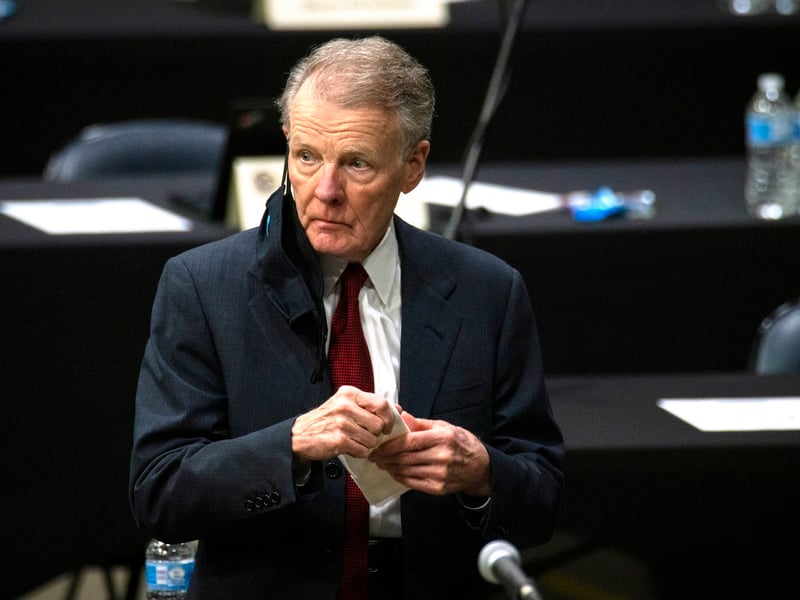
CHICAGO (CN) — A federal jury spent Halloween listening to multiple clips from secretly recorded phone conversations, part of the ongoing corruption trial of ex-Illinois House Speaker Mike Madigan. The clips jurors heard featured Madigan’s co-defendant, former Democratic state Representative-turned energy lobbyist Mike McClain, as well as former Madigan political staffer Will Cousineau.
Cousineau has been on the witness stand since late Tuesday afternoon, testifying to how Madigan’s inner circle, including McClain, made political strategy and managed crises as they emerged. The recordings federal prosecutors played Thursday continued that theme, as McClain and Cousineau can be heard on the calls discussing how to handle two high-profile sexual misconduct scandals that rocked the speaker’s office in 2018, when neither man was officially employed by the speaker’s office.
The first involved former Madigan aide Kevin Quinn, whom the office fired that February. Madigan’s longtime chief of staff Tim Mapes — since convicted of perjury for lying to a grand jury to protect Madigan — resigned under the cloud of his own sexual misconduct allegations that June.
It’s while Madigan’s team was dealing with the accusations against Mapes that Cousineau recommended hiring a professional public relations firm to protect Madigan’s position. He suggested a firm that had “dealt with real shit” like the impeachment trial of former president Bill Clinton.
“It’s gonna cost us a ton of fucking money, but if it saves him then so be it,” Cousineau can be heard telling McClain on a secretly recorded June 2018 call.
McClain agreed, saying he had “three or four” firms in mind.
“I just think we’ve got to get somebody in here that’s playing hard ball," McClain said.
On a separate call from that August, McClain and Cousineau can be heard discussing finding work for Quinn after Madigan’s office had booted him. McClain suggested getting a small group of allies to pay Quinn $1,000 each for six months or until he got back on his feet. McClain added that he wanted to keep the issue quiet.
“I’d like to keep the list of people that knows this real small,” McClain said.
The pair talked again a few days later, and Cousineau floated the idea of hiring Quinn himself.
“So I don’t have exactly how it’s all gonna happen, but we’ll make it work one way or the other… and I can give him things to do right?” Cousineau said.
McClain responded, “Yeah, so it’s up to you.”
He continued: “The way I pictured it, and maybe you don’t want to do it that way, but, he would do us a report, a written report of like six House members, three senators, three county board and three city council members and talk about things that are little known about them. Like maybe who their sugar daddies are or something like that, who can kind of get to them.”
Cousineau testified Thursday that Quinn did do some work for his own lobbying firm, Cornerstone Government Affairs. Cousineau isn’t currently being targeted for federal prosecution, but U.S. attorneys saw the mere existence of his conversations with McClain as furthering their assertion that Madigan was a political kingpin in Springfield and Chicago. A day before, jurors heard more evidence underpinning Madigan’s influence on the state legislature, including times when Cousineau said the speaker’s office would substitute people off different House committees, ensuring bill votes went the way Madigan wanted.
In one instance from November 2016, prosecutors pointed out how then-sub chair of the House energy committee, Democratic state Representative Michelle Mussman, was subbed off the committee as it considered the Future Energy Jobs Act. The bill secured subsidies for two Illinois nuclear power plants owned by the Exelon Corporation, and was among the legislation federal prosecutors say Madigan helped energy company ComEd — an Exelon subsidiary — pass through the legislature in exchange for jobs and contracts for his political allies.
Prosecutors showed that FEJA easily moved through the House energy committee, without Mussman voting on it.
“Certainly she was a target. We monitored her votes more than others,” Cousineau said on the witness stand Wednesday.
Both Wednesday and Thursday were short trial days, and Madigan’s defense team only managed to get in one hour of cross-examination before Blakey dismissed jurors at 2 p.m. Thursday for Halloween. In the time he had, Madigan’s attorney Dan Collins attempted to deflate the prosecution’s narrative over how much influence Madigan and his cabinet wielded.
He pointed out that when FEJA came up for a House floor vote in late 2016, multiple Democrats voted ’no’ on it. He also noted that House Republicans would sub their own representatives off committees, and that it was far from a rare occurrence.
“There was nothing unusual about it, is that fair?” Collins asked Cousineau.
“That’s fair,” he answered.
Cousineau will re-take the stand for further cross examination when trial resumes on Monday. The full trial is expected to take another 9 weeks at least.
 Follow @djbyrnes1
Subscribe to our free newsletters
Our weekly newsletter Closing Arguments offers the latest about ongoing trials, major litigation and rulings in courthouses around the U.S. and the world, while the monthly Under the Lights dishes the legal dirt from Hollywood, sports, Big Tech and the arts.