
 Search Articles


MARSEILLE, France (CN) — Strategic autonomy, an idea long brushed aside from Europe’s top agenda, is now center stage in the bloc as U.S.-EU relations teeter for the first time in recent history.
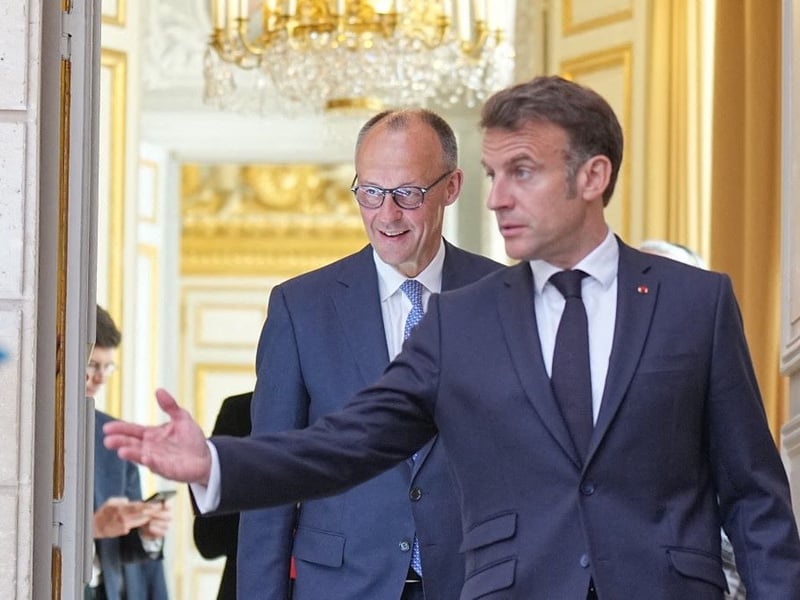
French President Emmanuel Macron has been seeking out the spotlight, turbocharging EU diplomatic relations in recent weeks with state visits, high-profile Ukraine summits and new initiatives launched continent-wide, largely from Paris.
“I think Macron is trying to position himself as sort of informal leader of the EU or of Europe, broadly speaking, and all these meetings are part of this strategy,” Petr Kratochvíl, senior researcher and professor at the Institute of International Relations in Prague, told Courthouse News. “Before Trump, there was this discussion of European strategic autonomy, and it seemed almost forgotten because it was clear that Europe relied happily on the United States.”
Macron and Polish Prime Minister Donald Tusk are expected to sign a “friendship treaty” Friday affirming the two nations’ mutual aid in case of a military threat. Before traveling to the meeting, Tusk mentioned the possibility of France extending its nuclear umbrella. Only France and the U.K. are nuclear powers in Europe. Poland shares part of its border with Russia.
But experts advise caution in assessing the effects of the flurry of activity.
“I think we shouldn’t overestimate the impact of these bilateral meetings, especially when it comes to examples in the Franco-Polish meeting; we know that they’ll sign a friendship treaty, but in the end, these treaties are more symbolic than what they actually bring to the table,” Gesine Weber, a fellow on the geostrategy team of the German Marshall Fund of the United States, told Courthouse News.
“So they’re a good base for cooperation, but in the end it really depends on governments to flesh them out, and the same is true for the meeting that we saw between Chancellor Merz and Macron; it’s a good starting point, it’s important that the relations are there and that the level of ambition is there, but in the end it needs to be filled with the actual policies,” she said.
Earlier in the week, Macron met with newly appointed German Chancellor Freidrich Merz, where the two ushered in a “new page in the Franco-German friendship,” according to Macron.
Franco-German relations were overtly tense between Macron and former leader Olaf Scholz; experts argue that Merz will not only revitalize this bond but will spearhead a new European policy for Germany.
“I think the former chancellor had no Europe policy at all, so for Merz, this is the priority — and I think Merz understands how important France and also Poland are,” Stefan Meister, head of the Center for Order and Governance in Eastern Europe, Russia and Central Asia, told Courthouse News.
“So we will see that he will be taking much more ownership of European policy, investing more in relations with other European leaders like Macron, but also in Brussels — I think there will be a different kind of priority setting and also a different kind of German policy from what we know,” he said.
The key topic across Europe now is defense and security. In Kratochvíl’s view, the bloc is seeking to move away from being a soft power that simply manages regional order through some kind of “intangible attraction,” but rather looks to introduce more elements of hard power.
“Bigger military spending, which we have already seen in Poland and other countries, but also in terms of describing or seeing itself,” he said. “I’m talking about the EU as a sort of regional empire, or regional hegemon; perhaps liberal, but still a hegemon.”
In his view, Macron is positioning himself as the informal leader of the EU out of the four figures who could viably contend for the role.
U.K. Prime Minister Kier Starmer has been facing trouble at home, including the right’s growing popularity; Italian Prime Minister Giorgia Meloni is playing a balancing act between aligning ideologically with U.S. President Donald Trump and opposing his tariffs; and Merz suffered an embarrassing first-round “no” vote on his leadership that weakened his image, according to Kratochvíl. That leaves Macron.
“So I think [these meetings are] part of a grand strategy of positioning France and Macron himself as the leader of the liberal world now, when the American President is definitely not,” Kratochvíl said.
 Follow @lilyradz
Subscribe to our free newsletters
Our weekly newsletter Closing Arguments offers the latest about ongoing trials, major litigation and rulings in courthouses around the U.S. and the world, while the monthly Under the Lights dishes the legal dirt from Hollywood, sports, Big Tech and the arts.