
 Search Articles


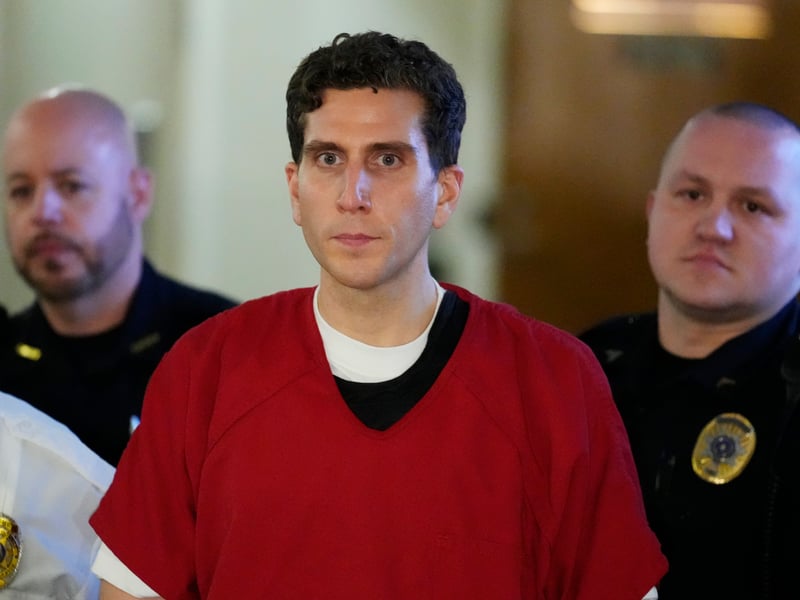
(CN) — The man accused of killing four college students in an Idaho college town implored the court trying his case to strike the death penalty, arguing that the state is ill-prepared to carry out the punishment that he says is unconstitutional.
Bryan Kohberger, a 29-year-old former Washington State University criminology doctoral student, appeared in a Boise court on Thursday with his defense team to argue against the state’s most extreme punishment should he be found guilty by a jury at the end of his August 2025 trial for the stabbing deaths of the four University of Idaho students.
“When somebody sits on death row, and there’s no means of executing them, that’s inhumane,” Ann Taylor, defense counsel for Kohberger, said.
Taylor pointed to the state’s recent botched lethal injection execution attempt from February, in which a warden halted the execution of convicted serial killer Thomas Creech after nearly an hour of unsuccessful attempts.
Taylor said it’s dehumanizing to subject someone to a death sentence when there are no reasonable means to execute them.
“I think to have him sit on death row and say ‘Idaho’s going to figure out how to kill you at some point in the future that isn’t cruel and unusual and in violation of your rights’ — I just don’t think that the constitutional protections allow that to happen,” Taylor said.
Ada County District Court Judge Steven Hippler appeared skeptical that the state’s recent trouble with executions would remain unresolved before it became relevant to this case. If convicted and sentenced to death, it would take years before an execution would occur, given the typical drawn-out nature of capital cases.
Jeffrey Nye, Idaho Deputy Attorney General, agreed.
“There’s no evidence whatsoever to suggest Idaho can’t do this, and certainly not decades from now,” Nye said.
Even if the state can’t acquire the drugs for lethal injection, or if firing squads are deemed unconstitutional, it’s too early to preclude there wouldn’t be a method to carry out the sentence, he argued. Further, the sentence is based on state and federal precedent.
Idaho is one of 27 states in the country that allows the death penalty, though six of those states have put executions on hold for various reasons.
Kohberger was charged with four counts of first-degree murder and burglary for the deaths of University of Idaho students Madison Mogen, Kaylee Gonclaves, Xana Kernodle and Ethan Chapin, who were found stabbed to death in an off-campus apartment in Moscow, Idaho, in November 2022.
The trial was originally set for October in Latah County, where the murders occurred, but it was moved to Boise after Kohberger’s defense team argued there would be a strong possibility for bias among potential jurors. A judge entered a not-guilty plea on Kohberger’s behalf in May 2023.
Kohberger’s defense team also argued for the court to strike all of the aggravating factors against him, including utter disregard for human life and propensity for future dangerousness. Removing aggravating factors would remove the death penalty as a sentencing option.
Taylor told the court that the language within the aggravating factors is constitutionally insufficient to narrow the broad language in the state’s murder statute.
“If truly we are to have an aggravator that selects out the worst of the worst of people who are convicted of murder, this doesn’t do that,” Taylor said.
A jury would only need to find that Kohberger met one of the aggravating factors to justify the death penalty sentence.
Prosecutors pointed out that the aggravating factors have been upheld by the Idaho Supreme Court.
Trying a different tactic, Kootenai County Public Defender Jay Logsdon argued that the death penalty violates international law and contemporary standards of decency and thereby shouldn’t be applied in this case. He also argued that more countries— and states for that matter — have moved away from capital punishment.
Nye pushed back, arguing the country is “nowhere near a national consensus that the death penalty is somehow immoral or improper or indecent.”
“Our argument is that the way that Idaho has its scheme set up, there are far too many statutory aggravators and some of them are big enough to drive a Mack Truck through,” Logsdon said. “Just about every murder could be charged and have the death penalty attached to it.”
Hippler appeared unconvinced.
“I understand the argument. I’ll be frank, it’s falling about as flat as you would expect it to fall before our Supreme Court or the Supreme Court of the United States,” Hippler said.
After four hours of arguments, Hippler took the matters under advisement but did not indicate when he would be issuing a written ruling.
Subscribe to our free newsletters
Our weekly newsletter Closing Arguments offers the latest about ongoing trials, major litigation and rulings in courthouses around the U.S. and the world, while the monthly Under the Lights dishes the legal dirt from Hollywood, sports, Big Tech and the arts.