
 Search Articles


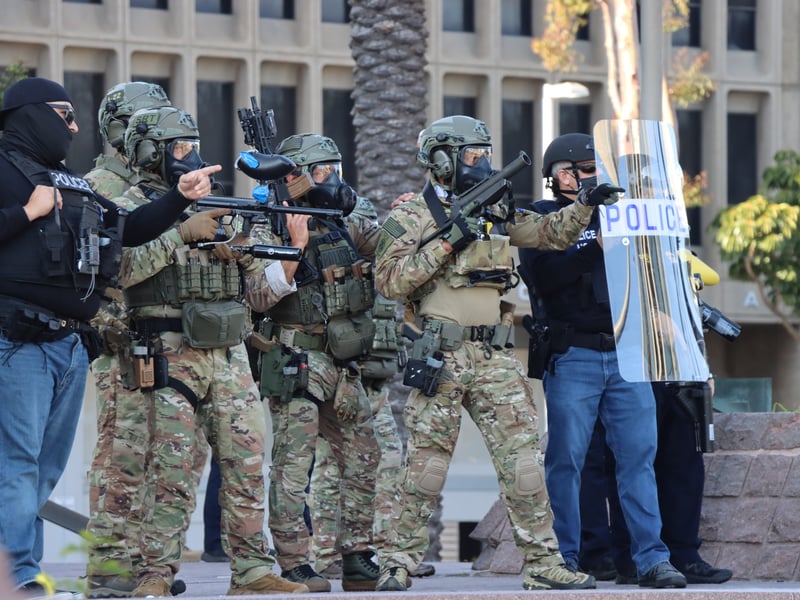
(CN) — The gloves are off in the fight over whether federal law enforcement can keep their masks on in California.
Bill Essayli, a former Republican state lawmaker who is now the top prosecutor for the Central District of California, has blasted passage of a law that would prohibit federal law enforcement from wearing masks while on the job, with some exceptions.
The bill’s author — state Senator Scott Wiener, a San Francisco Democrat and newly announced candidate for U.S. Representative Nancy Pelosi’s seat — has sparred with Essayli on social media over his law. When Essayli posted that state law doesn’t apply to federal agents, Wiener fired back.
“State law most certainly does apply to federal agents,” the senator said on Oct. 24. “You’re committing malpractice by repeatedly advising federal agents to ignore state law. They ignore state law at their legal peril.”
The bill, called the No Secret Police Act, targets federal immigration agents who have worn masks while detaining people suspected of being in the country without authorization. The bill also prevents local law enforcement from masking except in certain circumstances. State authorities are exempt.
Any law enforcement agency operating in California must create and publicly post a written policy limiting mask use by July 1, 2026. Officers of agencies that met that requirement would be exempt from the crime of wearing a facial covering, if their agency maintains that policy.
The law becomes effective Jan. 1, 2026.
Essayli declined comment to Courthouse News through a spokesperson, instead referring to a Sept. 26 letter he wrote on the issue.
In that letter, Essayli said Newsom had clearly stated he was targeting federal officers who wear masks during immigration enforcement actions to protect their own and their families’ safety.
“California’s law to ‘unmask’ federal agents is unconstitutional, as the state lacks jurisdiction to interfere with federal law enforcement,” Essayli posted on X. “I have directed federal agencies to disregard this state law and adhere to federal law and agency policies.”
Federal law preempting state law is referred to as the supremacy clause, and it’s a sticking point for some law professors.
Professor Leslie Jacobs, with the University of the Pacific McGeorge School of Law, said federal attorneys will argue that agents need masks to carry out their lawful function. That means as long as those agents act lawfully, the state can’t stop them.
“As far as applying it to federal officers, it’s shaky to do that,” she told Courthouse News.
States can opt against helping the federal government in its immigration enforcement action, and federal officials can’t force a state to assist it, Jacobs said. However, the federal government will argue that the law impedes its agents.
For Jacobs, the argument the federal government will make is that its officers can enforce the law and a state can’t make those officers less effective.
“It’s a difficult case for California to make,” she added.
Mike Vitiello, who also teaches at the McGeorge School of Law, called federal policy the law of land. As an example of federal supremacy, he pointed to Southern states trying to interfere with the federal government in the wake of the Civil War.
Despite what he called the extreme actions by federal Immigration and Customs Enforcement, the same general principle applies.
Additionally, a U.S. Supreme Court that Vitiello views as one of the most extreme in American history is going to uphold President Donald Trump’s policies.
However, Vitiello told Courthouse News that the law contains a severability clause. That means any portion of the law found unconstitutional wouldn’t make the entire law null and void. Instead, only the part deemed unenforceable would be excised.
“Proponents have to be aware that there’s a real risk that 627 will be struck down,” he added.
Masks off
Wiener is confident that his law passes constitutional muster.
“Federal employees frequently have to comply with state laws,” he told Courthouse News in a phone interview.
According to Wiener, masks aren’t necessary to enforce federal law. The public, he said, needs to know with whom they’re interacting.
“It’s antithetical to basic American values of a free society,” he said of officers hiding their identities.
During debate about the bill, Wiener on the Senate floor pointed to arguments made by Erwin Chemerinsky, dean of the UC Berkeley School of Law, who supports the constitutionality of the law.
Chemerinsky in an editorial argued that ICE has long avoided using masks. While he said acting ICE Director Todd Lyons has pointed to concerns about officer safety, including doxing, Chemerinsky claimed that there’s no evidence supporting that argument.
“Safety of officers is a pretext to justify a practice that exists to intimidate,” Chemerinsky wrote, adding later: “It serves no law enforcement purpose.”
While a state can’t directly regulate the federal government, states can require it to obey general laws. For example, federal employees must stop at red lights, unless it would interfere with their job. Mask requirements fall under that principle, Chemerinsky argued.
The issue, said University of Oklahoma associate law professor Noah Chauvin, is complicated.
In a paper expected to reach publication this month in the Southern California Law Review Postscript, titled “Can States Force ICE to Take Off the Masks?”, Chauvin points to two cases when arguing the California law likely will be overridden by the supremacy clause.
The first is In re Neagle , an 1890 case involving a U.S. marshal who fatally shot a man while protecting a U.S. Supreme Court justice.
California sought to pursue murder charges against the marshal, though the high court ruled he had intergovernmental immunity. The federal government had authorized him to perform a job, and he did no more than what was proper, Chauvin said.
The second case is from 1920. Johnson v. Maryland focused on a postal worker who pushed back on the state fining him for driving with no license.
While federal employees must abide by state laws regulating, for example, how to turn a street corner, states couldn’t require additional requirements — in this case, a driver’s license — the federal government had already deemed sufficient.
“My view on this, this statute pretty straightforwardly has supremacy clause problems,” Chauvin told Courthouse News.
Chauvin said a key question is whether federal agents act reasonably within the scope of their authority. Generally, courts have been “incredibly” deferential when determining what’s reasonable. He said the U.S. Supreme Court has even granted federal employees immunity in circumstances where they acted wrongly or unlawfully in hindsight.
“As a matter of policy, I’m utterly sympathetic to the goals of this bill,” Chauvin said.
“I don’t think law enforcement should obscure their face,” he added later. “But I don’t think states and localities should be violating the Constitution to achieve those values.”
Subscribe to our free newsletters
Our weekly newsletter Closing Arguments offers the latest about ongoing trials, major litigation and rulings in courthouses around the U.S. and the world, while the monthly Under the Lights dishes the legal dirt from Hollywood, sports, Big Tech and the arts.