
 Search Articles


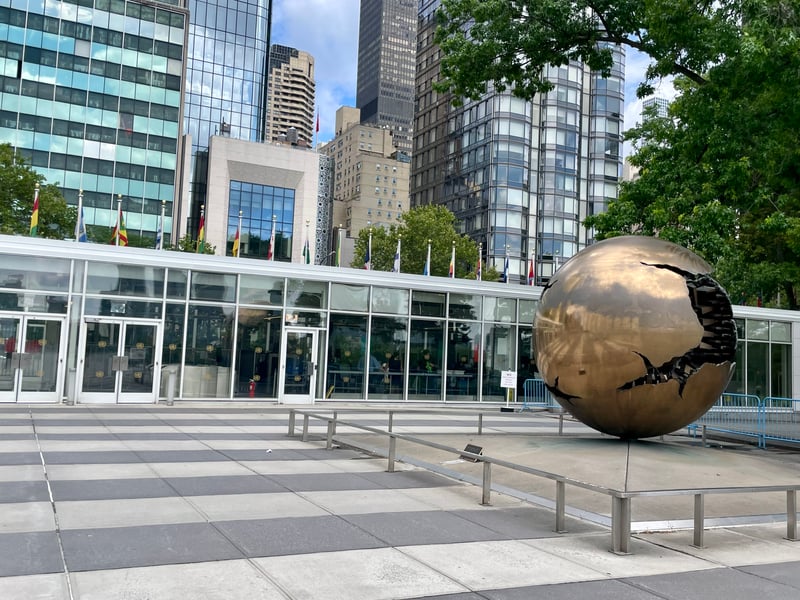
MANHATTAN (CN) — Delegates gathered at the United Nations this week to tackle the problem of atrocity prosecution which has divided nations for a quarter century, at a time the global tribunal faces open hostility from the United States and a second cyberattack in as many years.
After three days of meetings, members of the Assembly of States Parties to the Rome Statute, the International Criminal Court’s founding treaty, did not come to a consensus Wednesday on a resolution that would bring the crime of aggression in line with the other three major crimes the ICC prosecutes: war crimes, genocide and crimes against humanity.
As it stands, the crime of aggression can’t be prosecuted against countries that don’t recognize the court’s jurisdiction, rendering it essentially toothless. The ICC has never prosecuted a crime of aggression.
“There’s this movement to amend the amendment, so to speak, and fix the mistake that was made in order to align it with the jurisdiction regime,” said Yasmina Gourchane, advocacy officer at the Coalition for the International Criminal Court. The coalition — a global hub of nongovernmental organizations who backed the resolution to “harmonize” the crime of aggression with the others under the court’s jurisdiction — debated at this week’s special session.
Instead of adopting the proposal, the group agreed to commit to “the aim of strengthening the jurisdiction of the court over the crime of aggression" and to schedule meetings in 2027 and 2029 to continue the discussions.
Some experts say the conversation alone is a step forward — particularly in the face of major global conflicts, hostility from the United States, a sexual harassment investigation and relatively slim resources aimed at prosecution.
“All of these things take years,” said Leah Calabro, an international law attorney and professorial lecturer at The George Washington University Law School. “If it were to pass today, I think that that would be a miraculously fast instance … I’m of the mindset, as long as we’re talking about it, and it’s on the table, that’s progress.”
Even before countries signed the 1998 Rome Statute, giving life to the ICC, the crime of aggression was a subject of tension. That it was included at all was a compromise born of fierce debate, and initially the groups didn’t even agree on a definition of “aggression,” as it did for the other three crimes.
“Essentially, it got punted,” Calabro said.
While war crimes, genocide and crimes against humanity may be easier to define, some countries are concerned that charging the crime of aggression will interfere with leadership decisions and self-defense efforts.
“Aggression is inherently most likely going to mean you’re prosecuting someone high level in the government of a country,” Calabro said. “You’re putting your country at risk of those prosecutions, and you’re putting your government officials at risk of those prosecutions."
The ICC is legally separate from the United Nations, unlike the UN’s International Court of Justice, which was established after World War II to settle disputes between nations. Both courts are based in the Dutch city of The Hague.
There’s no question, however, that politics is involved in decisions regarding the ICC’s power — even from countries like the United States, which does not recognize the ICC’s jurisdiction and is staunchly against the court prosecuting non-parties on the crime of aggression.
The U.S. has see-sawed between varied levels of support for and cooperation with the court, but under President Donald Trump, its hostile stance is unequivocal.
Trump has sanctioned the court during both of his administrations. On Tuesday, addressing the UN gathering as an observer state, State Department legal adviser Reed Rubinstein broke from fellow speakers’ diplomatic tone with a hard-line message reaffirming the country’s contempt for the world’s only permanent court for atrocity crimes.
“The ICC has engaged in illegitimate and baseless actions targeting America and our close ally, Israel,” Rubinstein said, accusing the court of abusing its power and threatening that if investigations and arrest warrants against Israel or the U.S. aren’t terminated, the U.S. will “use all appropriate and effective diplomatic, political and legal instruments to block ICC overreach.”
Elisa Massimino, a visiting professor at Georgetown Law and the executive director of its Human Rights Institute, said the United States’ turn may act as a wake-up call for other countries.
“The rest of the world is starting to understand that it has to step up and be a champion for these institutions and for these norms, and cannot rely on the United States, which has been, in some respects, a standard bearer for these norms and institutions for many years,” Massimino said.
“Some might argue that the U.S. had an outsized influence anyway, and I think that the result of this kind of attitude and threats by the United States is likely to backfire and make the U.S. far less influential," she said.
The ICC meeting, while anticipated for years, arrived at a time that global wars and geopolitical strife since the Rome Statute have upped the ante, including Israel’s bombing campaign in Gaza that has killed more than 55,000 Palestinians; the United States’ decision to strike Iran’s nuclear sites; and the ongoing Russia-Ukraine war that has left more than a million dead,
The ICC has issued a war crimes arrest warrant for Russian President Vladimir Putin over the abductions of children from Ukraine.
Ukraine has also pushed for a special tribunal to prosecute high-level Russian officials — highlighting an instance in which the crime of aggression might be a fitting charge, were it possible to bring.
“The crime of aggression is the crime that spawns so many other crimes that the court has jurisdiction over,” Massimino said. “This is the crime that, really, the United Nations was established to prevent. And if we don’t have a way of doing that, then it calls into question the efficacy of the entire international rules structure.”
 Follow @NinaPullano
Subscribe to our free newsletters
Our weekly newsletter Closing Arguments offers the latest about ongoing trials, major litigation and rulings in courthouses around the U.S. and the world, while the monthly Under the Lights dishes the legal dirt from Hollywood, sports, Big Tech and the arts.