Search Articles


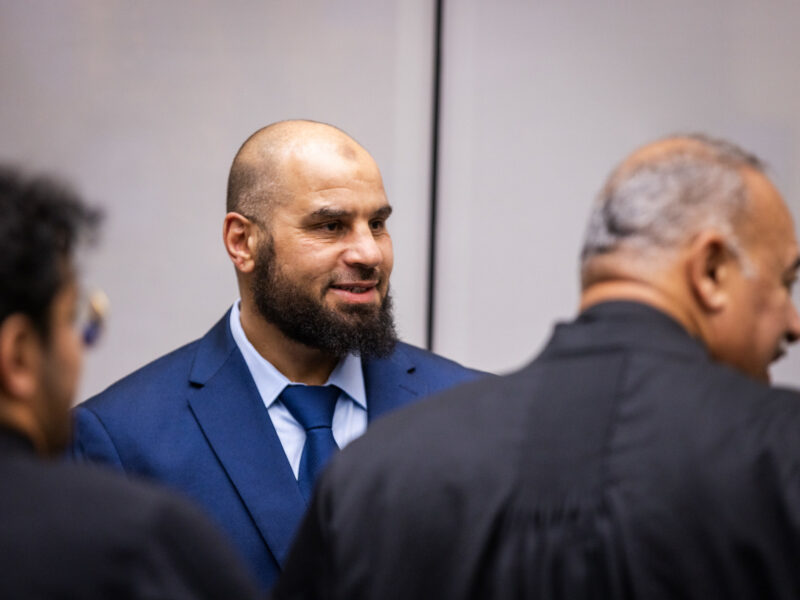
THE HAGUE, Netherlands (CN) — Fifteen years after Moammar Gadhafi’s fall shattered Libya and pulled the International Criminal Court into the chaos, judges in The Hague spent this week hearing two radically different stories about what really happened inside Tripoli’s notorious Mitiga Prison.
Prosecutors say the prison became a system of torture, rape, enslavement and terror run by militia figures hiding behind state institutions. Lawyers for Khaled Mohamed Ali El Hishri,the first Libya suspect ever physically brought before ICC judges, say prosecutors flattened Libya’s post-revolution collapse into a simple criminal conspiracy while ignoring the country’s fractured political reality and even NATO’s own role in the war.
The three-day confirmation hearing wrapped Thursday with defense lawyers urging judges not to send El Hishri to trial on 17 war crimes and crimes against humanity charges tied to Mitiga between 2014 and 2020. Prosecutors want charges including torture, murder, rape, persecution and enslavement confirmed. The defense says the court lacks jurisdiction and built its case around a fundamentally false portrayal of the Special Deterrence Force, or RADA.
By the final day, arguments had widened far beyond one prison.
Defense lawyer Yasser Mohamed Ahmed Hassan accused prosecutors of trying “to create a mental image” of RADA as “an outlaw armed group and not a legal governmental entity.” He spent hours guiding judges through Libyan decrees, ministry correspondence and presidential council decisions the defense says showed RADA formally operated under Libyan authorities.
“The RADA is a governmental entity and not an armed group,” Hassan argued earlier in the proceedings. Defense lawyers portrayed Mitiga not as a shadowy militia jail but as a legally established “Tripoli Correction and Rehabilitation Institution” connected to Libya’s justice system.
Hassan also challenged the entire legal foundation of the ICC’s Libya investigation.
He argued the court’s authority came from a 2011 U.N. Security Council referral focused on Gadhafi’s crackdown on protesters, not on accusations tied to Libya’s post-revolution security forces years later. He walked judges through the Arab Spring uprising, NATO’s intervention and Libya’s descent into competing governments, militias and armed factions.
He repeatedly pointed to civilian deaths from NATO airstrikes and questioned why Western actors never appeared before ICC judges, citing reports and victim testimony from the 2011 military campaign.
“My family has been destroyed. I lost my two little boys and my wife, who was also my best friend,” Hassan quoted one Libyan man regarding a NATO strike. “Nobody from the NATO contacted me, neither have the authorities has gotten in touch to ask what happened or to offer an explanation of what happened or to even say one word of apology.”
The criticism echoed a complaint that has shadowed the ICC for years: the court can investigate countries like Libya through U.N. Security Council referrals while major powers themselves often stay outside its reach. The United States, Russia and China are not ICC members, even though the Security Council can still give the court authority over conflicts involving nonmember states.
Prosecutors, meanwhile, focused less on geopolitics than on what they described as systematic abuse inside Mitiga.
Across the week, prosecution lawyers described overcrowded cells, starvation, forced labor, sexual violence and detainees reportedly controlled so completely that ordinary detention crossed into enslavement.
“There was an institutionalized system of enslavement,” trial lawyer Dianne Luping told judges while describing conditions inside Mitiga Prison. “The controls to which enslaved detainees were subjected and their corresponding deprivation of liberty and autonomy went far beyond those of any lawful prison facility and instead amounted to an exercise of powers of the rights of ownership over them.”
Prosecutors said detainees included Libyans, migrants from across Africa, women, men and children. Some were forced into labor or combat roles outside the prison compound. Others, prosecutors said, were beaten, raped or punished for violating the group’s religious and social rules.
The case has become one of the ICC’s clearest attempts to turn the wreckage of Libya’s post-Gadhafi collapse into criminal accountability.
Libya never joined the Rome Statute, the treaty establishing the Hague-based court, but the U.N. Security Council gave prosecutors authority to investigate crimes tied to the 2011 conflict as Gadhafi’s crackdown on protesters spiraled into civil war and NATO intervention. Years of stalled investigations, missing suspects and political fights over who the court should prosecute and why followed. Proceedings against Gadhafi ended after he was killed in 2011, while his son Saif al-Islam Gadhafi remains wanted by the court.
El Hishri was arrested in Germany in 2025 under an ICC warrant and was transferred to The Hague months later, becoming the first Libya suspect ever physically brought before ICC judges.
Judges must now decide whether prosecutors produced enough evidence to move the case to trial. If the charges are confirmed, the proceedings would become the ICC’s first full Libya trial since prosecutors opened the investigation in 2011, finally pushing one of the court’s longest-running Libya files out of diplomatic limbo and into a real courtroom battle.
Courthouse News reporter Eunseo Hong is based in the Netherlands.
Subscribe to our free newsletters
Our weekly newsletter Closing Arguments offers the latest about ongoing trials, major litigation and rulings in courthouses around the U.S. and the world, while the monthly Under the Lights dishes the legal dirt from Hollywood, sports, Big Tech and the arts.