
 Search Articles


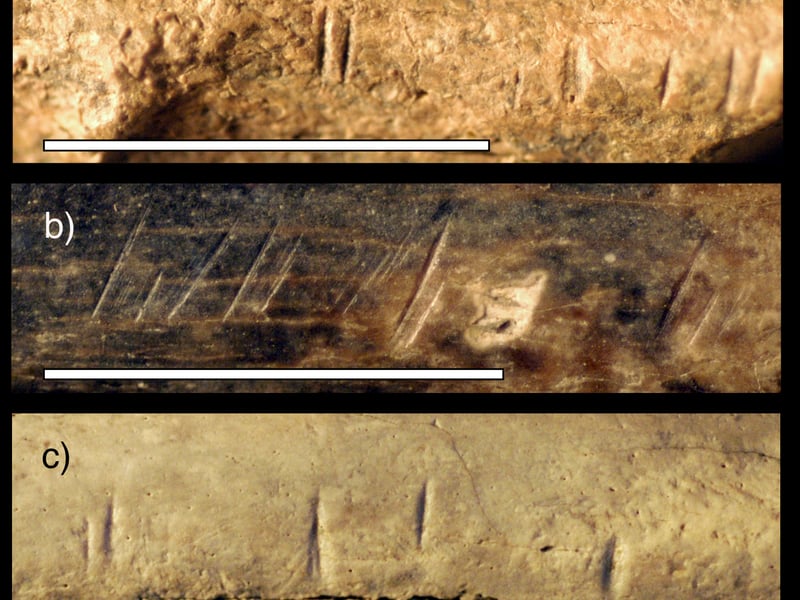
(CN) — Cut marks made on a leg bone from a relative of modern humans from 1.45 million years ago shows stone tools were used and could have been an example of cannibalism.
In a study published June 26 in Scientific Reports, researchers at Smithsonian’s National Museum of Natural History found nine cut marks, the oldest instance of this behavior known to date with a “high degree of confidence and specificity.”
“The information we have tells us that hominins (groups consisting of modern humans, extinct human species and all immediate ancestors) were likely eating other hominins at least 1.45 million years ago,” said Briana Pobiner, National Museum of Natural History paleoanthropologist and one of the co-authors of the study. “There are numerous other examples of species from the human evolutionary tree consuming each other for nutrition, but this fossil suggests that our species’ relatives were eating each other to survive further into the past than we recognized.”
Pobiner was in Africa at the National Museums of Kenya’s Nairobi National Museum researching what prehistoric animals were possibly feasting on humans’ ancient relatives when she discovered the tool marks. She was examining a tibia looking for evidence of bite marks, which would most likely would have come from long-extinct beasts, probably saber-tooth cats, when she noticed what she thought could be signs of butchery.
Being careful not to jump to conclusions on her findings, Pobiner made molds of the bone and sent them to a co-author of the study, Michael Pante, a paleoanthropologist and Colorado State University associate professor. Pobiner didn’t provide Pante with any details and asked him for his analysis on what made the marks.
After utilizing 3D scans of the molds and other tests, Pante affirmed that nine of the 11 marks were identified as coming from stone tools. The other two marks were likely bites from an animal, but there is no way of knowing if an animal was there first for a meal. Pante compared the shape of the marks to a database of 898 individual tooth, butchery and trample marks created through controlled experiments.
“These cut marks look very similar to what I’ve seen on animal fossils that were being processed for consumption,” Pobiner said. “It seems most likely that the meat from this leg was eaten and that it was eaten for nutrition as opposed to for a ritual.”
It seems the calf muscle was a meaty, sought-after food in prehistoric times. But Pobiner says in order to prove cannibalism, the eater and eaten have to hail from the same species. So this could be the case of a one species making a meal out of an extremely unfortunate evolutionary cousin.
“It marks a new standard for mark identification on bones that is more objective and reliable than the qualitative approaches used in the past,” said Pante, who has done extensive work studying the feeding behavior of early members of the human genus (Homo), particularly in Tanzania where many important discoveries about the evolution of human hunting have been made.
Another fossil, a skull, found in South Africa in 1976, is part of the conversation of earliest known cases of human relatives butchering one another. The skull is estimated to be 1.5 to 2.6 million years old. There is debate about the marks on the skull, mainly because there is a lack of large muscle groups which would provide nutrition. Pobiner is anxious to study the skull for answers.
Some experts say hominins caused the marks on the skull using stone tools, while others contend the marks were simply caused by sharp rocks the skull was lying on.
“Our ancestors likely did anything necessary to survive, including eating each other,” Pante said. “Hominin fossils are very rare, and most are not studied for butchery marks so potentially there are other currently unknown examples in museum collections.”
Pobiner trumpets the value of museums and said that taking additional looks at artifacts can be beneficial.
“You can make some pretty amazing discoveries by going back into museum collections and taking a second look at fossils,” Pobiner said. “Not everyone sees everything the first time around. It takes a community of scientists coming in with different questions and techniques to keep expanding our knowledge of the world.”
This research was supported by funding from the Smithsonian, the Peter Buck Fund for Human Origins Research and Colorado State University.
Subscribe to our free newsletters
Our weekly newsletter Closing Arguments offers the latest about ongoing trials, major litigation and rulings in courthouses around the U.S. and the world, while the monthly Under the Lights dishes the legal dirt from Hollywood, sports, Big Tech and the arts.