
 Search Articles


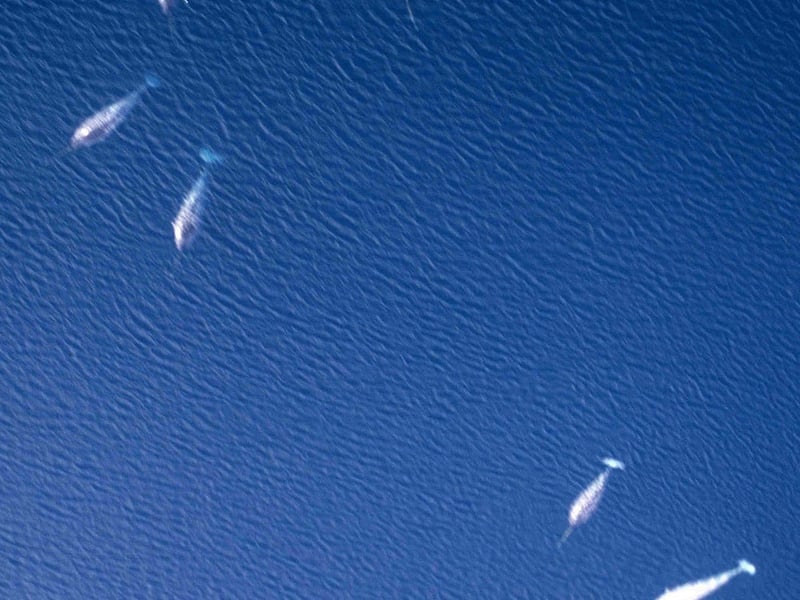
(CN) — As climate change continues to melt Arctic sea ice, a new study on Wednesday suggests increasing ship traffic and seismic airgun blasts negatively impact the region’s narwhals.
In the study published in Science Advances, a team of international researchers set out to understand the marine impact of increasing human activity in the Arctic due to sea ice melt-offs. Activities like oil and gas exploration, fishing, tourism and shipping are altering the Arctic Ocean’s acoustic environment, they say, but especially in habitats of the region’s established narwhal.
Known for its long spiral horn, the narwhal is a medium-sized whale found in cold Arctic waters near Canada, Greenland and Russia. But due to the species’ unique habitat that is rapidly transforming — and no option to go elsewhere — researchers say the whale is especially sensitive to environmental changes — particularly ship traffic.
Previously, studies have found that low-frequency noises generated by shipping activities cause male humpback whales to reduce or cease communication. A similar finding for orcas spurred a 2019 lawsuit claiming that low-frequency noise alters the species’ feeding behavior, starving some to death.
In this study, researchers concluded that the same disturbance, alongside seismic airgun blasting, affects narwhal foraging and diving behavior.
To come to this conclusion, the team conducted an extensive controlled-sound study in East Greenland in 2017 and 2018, later combining tag data from six free-ranging male narwhals. The research, split into two parts, analyzed around 854 hours of the whales’ reactions to both ship noise and airgun pulses that were from less than one to 39 miles away and then ship noise alone from about one to 35 miles out.
The team found that the closer a narwhal is to a ship, the more sound disturbances inhibit the whales’ propensity to “buzzing” or making fast-clicking noises when close to food. The noises also lessened narwhal deep diving — a behavior also associated with foraging — and increased the number of medium dives when the sounds became louder.
“When exposed to either sound type, the whales changed their deep diving behavior by decreasing their propensity of initiating a deep dive while simultaneously reducing the mean target depth,” the researchers write, explaining that because buzzing is most common at between 984 and 1,969 feet, the change in diving behavior also led to reduced foraging activity.
“Instead of diving deep, narwhals increased the number of shallower dives during both sound exposure types, possibly to accommodate traveling to avoid the exposure,” the researchers added, later noting that the latter behavior is associated with lower energy intake, greater energy expenditure and insufficient dive recovery times.
Additional study finds included that the presence of airgun pulses made little difference to the whale’s responses compared to the ship alone — a worrisome sign considering that the Northern Passage and Northern Sea Route is expected to be ice-free by 2050. However, the researchers also pointed out that cetacean responses to human-made noise may be influenced by antipredator behavior, including the cessation of buzzing.
“Similarly, responses to both killer whales and the ship and airgun in another analysis of this dataset led narwhals to head for shore and to be transiting as opposed to feeding,” the researchers wrote, concluding that narwhal responses to both types of sound exposures in the study resemble their reactions to a predator.
Overall, the team said their study demonstrates that a relatively low-amplitude, short-term disturbance can potentially affect the entire spatial range of a local narwhal population. As such, the narwhal’s sensitivity to sound disturbances, with their limited adaptability in niche selection and high fidelity, makes the species less resilient to human activities.
“If healthy narwhal populations are to be maintained, then it will be increasingly important to carefully manage human activities in the Arctic,” the researchers wrote. “This could include prohibition of noise-generating human activities within important narwhal habitats.”
 Follow @alannamayhampdx
Subscribe to our free newsletters
Our weekly newsletter Closing Arguments offers the latest about ongoing trials, major litigation and rulings in courthouses around the U.S. and the world, while the monthly Under the Lights dishes the legal dirt from Hollywood, sports, Big Tech and the arts.