
 Search Articles


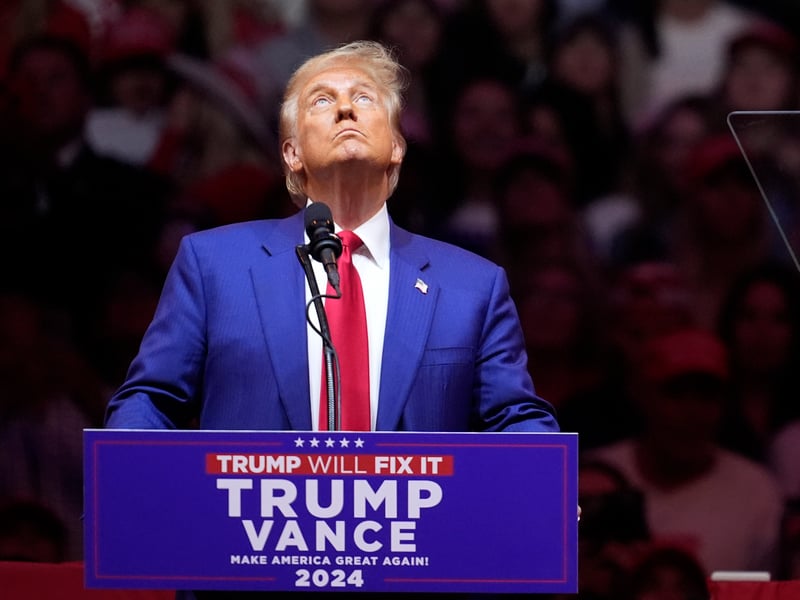
(CN) — Donald Trump’s win yesterday was “the greatest political comeback in American history,” Vice President-elect JD Vance declared in his victory speech, and for once a politician might not have been exaggerating. In historical terms, Trump’s win was even more dramatic than Richard Nixon’s victory in 1968 after losing the presidency in 1960 and the California governor’s race two years later.
The story of how Trump did it is one of unique political skill, dumb luck and frequent miscalculations by his opponents in both parties.
It’s hard to remember now how many political obituaries were written two years ago about the once and future president, after Trump put the country through turmoil trying to undo the 2020 election and then was blamed for backing weak candidates and costing Republicans significant gains in the 2022 midterms. By January of last year, Florida governor Ron DeSantis had opened up a 12-point lead over Trump in the New Hampshire primary.
And the political flak just kept on coming. In September 2023 Trump was found liable for fraud, and in February 2024 he was ordered to pay $464 million plus interest, leading to a struggle to come up with money for an appeal bond.
Three months later he was convicted of 34 felony counts involving falsified records of hush-money payments to a porn star. Meanwhile, he was facing three other felony indictments and was challenged for the nomination by five governors, a popular U.S. Senator and his own vice president. Officials in two states ruled that he couldn’t appear on the ballot because he was an insurrectionist.
Almost any other politician would have given up at that point, but Trump’s reality TV instincts kicked in. He cast himself as a martyr crucified by a rigged legal system, raising money off his mugshot and appealing not only to evangelicals but, unexpectedly, to minority men, many of whom have had their own concerns about encounters with the legal system.
Trump’s other clever move was to skip the primary debates. His rivals, wary of offending Trump’s fervid backers whose help they would need in the general election, mostly tiptoed around criticizing him and often ended up attacking and diminishing each other.
The early frontrunner, DeSantis, turned out to be “awkward and boring,” said David Niven, a political scientist at the University of Cincinnati. Another populist candidate, Vivek Ramaswamy, proved “immediately unlikeable,” said Andrew Smith, director of the University of New Hampshire Survey Center.
These candidates promised Trump’s policies without all the drama — but it turned out that large numbers of Republicans felt that the drama was part of the appeal. Trump without the drama was like hot sauce without the heat.
A more moderate, traditional Republican, former South Carolina governor Nikki Haley, eventually emerged as Trump’s chief challenger, but it soon became clear that the Republican rank-and-file had embraced Trump’s populist, nationalist agenda, and Haley was unable to attract even 40% of the vote in her own state’s primary.
In the general election, Trump benefited from a variety of mistakes by President Joe Biden. A weary electorate chose Biden in 2020 on the assumption that he would be a one-term moderate president who would bring back normalcy after the trauma of the pandemic. But Biden embarked on an ambitious FDR-like agenda, spending trillions on climate change and other priorities, loosening immigration restrictions, entangling the country in a foreign war and embracing a variety of “woke” policies, all while announcing plans to run for reelection even though he would be 86 years old at the end of his second term.
“People haven’t seen the return to normal that they were expecting,” said Shana Gadarian, a political science professor at Syracuse University. And despite the chaos of Trump’s first term, he was able to offer “a nostalgic vision.”
The immigration issue played directly into Trump’s hands because “Trump has been banging that same drum for a long time,” said David Macdonald, a political scientist at the University of Florida.
But an even bigger issue was inflation, which could be blamed on Biden’s massive spending bills. “We overrate the importance of campaigns. About 90% of politics is economics,” Smith said. And the public was miserable about higher prices.
Trump has always been a better extemporaneous speaker than a debater, but on June 27 he scored the only knockout in presidential debate history, with Biden’s dismal performance forcing him to withdraw from the race a little over three weeks later. This was a challenge for Trump, because he had spent a year and a half running against one opponent and he suddenly had to recalibrate his entire campaign.
For Democrats, Kamala Harris was a mixed blessing. She was an untested candidate who bombed in her first presidential run, had a low approval rating as vice-president and stepped into the campaign in midstream without any preparation. But she was buoyed by Democratic relief at getting rid of Biden and almost immediately saw a bump in the polls and a massive fundraising haul.
And the lack of preparation was in some ways an advantage. “Primaries divide parties and then the winner has to placate the losers and bring people together,” said Smith. “They cost a ton of money and resources that could go to the general election.”
Harris proved to be a more skilled campaigner than many expected, pulling off a successful convention and trouncing Trump in their September 10 debate according to most reviews. “She didn’t have any unforced errors,” said Niven. “She ran a clean race. It speaks volumes to her capacity.”
Reading the electorate: Exit polls and policy
The chief criticism of Harris was that she avoided the press and was vague about her policy proposals, which likely was due in part to her lack of preparation — but was also strategic. “She was purposely vague and didn’t take specific positions,” Smith said. “They’ve done research on that and it works. It worked in 2020 and 2022.”
“She spoke in places that her campaign thought was important to reach the voters she needed,” Niven said. “Did she speak to the Washington Post and the New York Times? No, but you don’t win elections in their pages.”
By the beginning of October, however, as low-interest voters began to tune into the election, the Harris honeymoon faded and the long-simmering issues of inflation and immigration, which helped Trump in the spring, came back to the fore. With her polling stalled and sensing weakness among some traditional Democratic groups — Latinos, young people and Black men — Harris changed course and began giving interviews. But her lack of practice showed.
On Oct. 8, she was asked on The View what she would have done differently from Biden and responded, “Not a thing comes to mind,” which didn’t help her cause given Biden’s grim approval ratings. (In this respect she was reminiscent of Hubert Humphrey, another vice president who unexpectedly took the reins at the 1968 Democratic convention and suffered from his loyalty to an unpopular boss.)
Some Democrats faulted Harris for choosing Tim Walz as her running mate instead of Pennsylvania Governor Josh Shapiro, who they thought possessed more gravitas and could have helped her in a critical swing state. “Both sides picked running mates who brought nothing to the ticket,” said Robert Kaufman, a political scientist at Pepperdine University who is writing a book on Trump’s foreign policy.
The Republican nominee managed a reasonably disciplined campaign by Trumpian standards, doing his best to finesse the abortion issue and keeping up a steady drumbeat of criticism tying Harris to the Biden presidency. He also received sympathy after surviving two assassination attempts.
Over the course of October, Trump began to notch a minuscule polling advantage in the swing states. Having no bold policy proposals to emphasize, Harris resorted to trying to drive up Trump’s negatives, going so far as to call him a “fascist,” while Biden described his supporters as “garbage,” a comment he later tried to walk back.
This was a mistake. When Trump was defeated in 2020 it was in large part because Biden offered a contrasting calm, statesmanlike demeanor. Trump, a reality TV star, thrives in an environment of overheated rhetoric, perversely gaining popularity from nasty epithets, lawsuits and even criminal indictments.
It’s possible that the country’s economic and other fundamentals were so negative that the Democrats never had a chance and that Trump won in spite of, not because of, his personality and policies. Kaufman said that half the country can’t stand Trump and his vote ceiling is about 50%, but that turned out to be just enough. Niven believes that a more mainstream Republican candidate could have pulled off an even bigger victory.
But it’s also possible that Trump simply read the electorate better than anyone else.
Republicans who thought there was an appetite for “Trump without the drama” went down in flames. Republicans who thought there was a market for traditional neoconservatism faced not just defeat but a backlash. “Mitt Romney and Liz Cheney are hiring bodyguards,” Niven quipped.
On the Democratic side, a Reuters exit poll conducted by Edison Research suggested many of the party’s assumptions about the electorate were simply misplaced, including the idea that the Dobbs decision, a key plank of Harris’s campaign, would be a big winner. Voters said they favored Harris over Trump on the abortion issue by only 6 points, 50% to 44%, and it was far less important to them than the economy.
And while Harris heavily focused her campaign on turning out women, Trump actually did two points better with women than he did in 2020, the poll showed — while he did two points worse with white men.
Among voters under 30 — another key target of Democratic turnout efforts — Trump did six points better than last time, while he lost ground with voters over 65.
With his victory, Trump has cemented his place as the 21st century’s most consequential political figure, having engineered a hostile takeover of the Republican party and reoriented it toward working-class populism while pushing the Democrats to respond by embracing progressive causes favored by the educated elite.
This Democratic response likely contributed to the party’s loss of the Senate this year. Democratic incumbents Sherrod Brown of Ohio and Jon Tester of Montana, who had long survived in red states due to their populist bona fides, had solid leads in the polls while “working-class Joe” Biden was at the top of the ticket, but once Harris, long known as a California progressive, took over, their numbers went south and last night they were trounced.
“Republicans are now a populist, working-class party,” said Dante Scala, a political science professor at the University of New Hampshire. “That battle has been won. The GOP is not going back.”
Subscribe to our free newsletters
Our weekly newsletter Closing Arguments offers the latest about ongoing trials, major litigation and rulings in courthouses around the U.S. and the world, while the monthly Under the Lights dishes the legal dirt from Hollywood, sports, Big Tech and the arts.