
 Search Articles


WASHINGTON (CN) — Google, the tech giant that has dominated American technology and become a cultural mainstay in the digital age, finds itself in the midst of several legal battles that could result in drastic changes to the company and its many products in coming years.
Those changes, however, will only materialize after a lengthy legal process and several likely appeals, all of which will bleed over into a new presidential term and new era in American politics.
Google, the so-called “gatekeeper of the internet,” with a name that became the colloquial verb for searching online, faces a trio of antitrust suits brought by the Justice Department and Fortnite-creator Epic Games over its dominance in internet search, its advertising market and its Google Play app store.
Federal judges presiding over both the search case in Washington and the app store case in San Francisco have ruled Google held illegal monopolies in their respective markets, setting up major overhauls in two of the company’s core products. A third case in Virginia centered on the ad market is ongoing, with closing arguments set for Nov. 25.
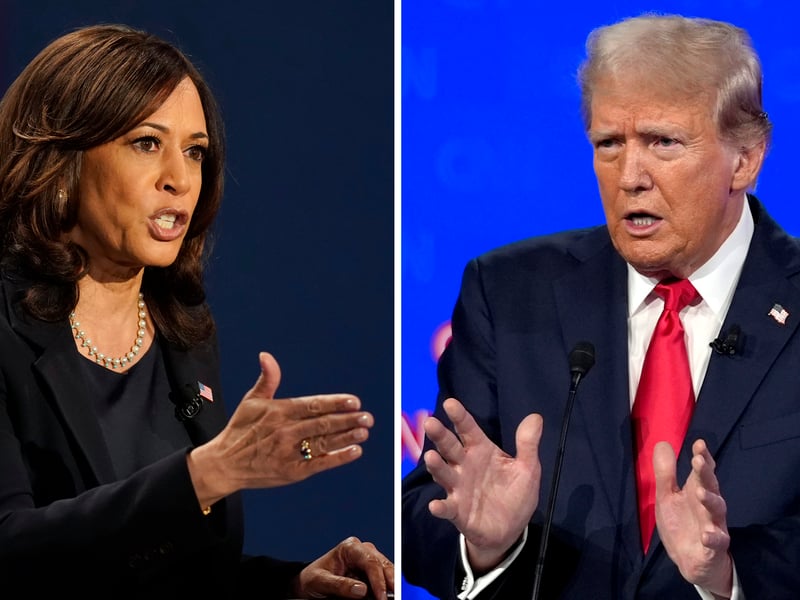
With any final outcomes likely years away, the upcoming Nov. 5 election between former President Donald Trump and Vice President Kamala Harris will influence how they continue to progress, particularly in the search and advertising market cases that involve the Justice Department.
The candidate who wins the White House will be able to appoint a new attorney general and therefore influence the cases the Justice Department is currently litigating. That relationship has been brought up repeatedly in relation to Trump’s federal criminal cases, where he could instruct his attorney general to drop the charges outright.
It is currently unclear how the candidates would treat the ongoing antitrust cases against the nation’s largest tech company, but certain signs suggest they may take a different approach than President Joe Biden has.
At an Oct. 15 Economic Club of Chicago forum, Trump suggested he may not break up Google, citing competition with China and the communist country’s apparent fear of the company and expressing concern such action could “destroy the company.”
He did, however, indicate he would like to “make sure it’s more fair,” but did not provide any details. At the same time, Trump has also recently derided Google for showing “bad stories” about him and threatened to prosecute the company in response.
Harris has not explicitly said how she would handle the ongoing cases, but has ties to Silicon Valley as the former district attorney of San Francisco. Those ties have materialized in her campaign, where she has employed Google attorney Karen Dunn, who led the company’s defense in the recent advertising market case in Virginia, as a top adviser.
A former Barack Obama administration official with experience in antitrust litigation, who spoke on condition of anonymity due to their work in political consulting, suggested that each of the cases are too far along for a new administration to radically alter their progress.
Further, there is broad bipartisan support for strong regulatory action against big technology companies like Google, both in Congress and among the public, the official said.
According to an April 29 survey by the Pew Research Center, 51% of respondents said they believe the government should regulate big companies more, with 31% saying the current level of regulation should remain the same and just 16% calling for less regulation. Democrats said they are more supportive of increasing regulation, with 60%, compared with 45% of Republicans.
Due to that wide support, the former official did not see any reason to believe the Justice Department would change its stance that Google should be partially broken up to remedy its monopoly in internet search.
At most, the transition between presidential administrations could lead to a similar outcome as another antitrust case that occurred in Washington, U.S. v. Microsoft , where that tech giant was nearly broken up in 2001.
In that case a federal judge ruled that Microsoft had illegally monopolized the web browser market for its Windows operating system and crushed potential competitors.
Then-U.S. District Judge Thomas Jackson ordered that Microsoft be split into two separate business, one to produce the operating system and another for other software components. That decision was immediately appealed to the D.C. Circuit Court of Appeals, which overturned the Ronald Reagan appointee’s rulings.
Following the reversal, the case was remanded to federal court under U.S. District Judge Colleen Kollar-Kotelly, due to the D.C. Circuit finding Jackson had violated the code of conduct for judges by discussing the case with the media during the proceedings.
Between Jackson’s June 2000 decision and the D.C. Circuit’s June 2001 ruling, the White House changed hands, with George W. Bush taking office.
Under the Bush administration, the Department of Justice backed off from seeking a breakup of Microsoft, and instead sought a lesser penalty. Microsoft then settled and agreed to share its application programing interfaces with other companies, a concession nine states and the District of Columbia saw as too lenient.
The same could happen in both the search case and the advertising market case, the official said, but added that a settlement of some kind was likely in the cases due to potential difficulty cutting off key parts of Google’s technology.
The Trump campaign and Harris campaign did not respond to requests for comment on this story.
 Follow @Ryan_Knappy
Subscribe to our free newsletters
Our weekly newsletter Closing Arguments offers the latest about ongoing trials, major litigation and rulings in courthouses around the U.S. and the world, while the monthly Under the Lights dishes the legal dirt from Hollywood, sports, Big Tech and the arts.