
 Search Articles


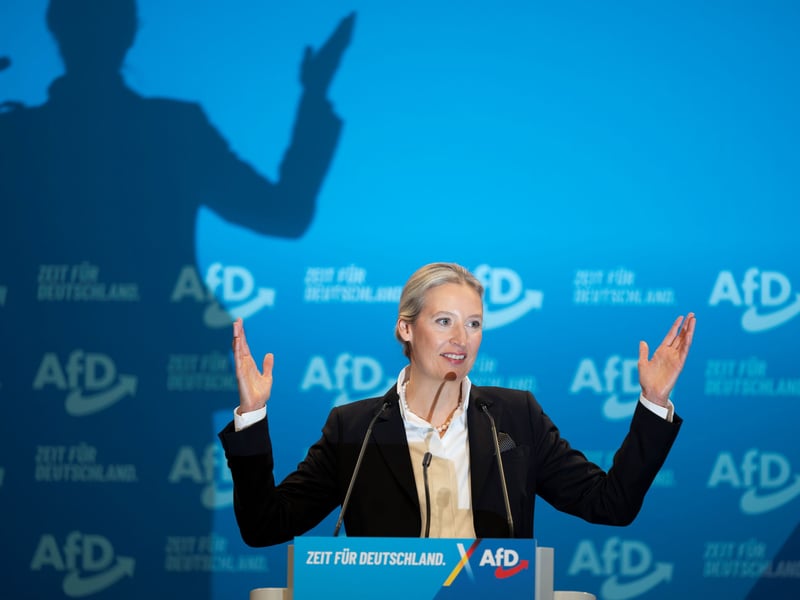
HENNIGSDORF, Germany (CN) — In the eyes of roughly 20% of German voters, and the richest man in the world, there’s only one party that can “save Germany” — the Alternative for Germany.
Elon Musk’s controversial endorsement of the far-right AfD party has attracted widespread attention to Germany prior to February’s snap elections. The newfound spotlight, intensified by Musk’s lengthy Jan. 9 interview with party chair Alice Weidel, has emboldened an already rapidly radicalizing AfD.
Musk said he hoped the conversation showed people that Weidel is reasonable. “Nothing outrageous has been proposed, just common sense,” Musk said. “People really need to get behind the AfD, otherwise things are going to get very, very much worse in Germany.”
At last week’s party convention, Weidel demanded mass “remigration” of foreigners — embracing a term she’d previously shied away from due to its links to last year’s leaked plan among German far-right groups to forcibly deport millions living in Germany.
After she was formally — and unanimously — nominated as the AfD’s candidate for chancellor, chants of “Alice for Germany” rang out at the convention — a play on words with the banned Nazi slogan “Everything for Germany.” Firebrand AfD member Björn Höcke was found guilty of using “Alles fuer Deutschland” multiple times.
As centrist parties falter and Germany reckons with a number of economic and social crises, the AfD’s countrywide popularity continues to skyrocket. Though other parties have categorically sworn off working with the AfD, its success has heaped on pressure and means it shapes German politics, whether it’s in government or not.
An increasingly popular alternative
Weidel, who’s married to a Sri Lankan-born Swiss woman, is an unlikely figurehead for a nationalist party whose campaign platform includes: “The family, consisting of father, mother and children, is the nucleus of society.” Party leader since 2017, she joined the AfD shortly after it was founded as a largely liberal, Euroskeptic outlet — and her politics have followed the party’s rightward shift.
“She wants to keep her hold on the party and reach power. If moving to the right and being even more extremist helps, then she’ll do it,” Johannes Kiess, political scientist at the University of Leipzig, told Courthouse News.
The party’s more extreme wing has dominated its politics for years, which has coincided with the AfD’s rise in popularity. Germany’s domestic intelligence agency has designated it a “suspected” right-wing extremist group and therefore keeps it under surveillance. The party recently replaced its youth wing, which had been deemed outright extremist by German authorities.
While the AfD’s popularity despite flirting with Nazi rhetoric has disturbed Germany’s mainstream, political scientist Maik Herold argues its rise represents a much wider trend.
“From Austria, to Italy, to France, or northern European countries like Sweden, a right-wing populist party in basically every European democracy has developed in the last 20-30 years,” Herold, who teaches at the Technical University of Dresden, told Courthouse News.
“The more interesting question is almost why did this take so long to happen in Germany compared to the other countries,” he continued.
Herold argues Germany’s unique history and the taboo of Nazism helped hold off the rise of the right longer than elsewhere but didn’t render the country immune to global trends. There are also German-specific developments that aided the AFD’s rise.
According to Herold, the conservative Christian Democrats had long been the most rightward popular party in German politics, but the party shifted toward the center during Angela Merkel’s 12 years as chancellor, eight of which were spent presiding over a “grand coalition” with the center-left Social Democrats.
This opened a political vacuum on the right, which along with the failure of current Chancellor Olaf Scholz’s “traffic light” coalition and compounding crises — from the pandemic to the war in Ukraine to Germany’s economic struggles — have proven fertile ground for the right-wing populist party.
Germany’s stagnant economy was a central issue at a recent packed AfD campaign event in the state of Brandenburg.
“More and more people in my circles, whether it’s work, family, whatever, used to be totally closed off to the idea of the AfD. But in the last years, more and more have warmed up to the party because they’re seeing what’s happening economically,” Jürgen, a 67-year-old small business owner, told Courthouse News.
And while most potential AfD voters at the event mentioned the economy, it wasn’t the only issue on everyone’s lips.
“The economy is the most important. But also that that I can move freely in this country again. That I don’t have too many foreigners around me,” said 60-year-old Birgite.
A brittle firewall
While hundreds of thousands of Germans took to the streets against the far right at the beginning of last year, little has been done to stem the right-wing tide.
“There were huge demonstrations and nothing happened. People asked the democratic parties to do something about it, and what they did was restricted migration,” said Kiess. “They followed through on the AfD claims, but not on popular claims, which I think demobilizes democratic milieus.”
While Germany’s democratic parties have long established a “firewall” against cooperating with the AfD, many of them have tacked to the right in a failed attempt to win back voters. Under chancellor frontrunner Friedrich Merz, the Christian Democrats in particular have taken a hard line on immigration and other cultural questions.
“Copying their claims normalizes what the AfD is saying, and at the same time it reduces the differences between parties, at least in the view of voters. And this is dangerous for the Christian Democrats, because from a long-term perspective, why do you need a second far-right party if you already have one?” Kiess said.
The Christian Democrats’ rightward shift means many of their policies have converged with the AfD. While Musk’s intervention has shifted some media perceptions of the AfD, it remains extremely unlikely the two parties would form a national coalition in 2025.
Still, Herold points out that the parties already work together at the local level. Minority centrist state governments in the east due to the AfD’s regional dominance make further cooperation — and potentially shared coalition — all but inevitable.
“The firewall isn’t about ethics or a moral argument, it’s a strategic concept, and one day it simply won’t work anymore. My prediction is that the political discourse will change completely and in the next four or five years we’ll see the first coalition government with the AfD,” said Herold.
Merz’s CDU, which is currently polling at around 30%, has to reject the AfD, which has eaten into its vote share, while hoping to avoid another awkward centrist coalition with the Social Democrats, who have about 16% support, or Greens, with 14%.
Whatever the next government does, it’s going to have to reckon with a loud, and likely ever-growing, AfD opposition.
“The AfD is really strong, and the AfD is not going to disappear in the next years or decades,” Herold said.
 Follow @braneck
Subscribe to our free newsletters
Our weekly newsletter Closing Arguments offers the latest about ongoing trials, major litigation and rulings in courthouses around the U.S. and the world, while the monthly Under the Lights dishes the legal dirt from Hollywood, sports, Big Tech and the arts.