
 Search Articles


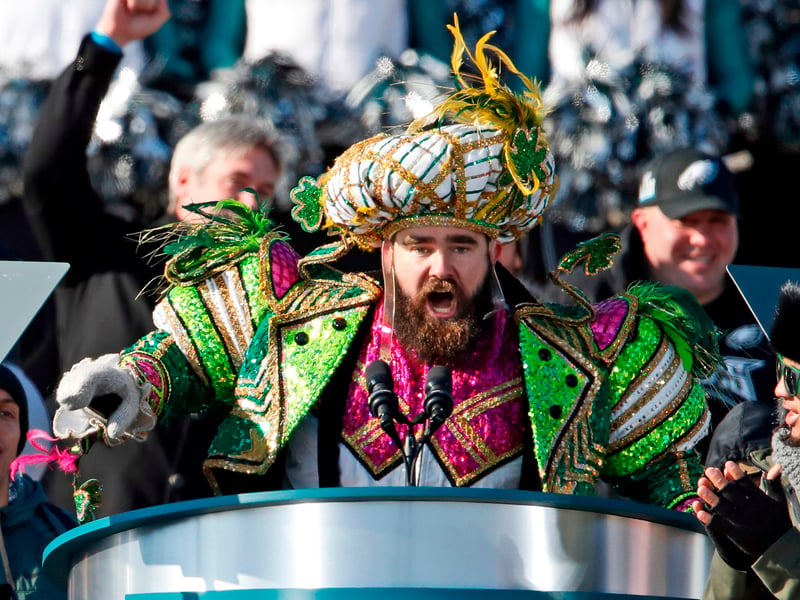
PHILADELPHIA (CN) — If Super Bowl LIX ends in green confetti Sunday night, you can be certain Philadelphians will take to the sky.
Explanations for the strange and at times obscene behavior of Philadelphia’s sports fans have long eluded the rest of the world, and the city’s obsession with climbing greased street poles is no different.
However, there may just be a method to the city’s madness.
Approximately a decade before the first recorded instance of Philly’s celebratory pole climbing, the city’s South 9th Street Italian Market Festival began a grease pole climbing competition in the 1960s. Teams climb atop one another in the hopes of reaching a greased pole’s peak, which is strung with meats, cheeses and gifts for whoever can reach them.
“It’s a tremendous attraction for the community there,” said Saverio Nestico, president of Italian-American nonprofit Filitalia International. “It’s kind of the shining silver dollar of the festival that weekend.”
And while photos exist of Flyers fans climbing light poles during the hockey team’s 1974 Stanley Cup victory parade, pole climbing as a Philadelphia sports celebration didn’t fully take hold until 2008, when the Phillies defeated the Tampa Bay Rays 4-1 to capture their first World Series in 28 years and the city’s first championship in 25 years.
Immediately after Phillies pitcher Brad Lidge sealed the series, Philadelphians took to the streets before scaling the city’s light poles, with many fans tearing down World Series banners as keepsakes. Critically, at least one traffic signal pole had been uprooted from the pavement along Broad Street, Philadelphia’s main thoroughfare.
The next year, when the Phillies again reached the World Series following a 4-1 rout of the Los Angeles Dodgers, city officials had a new way to deter “phanatics” from damaging public property — coating street lights, signs, bus shelters and even trees with a “yellowish goo” similar to petroleum jelly.
While Philadelphia sports fans had climbed street poles before, this marked the first instance in which the city preemptively greased the poles as a deterrent.
Though the Philadelphia Flyers reached the Stanley Cup Finals in 2010, fewer fans gathered to bully Broad Street, and a hefty police presence ensured that celebrations remained grounded.
Fly Eagles fly
Above all else, though, the City of Brotherly Love bleeds green.
In 2018, an unlikely Philadelphia Eagles’ playoff run revived — and ultimately, cemented — pole climbing as part of the city’s sports culture.
Following then-MVP-favorite quarterback Carson Wentz’s season-ending ACL injury in Week 14 of the 2017 season, pundits and fans alike assumed the Eagles’ chances at a deep playoff run were all but dashed.
Despite all odds, however, the team eked out a close divisional-round win against the Atlanta Falcons before backup quarterback Nick Foles surged in the NFC Championship game, racking up 456 total yards in a 38-7 blowout against the Minnesota Vikings to send the Eagles to the Super Bowl against the New England Patriots.
With the city’s darling team on a miracle run to the championship, a fervor set over Philadelphia. Police officers applied Crisco to street poles in the hopes that it would deter pole climbing. To Philadelphians, this was seen as little more than a challenge, paradoxically encouraging fans to try their luck at reaching new heights.
“I think many, many social psychologists could have told you that’s exactly what would happen,” said Deborah Ward, an assistant psychology professor at Saint Joseph’s University and lifelong Eagles fan. “People do not love being told they can’t do something.”
“As Philadelphians, we certainly have that culture of, ‘You can’t tell us what to do,’” she added. “We feel like underdogs. We feel like we can overcome.”
Word spread of Eagles fans’ slippery stunts as videos of pole climbers went viral on social media, and a national media frenzy began. Pornographic website Pornhub even offered the Philadelphia Police Department 110 gallons of personal lubricant for the then-upcoming Super Bowl. The police department ultimately declined Pornhub’s offer, instead coating poles with hydraulic fluid.
Still, on Feb. 4, 2018 — when the Eagles defeated the Patriots 41-33 to capture the franchise’s first ever Super Bowl victory — the city’s efforts were no match for the mighty Philadelphian.
With a spotlight on the greased poles and a storybook triumph, Eagles fans surmounted slick street posts en masse across the City of Brotherly Love. Forever tied to the greatest moment in Philadelphia sports history, pole climbing enshrined itself in the city’s culture and “grease the poles” became a rallying cry uttered whenever a Philly team nears a championship.
The once-absurd act had become a citywide ritual of civic pride and sports fanaticism.
“In a place where bizarre behaviors are pretty run-of-the-mill in our sports culture, you really have to do something big to make yourself stand out from the pack,” said Megan Robb, an associate religious studies professor at the University of Pennsylvania specializing in the intersection of religion and sport.
“The police greasing the poles and then publicizing that they greased the poles, and then being present and telling people not to climb the poles, all kind of contributes to this sense that climbing the pole must be the most ultimate expression of Philly sports culture,” she added.
Super Bowl LIX
However, despite the city’s sports fans continuing to climb street poles following significant sports victories, the practice remains illegal — and dangerous.
Following the Eagles’ NFC Championship victory on Jan. 26, 18-year-old Temple University student and gymnast Tyler Sabapathy climbed a street pole during celebrations in Center City before falling and hitting his head. Sabapathy suffered a brain injury as a result of the fall and died two days later.
Citing the dangers of climbing street poles at a press conference Thursday, Philadelphia Mayor Cherelle Parker implored Philadelphians to keep their feet on the street if they choose to celebrate outdoors after the Super Bowl.
“Climbing or attempting to climb up a light pole or a bus shelter, or really any structure for that matter, it can lead to tragedy,” Parker said. “We do not want anything to happen to you, your friends or your family members. So for your mayor, please just don’t climb onto anything, okay? That’s our golden rule.”
Parker declined to say whether city officials plan to grease poles ahead of Super Bowl LIX on Sunday, citing public safety reasons.
Still, Ward suggested the mayor’s pleas would likely fall on deaf ears in the event of an Eagles victory.
“Regardless of how it happened, it’s kind of a cultural thing now, and you want to engage in your culture,” Ward said. “If somebody’s telling you, ‘You can’t live that,’ well, it’s gonna make you want to do it even more.”
Instead of taking an abstinence-only approach to pole climbing, Ward suggested the city focus on ways to minimize harm when rebellious Philadelphians ultimately take to the streets — and several feet above the streets.
“I think the best thing to do is just try to make sure people don’t get hurt,” Ward said. “You know that people are going to do this activity. What kind of things can we have in place to try to ensure that people don’t get really hurt from this?”
“Go Birds,” she added.
 Follow @JacksonHeals
Subscribe to our free newsletters
Our weekly newsletter Closing Arguments offers the latest about ongoing trials, major litigation and rulings in courthouses around the U.S. and the world, while the monthly Under the Lights dishes the legal dirt from Hollywood, sports, Big Tech and the arts.