
 Search Articles


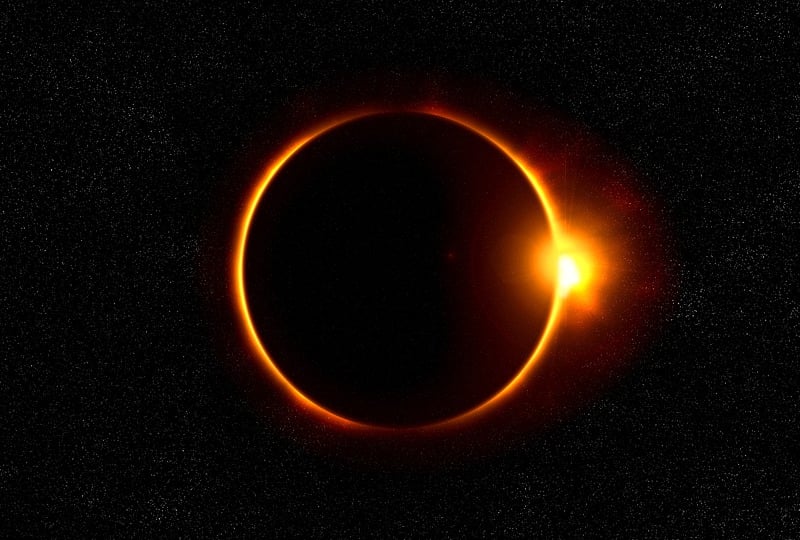
(CN) — For over a century, scholars have puzzled over the eclipse table in the Dresden Codex, one of the few surviving texts from the ancient Mayan civilization.
Now, researchers John Justeson from the University at Albany and Justin Lowry from SUNY Plattsburgh have dramatically revised our understanding of how Mayan calendar specialists developed and maintained their eclipse prediction system.
The study, published Wednesday in Science Advances and titled “The eclipse table of the (Mayan) Dresden Codex,” challenges long-held assumptions about Mayan astronomical methods and highlights a level of mathematical sophistication that allowed daykeepers to anticipate solar eclipses for centuries.
The Dresden Codex eclipse table spans 405 lunar months and contains 69 new moon dates, of which 55 were designed to predict solar eclipses. The remaining 14 dates were what the researchers call “contrived” entries, included to maintain the table’s mathematical structure.
This careful design allowed Mayan astronomers to track celestial patterns using intervals of six lunations, approximately 177 days, while incorporating longer spans of 11 or 17 lunations to account for the complex dance between lunar cycles and eclipse patterns.
What makes Justeson and Lowry’s findings significant is their theory that Mayan daykeepers likely reset their eclipse tables much earlier than previously thought — at 358 or 223 lunation months rather than at the table’s end. This approach would have enabled them to maintain accurate predictions across generations, anticipating every solar eclipse visible in Mayan territory.
Their research also suggests that the eclipse table was not originally designed for eclipse prediction at all.
“The earliest version of the eclipse table seems to have been a repurposed revision of a less complex table, which listed 405 successive lunar months, each lasting either 29 or 30 days,” the researchers said in their study.
Within a few cycles of this general lunar calendar, Mayan daykeepers observed patterns in eclipse intervals and adapted the table for eclipse prediction.
“Unfortunately, however, our understanding of Mayan astronomy is severely hindered by the relatively small amount of material available for study,” Justeson and Lowry said. “One of the surviving works, now known as the Dresden Codex, contains a table for predicting eclipses, but its exact workings are not yet fully understood.”
The Mayan civilization, which flourished in Mexico and Guatemala over 2,000 years ago, developed two primary calendars: a 260-day divinatory calendar used to predict individual fates and a 365-day civil calendar. Around 500 BCE, the divinatory calendar became associated with lunar phenomena, tracking the moon’s visibility and phases, and was later applied to planetary cycles.
Eclipses held profound significance for ancient civilizations.
“One of the most awe-inspiring of celestial events seen by early man must surely have been the occurrence of an eclipse of the sun or moon,” the researchers write. “With no apparent warning, one or two times a year, a darkness encroaches upon the bright light of the sun or moon; sometimes to completely cover the heavenly body, sometimes to retreat before the light is fully extinguished.”
The study examined 145 solar eclipses visible in Mayan territory between 350 and 1150 CE — all total, annular or hybrid eclipses, as partial solar eclipses were rarely visible in Mesoamerica.
The researchers identified crucial patterns: While solar eclipses reliably occur 223 months apart, after 669 months — a triple-saros cycle — they tend to occur near the same east-west longitude and around the same time of day. This interval was likely the most reliable predictor available to Mesoamerican daykeepers.
The earliest known Mayan lunar day count appears on Naachtun Stela 23, dated Aug. 1, 361 CE, coinciding with the period when Teotihuacanoid leaders took control of the central Peten region in Guatemala.
By analyzing eclipse patterns from this period forward, the researchers concluded that by 550 CE, Mayan astronomers likely possessed sufficient observational evidence to develop a predictive table similar to the Dresden Codex.
“Daykeepers would have had sufficient evidence for the table’s stations long before that date,” the researchers found. “From the first Mayan lunar day records until 808 CE, 51 of the 55 stations had corresponded to between four and 17 intereclipse attestations.”
Justeson, a scholar with decades of experience in Mayan astronomy and who has collaborated with prominent figures such as Floyd Lounsbury and Anthony Aveni, was responsible for the study’s text and data tables. Lowry contributed by producing figures and compiling a database of lunar crescent appearances, which was used to analyze intervals between lunar months.
 Follow @JeremyYurow
Subscribe to our free newsletters
Our weekly newsletter Closing Arguments offers the latest about ongoing trials, major litigation and rulings in courthouses around the U.S. and the world, while the monthly Under the Lights dishes the legal dirt from Hollywood, sports, Big Tech and the arts.