
 Search Articles


(CN) — Birds didn’t just inherit their dinosaur lineage — they rewired it.
That’s according to researchers in a study that say as their brains grew, birds’ skulls became more flexible, unlocking new ways to eat, move and survive. Researchers think that this shift in skull mechanics may have helped shape bird evolution, setting them apart from their prehistoric ancestors.
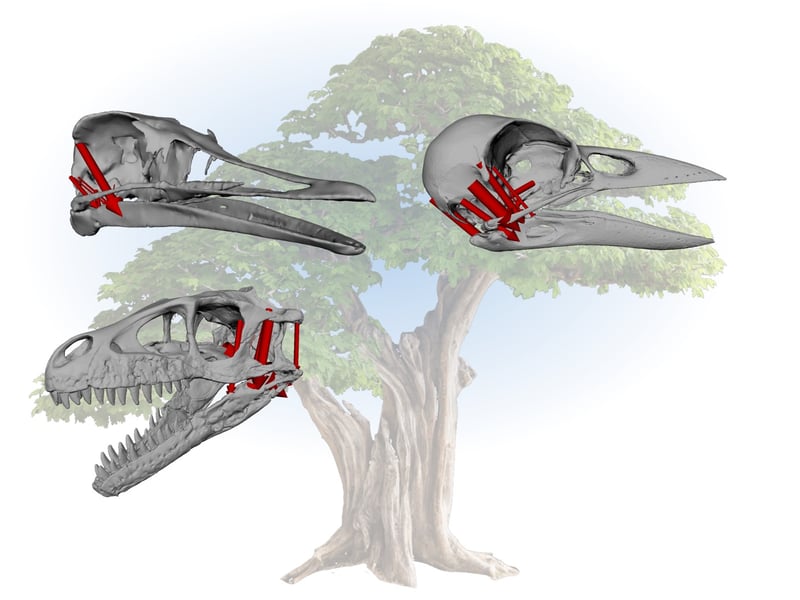
Researchers from the University of Chicago and the University of Missouri found that as non-avian theropods — dinosaurs like velociraptors — developed larger brains, their skulls adapted in response. Their study, published Monday in Proceedings of the National Academy of Sciences, shows that these structural changes eventually led to the highly mobile beaks seen in birds today.
Unlike mammals, turtles, or non-avian dinosaurs, modern birds have flexible skulls with mobile jaws and palates, a trait known as cranial kinesis. According to researchers, this flexibility allows birds to use their beaks not just for eating but for a variety of functions, from cracking nuts to climbing.
Lead author Alec Wilken, a graduate student in integrative biology at the University of Chicago, describes bird skulls as “wiggly” — but adds that understanding how they move is another challenge.
“Just because you have a joint there, that doesn’t mean that you know how it moves,” Wilken said in a statement. “So, you also have to think about how muscles are going to be pulling on the joint, what kind of torque they have, and how other joints in the head limit the mobility.”
The research team used CT scans to analyze fossils and skeletons from birds and their reptilian relatives, like alligators. They then built 3D models to simulate how the skulls functioned, examining muscle sizes, movements and mechanics.
Their analysis revealed that as bird ancestors evolved larger brains, their skull structures changed to accommodate them. According to researchers, these changes allowed the palate to separate and become more mobile, leading to increased muscle force and greater cranial kinesis.
“We see this cascade of changes that happened along the dinosaur to bird transition,” said Casey Holliday, an associate professor at the University of Missouri and co-author of the study, in a statement. “A large part of it hinges upon when birds evolved a relatively large brain. Just like in humans, bigger brains drive a lot of changes in the skull.”
Paleontologists have long debated what distinguishes birds from their dinosaur ancestors. Scientists say feathers — once thought to be unique to birds — were actually common among many dinosaurs.
According to researchers, flight evolved multiple times in different species. However, they suggest that the development of flexible skulls and palates may have been a later evolutionary shift, emerging after early bird-like dinosaurs such as Archaeopteryx.
Holliday believes this could be an important distinction between modern birds and their more dinosaur-like ancestors.
“Cranial kinesis might be one of the clear dividing lines between modern birds and their more dinosaur-like bird ancestors,” he said in a statement.
Subscribe to our free newsletters
Our weekly newsletter Closing Arguments offers the latest about ongoing trials, major litigation and rulings in courthouses around the U.S. and the world, while the monthly Under the Lights dishes the legal dirt from Hollywood, sports, Big Tech and the arts.