
 Search Articles


WASHINGTON (CN) — House Republicans on Wednesday passed a bill that would slap new restrictions on federal courts affecting their ability to issue nationally binding injunctions, which so far have hampered parts of the Trump administration’s ambitious agenda.
It’s the GOP’s most concrete move yet to push back on so-called “activist” federal judges, whom some lawmakers have accused of overstepping their constitutional authority for political purposes.
Though efforts to crack down on universal injunctions — orders from federal courts which apply on a national level and not just to a case’s parties — have historically been championed by members of both parties, it’s been Republicans in recent months who have framed the mechanism as illegal overreach.
Since President Donald Trump returned to the White House, judges in federal district courts have issued dozens of injunctions and temporary restraining orders blocking some of his administration’s actions. Court orders have stopped the president from gutting federal agencies and rolling back immigration rights, among other things.
But these injunctions are not permanent — and the Supreme Court has already demonstrated its willingness to strike down lower courts’ orders. The justices earlier this week scuttled an injunction issued by the D.C. federal district court, which stopped the Trump administration from deporting migrants using a little-known wartime law.
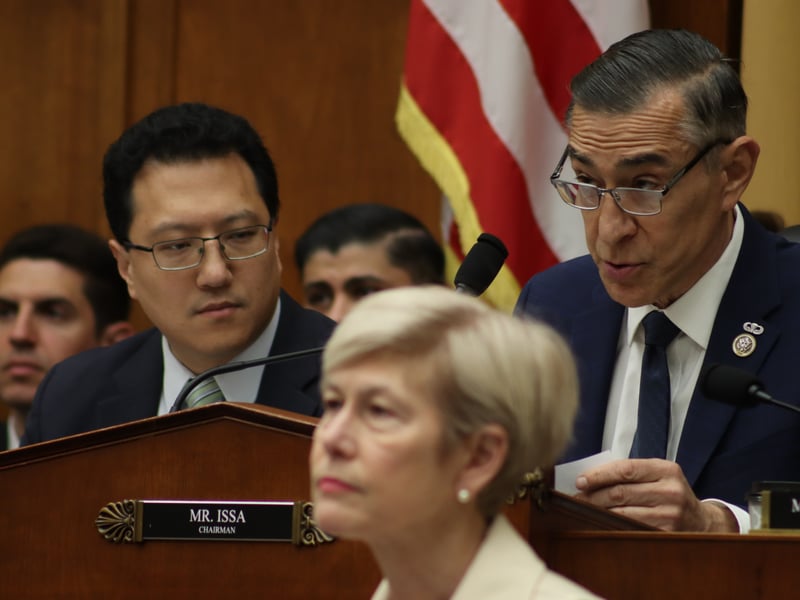
Still, the president and his Republican allies have called for action to address what they have dubbed “rogue rulings” from federal judges. And in a 219-213 vote Wednesday, the House heeded that call, passing California Representative Darrell Issa’s “No Rogue Rulings Act.”
If made law, Issa’s legislation would restrict courts’ ability to issue nationwide injunctions, forcing judges to only issue orders that apply to the parties to a case.
Speaking on the House floor Tuesday, the California congressman positioned his bill as a check on federal judges who “believe they can make a law of the land.”
“These sweeping injunctions represent judicial activism at its worst,” said Issa. “It empowers individual, unelected judges to dictate national policy and thwart the Constitution — to take rights reserved to Congress and the president of the United States.”
But Democrats have fired back that their Republican colleagues are “misdiagnosing” the root cause of recent nationwide injunctions against the Trump administration.
Maryland Representative Jamie Raskin argued Tuesday that judges who have issued orders halting White House executive actions have explained in “painstaking detail” that the administration’s activity was unlawful. He added that the Trump administration has offered “no substantive critique” of the courts’ reasoning.
Raskin also pointed out that the Supreme Court has intervened to roll back at least one lower court injunction. “The system’s working,” he said. “We don’t need to turn the world upside down to distract from the economic calamities they brought upon us.”
The Maryland Democrat also warned that rhetoric branding federal judges as activists or politically biased raises concerns about their safety and that of their families.
“It’s a dangerous situation,” he said.
Now that it’s passed the House, Issa’s national injunctions legislation heads to the Senate. But Republican lawmakers in the upper chamber are already working on their own, functionally similar bills. Both Iowa Senator Chuck Grassley and Missouri Senator Josh Hawley have unveiled measures that would also block federal courts from issuing universally binding court orders.
Republican leaders in the Senate have, however, approached the issue with less enthusiasm than their House counterparts.
Senate Majority Leader John Thune offered a tepid response to national injunction legislation when asked about it during a news conference last week. “We’ll consider that,” he replied, but added that the recent spate of court orders against the Trump administration “needs to be addressed.”
The Trump administration, meanwhile, has thrown its support behind Issa’s bill. Writing in a policy statement Wednesday, the White House said that federal courts were “weaponizing” national injunctions in an attempt to undermine Trump’s “legitimate powers” under the Constitution.
“This bill is consistent with the administration’s commitment to preserving the separation of powers enshrined in our Constitution,” the White House said.
The effort to clamp down on universal injunctions comes as some Republican lawmakers have pushed for Congress to impeach and summarily remove judges who have ruled against the president. Tennessee Representative Andy Ogles and several others have introduced articles of impeachment against a handful of jurists — and Ogles displayed a “wanted” poster outside his Capitol Hill office emblazoned with the faces of several impeachment targets.
Top Republicans, though, have been skeptical of judicial impeachments. Issa himself has condemned his colleague’s “wanted” poster, and suggested during a hearing in the House Judiciary Committee last week that impeachment efforts were not going anywhere.
The California congressman has positioned his bill restricting nationwide injunctions as an alternative to impeachment.
 Follow @BenjaminSWeiss
Subscribe to our free newsletters
Our weekly newsletter Closing Arguments offers the latest about ongoing trials, major litigation and rulings in courthouses around the U.S. and the world, while the monthly Under the Lights dishes the legal dirt from Hollywood, sports, Big Tech and the arts.