
 Search Articles


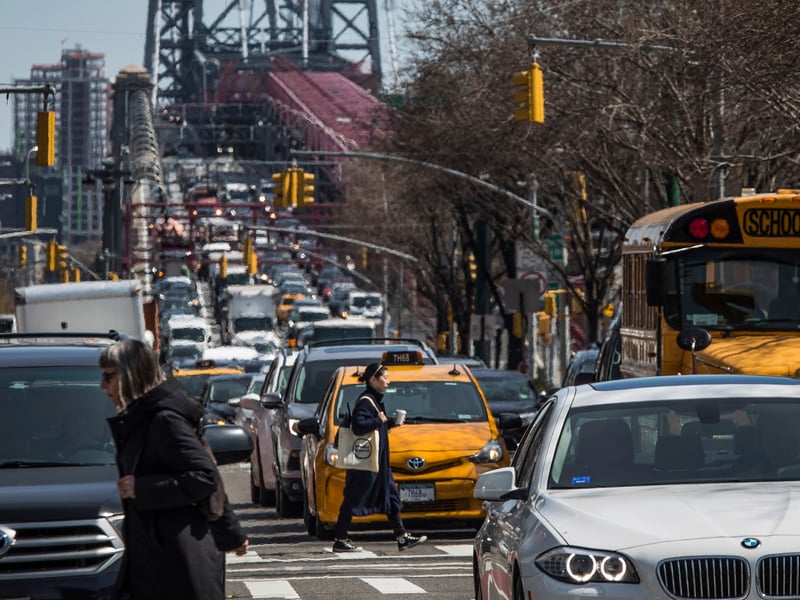
MANHATTAN (CN) — New York Governor Kathy Hochul on Thursday announced plans to relaunch Manhattan’s congestion pricing program less than six months after she unceremoniously put it on ice.
Hochul’s new plan, set to begin Jan. 5, 2025, includes a $9 toll for passenger cars driving south of 60th Street in Manhattan during peak traffic hours — down from the $15 price that was initially approved by the Manhattan Transit Authority to pump $15 billion into the aging transportation system.
At a press conference in Manhattan on Thursday, Hochul promised she can raise the same funds with the reduced fare.
“We’re still getting the $15 billion to fund the MTA and drivers are paying $6 less,” she said. “This lower toll will still allow us to accomplish all — and I mean all — of the goals of congestion pricing.”
Hochul took heat in June when she announced the indefinite halt on the program just weeks before its planned implementation. She claimed that the toll adds “another burden to working and middle class New Yorkers” in their efforts to financially recover from the Covid-19 pandemic.
The governor defended that decision Thursday: “$15 was too much,” she said.
“This lower toll will save daily commuters nearly $1500 annually, and that kind of money makes a big difference for our families, and there’ll be further discounts for low-income New Yorkers.”
Over the summer, critics accused Hochul of axing the toll for political reasons amid fears that Republicans could weaponize the program to win close races in New York City suburbs. Hochul vehemently denied those allegations.
The pause spawned several lawsuits against the governor with the goal of pressuring her to restart the program. One accused her of overstepping her legal authority by directing the MTA to ice the approved plan. Another claimed her decision violated environmental provisions in New York’s constitution.
Hochul’s deadline to respond to those two lawsuits is Friday; her Thursday announcement means she’ll be able to point to her new plan in those briefs.
Environmental lawyer Michael Gerrard, who coordinated those lawsuits alongside New York City Comptroller Brad Lander, told Courthouse News on Thursday that Hochul’s new plan will likely be the end of those suits.
“I think we will have achieved our objective,” Gerrard said.
The plaintiffs’ attorneys in both cases didn’t comment on the status of the suits. Lander’s office didn’t comment on the status of the lawsuits either, but said in a statement that Hochul’s announcement is a “long-awaited win for millions of hardworking straphangers who ride the subway every day.”
“We brought our lawsuits to ensure that congestion pricing would go into effect as required by law – and it couldn’t come at a more urgent time,” Lander said. “If we don’t get the system in operation before Donald Trump becomes president, we’ll lose $15 billion in critical transit investments that we’ll never see again.”
Trump, who became president-elect last week after defeating Democrat Vice President Kamala Harris in the race for the White House, has vowed to “terminate” congestion pricing his first week back in office. He told the New York Post on Thursday that he “strongly disagree[s]” with Hochul’s revival of the program, which he called “the most regressive tax known to womankind.”
Earlier this week, House Republicans penned a letter to Trump, begging him to kill the program when he takes office in 2025.
But the planned start date of early January will make it very difficult for Trump to end the program, since it presumably would have gained approval from the Federal Highway Administration before his return to the White House.
“It’s conceivable that he might say to the state, ‘You need to shut this down,’ in which case I think the state would refuse and we might be back in court,” Gerrard said. “Because it’s not clear what legal authority he would have to do that.”
Hochul is still fighting numerous lawsuits from plaintiffs on both sides of the congestion pricing debate, including one from the mayor of Fort Lee, New Jersey, who wants Hochul to scrap the program completely.
Congestion pricing was signed into law in 2019 when then-Governor Andrew Cuomo approved it in the state’s budget. The program, a form of which exists in other large cities like London, Singapore and Stockholm, is slated to reduce traffic and pollution in New York City’s busiest streets while raising much-needed funds for the city’s transit system.
 Follow @Uebey
 Follow @uebey.bsky.social
Subscribe to our free newsletters
Our weekly newsletter Closing Arguments offers the latest about ongoing trials, major litigation and rulings in courthouses around the U.S. and the world, while the monthly Under the Lights dishes the legal dirt from Hollywood, sports, Big Tech and the arts.