
 Search Articles


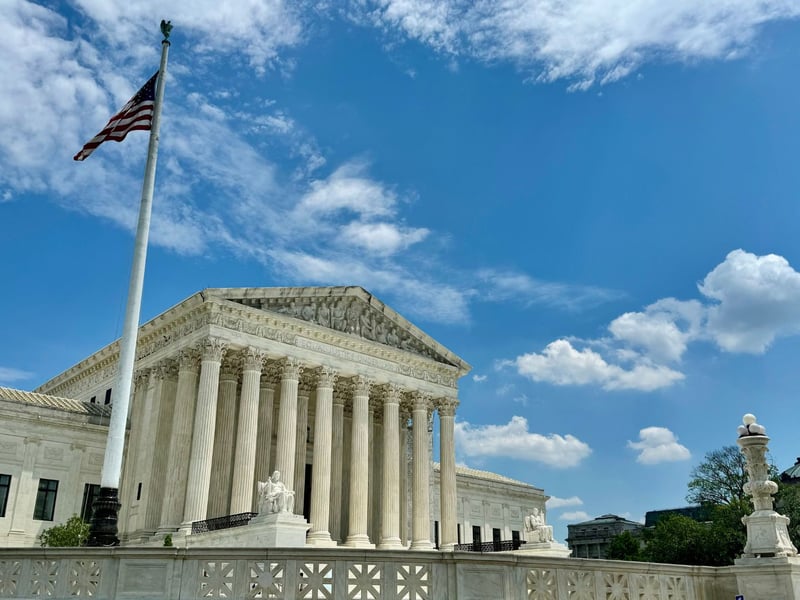
WASHINGTON (CN) — The Supreme Court ruled Wednesday against**** two veterans who were denied post-traumatic stress disorder disability benefits by the Department of Veterans Affairs.
In a 7-2 opinion, the high court held that when the U.S. Court of Appeals for Veterans Claims reviews benefit decisions by the Department of Veterans Affairs, it should treat it like any other determination.
Justice Clarence Thomas, a George H.W. Bush appointee, wrote in the court’s opinion that when the veteran appeals court applies the long-standing “benefit of the doubt” rule, meant to give leeway to veterans challenging benefits decisions, it only needs to look for clear errors by the VA to comply with the rule.
The rule comes into play when there is an “approximate balance” between evidence in favor and against a veteran’s claim. Otherwise, the party with more persuasive evidence comes out on top.
Thomas said the balancing test is mainly a factual issue, rather than a legal one as the veterans argued, and is at most a mix of the two. Therefore, the veteran appeals court’s decisions should receive some deference.
Thomas was joined by Chief Justice John Roberts and Justices Samuel Alito, Sonia Sotomayor, Elena Kagan, Brett Kavanaugh and Amy Coney Barrett.
During his Air Force service from 2005 to 2006, Joshua Bufkin’s wife began having mental health problems that affected his training, including threatening to commit suicide if he did not leave the military.
Officials gave Bufkin an ultimatum: divorce his wife or take a general discharge and leave under hardship. Bufkin chose the latter. Several years after his departure, he sought disability compensation for PTSD connected to his military service.
Veterans Affairs denied his benefits claim. On appeal, the Board of Veterans’ Appeals found that the evidence against Bufkin overrode the application of the benefit-of-the-doubt rule.
The second veteran in the case, Norman Thornton, served in the Army from 1988 to 1991, deploying to Kuwait and Saudi Arabia to provide advanced first aid and lifesaving procedures to injured soldiers. A Veterans Affairs physician diagnosed Thornton with PTSD, but the agency concluded that he only met the criteria for a 50% disability evaluation.
The Board of Veterans’ Appeals similarly denied Thornton’s appeal, and the veteran appeals court affirmed the VA’s determination, finding found no clear error in the board’s approximate balance decision. They appealed again to the Federal Circuit Court of Appeals, which rejected their arguments, as did the Supreme Court.
Melanie Bostwick, of Orrick Herrington and representing the veterans, wrote in her petition to the high court that the benefit of the doubt rule was a reflection of the respect owed to veterans.
“This standard of proof, unlike any other in civil or criminal litigation, reflects a core societal judgment that it is better to err on the side of providing benefits to those who sacrificed their own interests on behalf of the nation,” Bostwick said.
Justice Ketanji Brown Jackson, a Joe Biden appointee, dissented and was joined by Justice Neil Gorsuch, a Donald Trump appointee.
Jackson roundly rejected the majority’s interpretation of the statute creating the rule and governing its application, particularly a reading that a section instructing the veterans court to “take due account” of the rule simply required courts to proceed as normal.
“Reading the provision in that fashion, as the majority does, makes little sense,” Jackson said.
She disagreed with the majority’s finding that the clear error standard was appropriate, as the VA’s application of the veteran-friendly rule was a legal, not factual, question.
“In short, the court today concludes that Congress meant nothing when it inserted [take due account] in response to concerns that the Veterans court was improperly rubber-stamping the VA’s benefit-of-the-doubt determinations, and also that the Veterans court is not obliged to do anything more than defer to those agency decisions notwithstanding Congress’s ‘take due account’ direction,” Jackson said.
Attorneys for the veterans and the government did not respond to requests for comment.
 Follow @KelseyReichmann
 Follow @kelseyreichmann.bsky.social
Subscribe to our free newsletters
Our weekly newsletter Closing Arguments offers the latest about ongoing trials, major litigation and rulings in courthouses around the U.S. and the world, while the monthly Under the Lights dishes the legal dirt from Hollywood, sports, Big Tech and the arts.