
 Search Articles


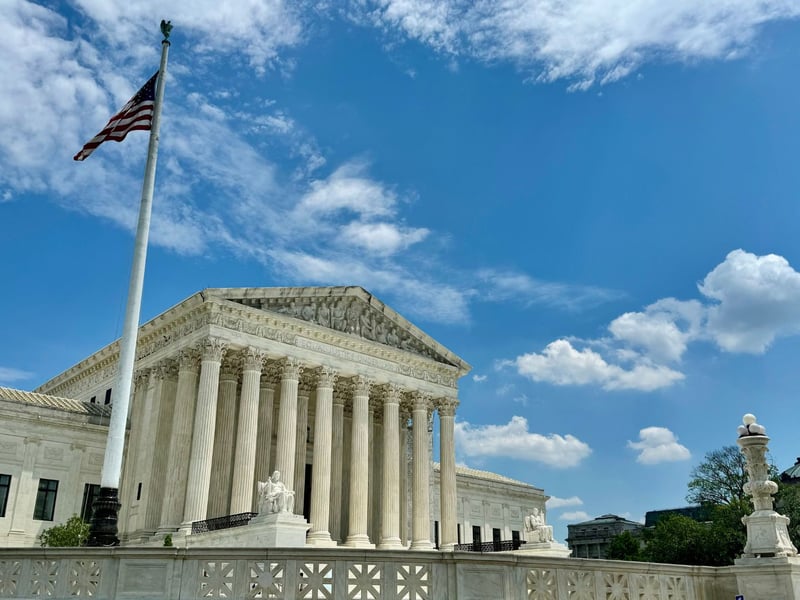
WASHINGTON (CN) — The Supreme Court shelved challenges over gun laws and administrative authority Monday, delaying two major conflicts stemming from the justices’ landmark rulings in recent terms.
Instead of taking on the next frontier of firearms regulations, the justices tossed a highly anticipated review of prohibitions on gun ownership for felons. Lorenzo Garod Pierre asked if criminal defendants could challenge a federal law barring them from owning a firearm using the court’s 2022 ruling, New York State Rifle & Pistol Association v. Bruen .
The question has split the lower courts, resulting in several petitions for the court’s review. Pierre urged the justices to refute claims that Congress disarmed all convicted felons.
“This substantive position advanced by the United States — which would disarm all individuals based on status alone — has no analogous principle in the relevant historical record and is starkly wrong,” Pierre wrote.
The court sent Pierre’s case back down to the 11th Circuit for review under their most recent Second Amendment ruling, United States v. Rahimi . In June, the justices said individuals who post a credible threat to physical safety can be temporarily disarmed without violating the Second Amendment.
Rahimi is unlikely to settle the question, however. Pierre predicted in his petition that the justices would eventually have to intervene.
“Petitioner agrees with the United States that this fundamental legal question continues to divide the circuits, and that this court’s decision in Rahimi — which concerned a facial challenge to Section 922(g)(8) — does not resolve the split; rather, ‘the present conflict is unlikely to resolve itself without further intervention by this court,’” Pierre wrote.
The court also dodged another fight over federal agency authority, refusing to review whether independent consumer safety commissioners can be fired at will by the president.
Last term, the justices avoided the same question in Securities and Exchange Commission v. Jarksey. ** While the conservative majority sided with a hedge fund manager challenging agency judges, the justices did not reach questions over presidential authority over their employment.
Justice Brett Kavanaugh, a Donald Trump appointee, rejected an emergency appeal asking the same question last week.
This time, the Consumer Product Safety Commission was under attack. Congress created the board in 1972 to track consumer product harms and develop safety standards to reduce injury risks, which at the time impacted 20 million Americans.
Presidents appoint the five agency heads to seven-year terms, but the chief executive cannot remove commissioners except for neglect of duty or malfeasance in office.
According to advocacy organizations challenging the commission’s authority, their petition posed a seminal question for American democracy.
“This petition ‘tees up’ a question that goes to the heart of our system of government: Whether a federal agency may exercise substantial executive power while shielded from the President’s supervision and control,” Consumers’ Research and By Two wrote.
Consumers’ Research and By Two are conservative-leaning organizations that frequently file Freedom of Information Acts for the commission’s records. Consumers’ Research includes a “report woke” submission form to relay “companies who are going woke in order to distract from bad business practices.”
Because the groups do not make, sell or distribute consumer products, they are not regulated by the commission or subject to any enforcement action.
Consumers’ Research and By Two submitted an information request for drop-side cribs and voluntary safety standards by the American Society of Testing and Materials. The commission initially denied the request for safety standards, saying that the documents contained copyrighted material. The drop-side crib information was also delayed, leading the groups to file an administrative appeal.
Eventually, the commission provided all their requested documents at no charge, but the Consumers’ Research and By Two filed a lawsuit during the process, arguing that the commissioners’ removal restrictions were unconstitutional. A lower court ruled in their favor but a divided panel on the Fifth Circuit reversed.
Like felon possession of firearms, it’s likely questions over presidential firing power at federal agencies will return to the high court steps again.
 Follow @KelseyReichmann
 Follow @kelseyreichmann.bsky.social
Subscribe to our free newsletters
Our weekly newsletter Closing Arguments offers the latest about ongoing trials, major litigation and rulings in courthouses around the U.S. and the world, while the monthly Under the Lights dishes the legal dirt from Hollywood, sports, Big Tech and the arts.