
 Search Articles


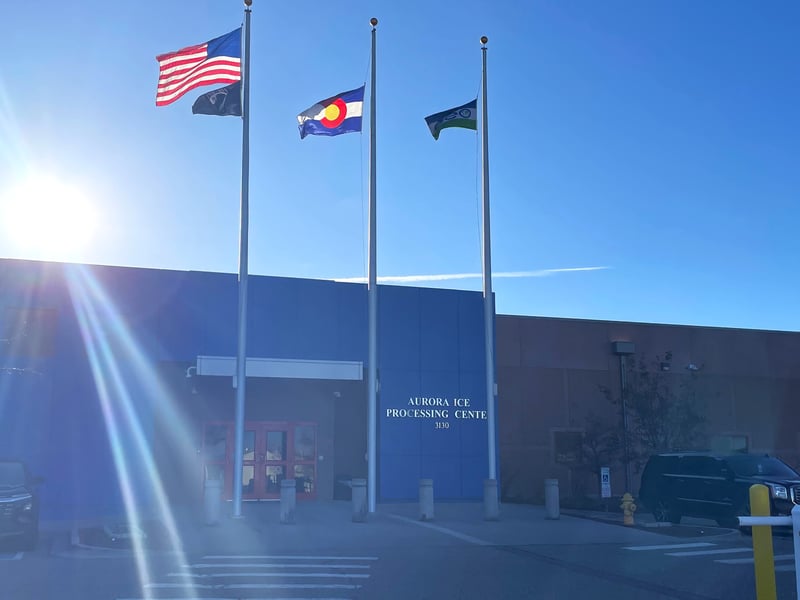
DENVER (CN) — A federal judge on Monday heard arguments from two Venezuelan migrants detained in Aurora, Colorado, requesting a temporary restraining order to bar their deportation under President Donald Trump’s use of the Alien Enemies Act to declare war on the foreign gang Tren de Aragua.
On Saturday, the U.S. Supreme Court issued a stay of removal for all migrants detained under the challenged executive order, prompting U.S. Judge Charlotte Sweeney in Denver to ask whether a restraining order was still warranted in the U.S. District of Colorado.
“ Petitioners ask that you extend the court’s existing April 14 order to preserve this court’s power to adjudicate this case,” the migrants’ attorney Timothy MacDonald, who practices with the American Civil Liberties Union of Colorado, told Sweeney.
Two Venezuelan men filed a class action against Trump and the U.S. Department of Homeland Security on April 12, claiming the federal government was misusing the Alien Enemies Act to deport migrants without due process.
One man referred to as D.B.U. is a 32-year-old father of two who entered the U.S. to seek asylum from persecution in his home country where he faced retaliation due to his political activity. He was apprehended on Jan. 26, at a party characterized by Immigration and Customs Enforcement as “a Tren de Aragua party,” even though D.B.U. says he is not a member of the gang and has a single tattoo, of his niece’s name.
Twenty-five-year-old R.M.M. has two children and said in the petition that he sought asylum in the U.S. after Tren de Aragua killed two of his family members in Venezuela. In the complaint, R.M.M. said his tattoos are significant to his family and faith, not the gang.
On the campaign trail last year, Trump amplified claims stemming from a series of TikTok videos that Venezuelan gangs had taken over Aurora, Colorado, generating support for his proposed increase in deportations. Trump began carrying out the campaign promise with a March 15 executive order deploying the rarely used Alien Enemies Act to declare the gang Tren de Aragua a foreign enemy, authorizing deportation of “all Venezuelan citizens 14 years of age or older who are members of TdA.”
In their lawsuit, D.B.U. and R.M.M. claim the Trump administration is misusing the 1798 law that gives the president the power to deport foreigners in times of war or invasion. This marks the fourth time in the nation’s history that the Alien Enemies Act has been used, with past presidents deploying the law during the War of 1812 and both world wars.
President Franklin D. Roosevelt notoriously used the Alien Enemies Act in 1941 to intern Japanese noncitizens along with Americans in concentration camps through the duration of World War II.
The March deportation of 127 men to a notorious prison in El Salvador, including legal U.S. resident Kilmar Armando Abrego Garcia, prompted the U.S. Supreme Court to issue an order declaring that individuals be given notice and a chance to challenge their removal through the habeas corpus process.
After migrant detainees were moved from a detention center in Pennsylvania, where a temporary restraining order prevented deportation, to a detention center in northern Texas where there was no restraining order in place, ACLU attorneys filed an appeal to the U.S. Supreme Court on Friday requesting a stay of deportation across the class.
The high court on Saturday issued an unsigned order preventing the removal of detainees challenging deportation under the Alien Enemies Act pending a Fifth Circuit appeal.
In light of the Supreme Court’s recent flurry of rulings, U.S. Attorney Michael Velchik argued D.B.U. and R.M.M. are not currently facing removal under the Alien Enemies Act so Sweeney lacks jurisdiction to review their case.
MacDonald countered that the possibility and swiftness of removal still warranted an extension of an April 14 restraining order.
Sweeney pressed the U.S. attorney for a commitment that the government would not prosecute the migrants under the Alien Enemies Act if she lifted the restraining order.
“It would be a grave consequence if I deny the temporary restraining order, and in two days you find the petitioners are alien enemies subject to removal,” the Joe Biden appointee said.
Velchik declined to make such a pledge and instead urged the court to allow the government to simply enforce immigration law.
“I’m not sure it would be appropriate to permanently immunize these two petitioners,” Velchik said.
Sweeney also scrutinized a notice written in English being provided to Spanish-speaking detainees to inform them of pending removal. The federal judge analyzed two timelines suggested as appropriate notice before removal as well — MacDonald said migrants should get at least 30 days to contest their removal, about the same time given to Nazis during World War II, while Velchik suggested 24 hours would suffice.
Sweeney did not indicate whether she would grant an extended restraining order or thought she could maintain jurisdiction over the case, but promised a written ruling within 24 hours.
 Follow @bright_lamp
Subscribe to our free newsletters
Our weekly newsletter Closing Arguments offers the latest about ongoing trials, major litigation and rulings in courthouses around the U.S. and the world, while the monthly Under the Lights dishes the legal dirt from Hollywood, sports, Big Tech and the arts.