
 Search Articles


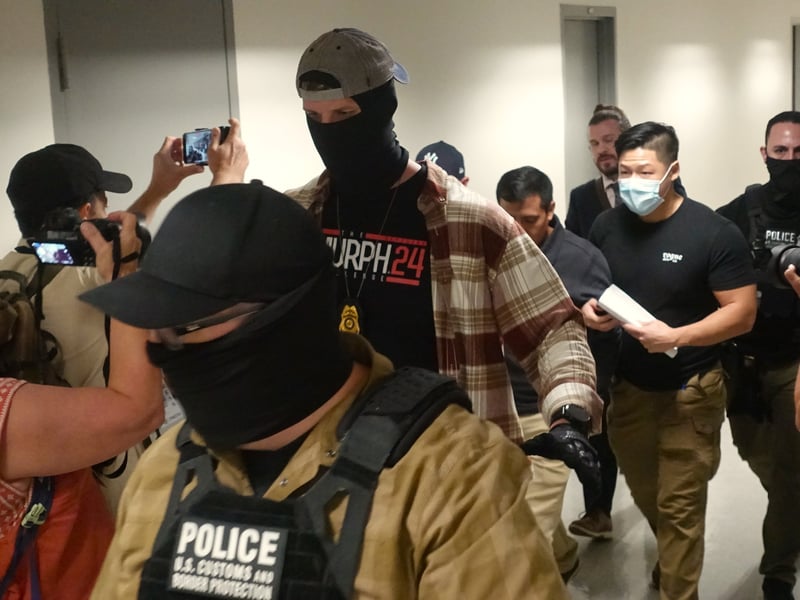
MANHATTAN (CN) — Millions of people saw the moments leading up to Maria Tumba Huamani’s ICE arrest in New York City.
On Sept. 30, the 20-year-old asylum-seeker from Peru was leaving her routine hearing at 26 Federal Plaza, Manhattan’s top immigration courthouse, where a judge had just set another asylum hearing for next year.
On her way out, three masked federal agents boarded the elevator alongside her. A photojournalist, amNY’s Dean Moses, tried hopping on too, but the officers swore at him and shoved him back into the hallway. In the scuffle, agents pushed two more reporters to the ground. One of them, L. Vural Elibol of Turkish news agency Anadolu Ajansi, appeared to hit his head on the way down and had to be hospitalized.
The moment went viral; tensions between Immigration and Customs Enforcement agents and the numerous journalists documenting their scrutinized courtroom arrests at 26 Federal Plaza seemed to reach an explosive boiling point.
But what the cameras didn’t capture that day was what happened to Huamani after the elevator doors closed.
“They took her papers from my hands and they told me to leave,” Elizabeth, Huamani’s close friend and neighbor who she calls an aunt, told Courthouse News via a Spanish translator. “We didn’t say anything. We were kind of in shock because we saw what happened with the reporters.”
Elizabeth, who asked to be identified only by her first name, escorted Huamani to her immigration hearing that day. She can be seen standing next to Huamani in the elevator in the now-viral video of the moments leading up to her arrest.
Elizabeth hasn’t seen Huamani since.
Communication with Huamani has been scarce, Elizabeth said. After her arrest, Huamani was briefly detained in 26 Federal Plaza’s makeshift ICE jail, nestled just two floors below the immigration courtrooms, before getting shipped off to Louisiana — unbeknownst to her mom and Elizabeth, who said they didn’t hear from her for a week.
Huamani entered the United States with her mother in 2024. In addition to her asylum claim, she’s seeking Special Immigrant Juvenile Status, a form of humanitarian relief for minors who have suffered abuse, neglect or abandonment by a parent that could grant her permanent residency.
That process has been stunted due to her arrest, according to Huamani’s lawyers. But more than 30 days in federal lockup has also taken a personal toll on Huamani, who Elizabeth described as “always happy,” “very educated” and “very caring,” at home in New York City.
“She’s not doing well,” Elizabeth said, adding that Huamani’s presence is missed daily by her family in the city. “We can’t live our normal lives. It’s hard to explain, everything is upside down … We just want her home.”
It’s a “race against time,” according to her lawyer, Harold Solis of immigrant rights firm Make the Road New York.
Solis is representing Huamani in a habeas corpus petition in Manhattan’s federal court, which challenges her arrest as unconstitutional and seeks her immediate release so she can continue to pursue her asylum claim. Since Huamani has no criminal history and no demonstrated flight risk, Solis claims the government lacks justification to continue detaining her.
Several judges in the Southern District of New York have been sympathetic to similar arguments. On Oct. 19, U.S. District Judge Analisa Torres, a Barack Obama appointee, ordered the release of Colombian asylum-seeker and father of two Wagner Carabello Gonzalez, who she said was jailed “pursuant to its policy of arbitrary detention without affording him notice or opportunity to be heard.”
Earlier this week, U.S. District Judge Arun Subramanian slammed the government for detaining a Venezuelan asylum-seeker — referred to only as J.G.O. in court papers — for more than nine months, nearly deporting him to Salvadoran megaprison CECOT, all for the ultimately unfounded claim that J.G.O. was a member of the Tren de Aragua gang.
“J.G.O.’s detention has been improperly prolonged by a constantly moving set of goalposts. That ends now,” the Joe Biden appointee wrote in the case docket on Tuesday, ordering the man to be released.
But for every release order, there are dozens of pending habeas petitions from ICE prisoners, mostly other asylum-seekers, asking for their freedom before their removals get expedited and they’re deported by the immigration system.
“It’s quite normal for detained cases to move a lot quicker than non-detained cases in the immigration court system,” Solis said. “It’s a race against time for all of them, but also for Maria.”
And federal judges are now dealing with an unprecedented amount of habeas petitions from ICE prisoners, due to the Trump administration’s mass nationwide deportation campaign.
In the past month alone, there have been 24 habeas petitions filed in the Southern District of New York filed by noncitizens challenging their arrests by immigration authorities. In all of 2024, fewer than five of those cases hit the docket in the district.
The result is federal judges being asked to weigh in on immigration issues more than ever before, often with little road map to do so. In Manhattan, Huamani has drawn U.S. District Judge Lewis Liman, a Donald Trump appointee who has overseen high profile cases ranging from New York’s congestion pricing battle to Blake Lively’s ongoing civil suit against Justin Baldoni.
Liman released another habeas petitioner this week, a green-card holder from the Dominican Republic, who the judge ruled was unlawfully detained by ICE for a criminal history, despite his status as a lawful permanent resident.
But Huamani’s case remains pending, with no hearing date set. As each day passes without a release order, the risk of Huamani getting marked for removal grows.
“It’s certainly not in Maria’s best interest to have an immigration judge down south to order her removed while she’s still pursuing [Special Immigrant Juvenile Status] and while we’re trying to litigate her habeas petition up here in New York,” Solis said.
Unwilling to relive that day, Elizabeth still hasn’t watched the dramatic video of the moments leading up to Huamani’s arrest.
“I don’t feel brave enough,” she said.
Meanwhile, asylum-seekers like Huamani continue to get swept up by federal officers at immigration courts around the country, bucking a longstanding ICE tradition to steer clear of courthouses to avoid discouraging attendance at mandatory hearings.
Aware of this trend under the second Trump administration, Elizabeth acknowledged that she was worried as she walked Huamani into court last month.
“We went there afraid,” she said. “But we needed to go. We needed to do the right thing. She had an appointment.”
 Follow @Uebey
 Follow @uebey.bsky.social
Subscribe to our free newsletters
Our weekly newsletter Closing Arguments offers the latest about ongoing trials, major litigation and rulings in courthouses around the U.S. and the world, while the monthly Under the Lights dishes the legal dirt from Hollywood, sports, Big Tech and the arts.