
 Search Articles


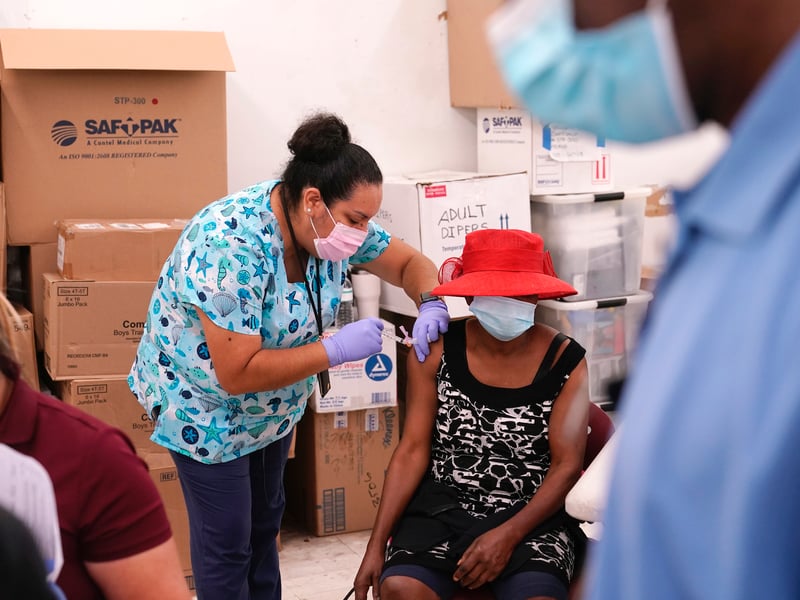
(CN) — More than one-third of Americans find themselves unable to afford health care when they need it, according to a survey that highlights the growing medical affordability crisis in the United States.
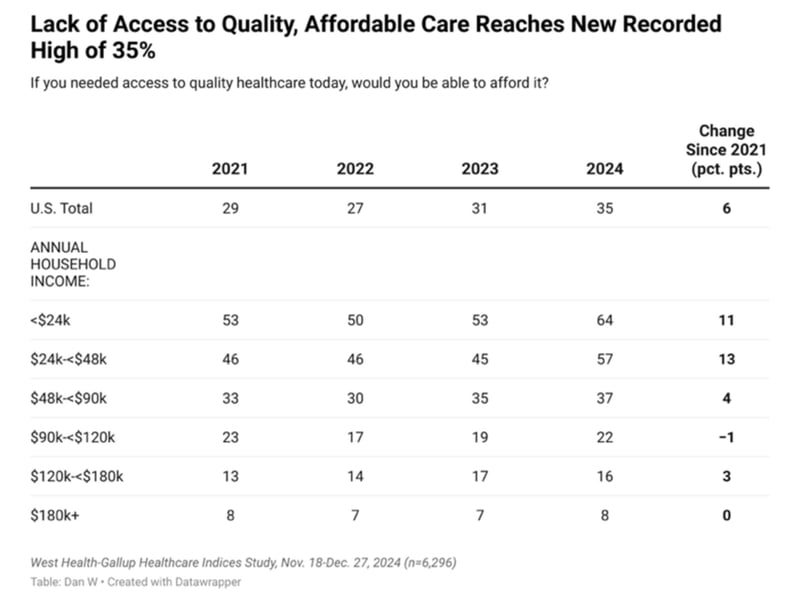
The latest West Health-Gallup Healthcare Affordability Index, released Tuesday, suggests that 35% of Americans — representing an estimated 91 million people — could not access quality health care if needed today. This figure marks the highest level recorded since the organizations began tracking health care affordability in 2021.
The burden falls particularly heavily on communities of color, with nearly half of Black Americans (46%) and more than half of Hispanic Americans (52%) reporting inability to afford quality health care.
According to West Health and Gallup, lower-income households have experienced the most dramatic deterioration in health care access. Among Americans earning less than $24,000 annually, 64% now report difficulties affording care — an 11-point surge from 2023. Similarly, households with incomes between $24,000 and $48,000 saw a 12-point jump to 57% facing affordability challenges.
Health care policy experts view these trends with growing concern.
“The rising trajectory in the inability to pay for health care is a disturbing trend that is likely to continue and even accelerate,” Tim Lash, president of West Health Policy Center said in a press release. “Policy action at both the state and federal level is urgently needed, or even more Americans will have to go without treatment or be forced to make painful tradeoffs between paying for medical care or paying for other necessities. The human and economic costs are enormous.”
The index categorizes Americans into three groups based on their health care security. Those considered “Cost Secure” — 51% of Americans — faced no recent difficulty accessing or affording care or medications.
The “Cost Insecure” have recently been unable to access care or afford either care or medications. And a record 11% of Americans — approximately 29 million people — are now classified as “Cost Desperate,” meaning they were recently unable to access care and afford care and prescription medicine.
Hispanic adults have experienced the steepest decline in health care security over the four-year tracking period, dropping 17 percentage points to just 34% now considered “Cost Secure.” Black adults saw a 13-point decline to 41%.
The data reveals a widening health care divide along both racial and economic lines. While Hispanic adults (up eight points to 18%), Black adults (up five points to 14%), and lower-income households (up 11 points to 25%) have seen significant increases in those classified as “Cost Desperate,” White adults and middle-to-high-income Americans have remained relatively insulated from these trends.
Age also plays a factor; Americans under 50 experienced just a four-point increase to 14% in the “Cost Desperate” category, while those 65 and older saw only a slight one-point increase to 4%.
“Health care affordability and access continue to erode nationally, and this issue is especially acute among Black, Hispanic, and lower-income adults. White adults and those in higher-income households, in contrast, remain largely insulated from these worsening trends,” Dan Witters, senior researcher at Gallup said via a written statement. “Among these groups, this is the widest gap in access to care we have recorded thus far, with many Americans experiencing increased hardship year over year.”
The survey was conducted between November 18 and December 27, 2024, including 6,296 adults across the country. The survey has a margin of error of 1 to 1.6%.
The news comes as members of Congress from both sides of the aisle take aim at Medicare and Medicaid reform. While some lawmakers push for stricter eligibility requirements and spending reductions to curb rising federal spending, others advocate for expanded coverage and lower prescription drug costs to ease the financial burden on vulnerable populations.
 Follow @JeremyYurow
Subscribe to our free newsletters
Our weekly newsletter Closing Arguments offers the latest about ongoing trials, major litigation and rulings in courthouses around the U.S. and the world, while the monthly Under the Lights dishes the legal dirt from Hollywood, sports, Big Tech and the arts.