
 Search Articles


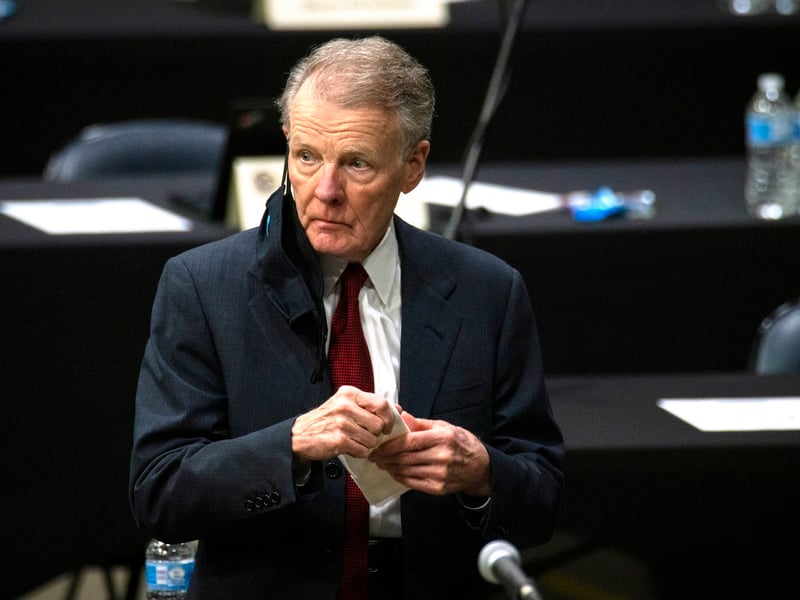
CHICAGO (CN) — Ed Moody, a former Cook County commissioner, Cook County recorder of deeds and Chicago 13th Ward precinct captain, took the stand Wednesday in the ongoing federal corruption trial of ex-Illinois House Speaker Mike Madigan. His testimony gave the jury a look into how Madigan’s political network in Chicago operated.
Moody testified that he began working in politics in Chicago in the early 1990s alongside his brother Fred. The brothers met Madigan in 1989 or 1990, Moody said, and they earned a reputation as effective political canvassers during the 1992 elections. Madigan’s political office in Chicago’s 13th Ward — which overlapped with his state legislative district — made them local precinct captains, charged with turning out Democratic votes. By 1994, Moody said he and his brother were training other Democratic political workers, and that Madigan attended their training seminars.
Moody stayed active in Chicago Democratic politics for more than two decades afterward, and said he landed a court coordinator job with the Cook County court system in 1993 with Madigan’s help. He kept that gig for 23 years, and was appointed a Cook County commissioner in October 2016 to fill a recent vacancy. He served in that role for two years before becoming Cook County recorder of deeds, a now-abolished position, from December 2018 to December 2020.
Through it all, he credited Madigan as his patron.
“He’s my political leader,” Moody said of Madigan on Wednesday.
Moody is one of multiple Madigan associates who prosecutors say received payments from energy company ComEd between 2011 and 2019, in exchange for Madigan’s support of ComEd’s agenda in the Illinois legislature. Rather than receiving the payments directly, prosecutors say other people in Madigan’s Chicago network became subcontractors for consulting and law firms that were also owned by Madigan allies.
ComEd would contract with the firms, and the firms would pay Moody and Madigan’s other Chicago associates. Jurors saw evidence to that effect earlier in the trial, and saw more evidence again Wednesday — including invoices Moody sent to different firms between 2012 and 2018.
Moody told jurors as much on Wednesday. He laid out his history with the firms, starting in 2011 when he says he went to Madigan looking for work that would pay an extra $45,000 per year. Moody said that, after some hurt feelings over Madigan not initially getting back to him on the issue, the speaker eventually set him up with a subcontractor position under Mike McClain’s law firm Awerkamp & McClain.
At the time, McClain was a ComEd contract lobbyist. He was once among Madigan’s closest allies, and is now the ex-speaker’s codefendant in this trial. He is also among the “ComEd” Four convicted on separate but related charges in May 2023.
Moody was on McClain’s payroll from April 2012 to February 2014. Jurors saw invoices showing Moody billed McClain for as much as $4,500 per month, but he clarified that he spent, at most, a few hours per month doing any ComEd-related work for that money. What little he did in that regard, Moody said, consisted of calling state representatives and telling them to contact McClain with any concerns they had regarding the energy company. He also testified that in 2013 he did some customer door-knocking work on ComEd’s behalf.
Both Madigan and McClain, Moody testified, were aware of how cushy a set-up this was.
“He said it was one hell of a plum and I owed the speaker big,” Moody said McClain told him.
Madigan, Moody said, explicitly called it a reward.
“This is how I reward my good soldiers,” Moody claims Madigan said.
Moody’s subcontractorship jumped from McClain’s law firm to a consulting firm owed by Madigan ally Jay Doherty in March 2014, from Doherty to a lobbying firm owned by former Madigan staffer Shaw Decremer in November 2016, and from Decremer to a law firm owned by Madigan ally John Bradley in March 2018. The checks finally stopped at the end of 2018, and in May 2019 the FBI searched the homes of Moody, McClain, Doherty and others as part of the corruption investigation into ComEd.
Through it all, Moody said he did little if any work benefitting ComEd, despite his contracts with the firms stating that was part of his responsibilities. Instead, he continued to do political work for Madigan and the Democratic party on Chicago’s southwest side — he even testified he believed his checks from Madigan’s allies depended on him staying politically active.
He says Madigan told him doing political work was good for ComEd, when the pair ran into each other in 2018. At the time, Moody says he was canvassing Madigan’s neighborhood ahead of the 2018 elections. He expressed concern to the speaker that he wasn’t doing much actual work for Bradley.
“What you’re doing right now is what I want, what he wants, what ComEd wants,” Moody said Madigan told him.
Moody is one of the last witnesses the government plans to call in the “ComEd episode” of charges against Madigan. Four other episodes remain; the former speaker faces 23 bribery, fraud, conspiracy and racketeering charges in total. Trial is expected to last through the new year.
 Follow @djbyrnes1
Subscribe to our free newsletters
Our weekly newsletter Closing Arguments offers the latest about ongoing trials, major litigation and rulings in courthouses around the U.S. and the world, while the monthly Under the Lights dishes the legal dirt from Hollywood, sports, Big Tech and the arts.