
 Search Articles


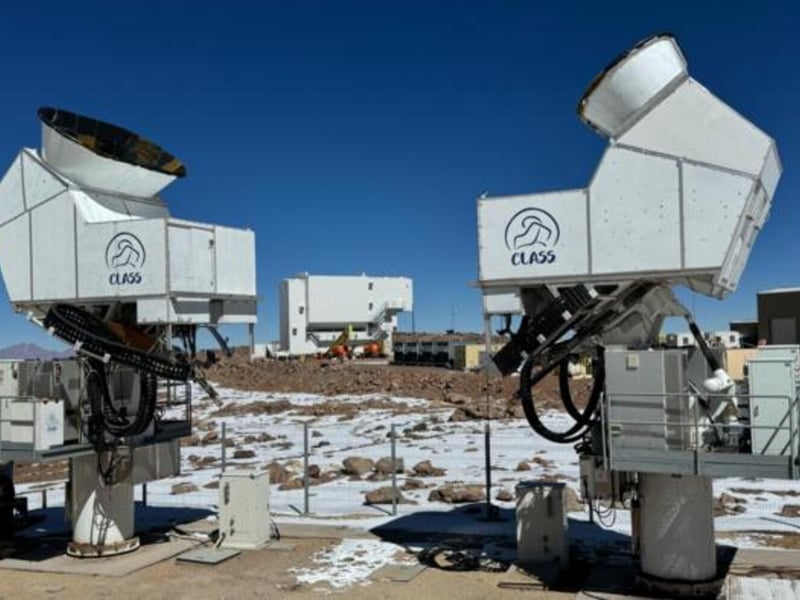
(CN) — High in Chile’s Andes Mountains, telescopes have captured whispers from the universe’s first stars — signals so faint they are a million times weaker than the already dim cosmic microwaves that fill space.
The research represents the first time ground-based observations have captured signals from the Cosmic Dawn, according to Tobias Marriage, project leader and Johns Hopkins professor of physics and astronomy.
“People thought this couldn’t be done from the ground,” Marriage said in a statement. “Astronomy is a technology-limited field, and microwave signals from the Cosmic Dawn are famously difficult to measure.”
The breakthrough came from the U.S. National Science Foundation’s Cosmology Large Angular Scale Surveyor, or CLASS, project telescopes. The instruments were uniquely designed to detect the fingerprints left by the first stars in relic Big Bang light — a feat previously accomplished only by space-based technology like NASA’s Wilkinson Microwave Anisotropy Probe and the European Space Agency’s Planck telescope.
The cosmic microwaves are mere millimeters in wavelength and extremely faint, with polarized signals about a million times fainter still. On Earth, broadcast radio waves, radar and satellites can drown out these delicate signals, while atmospheric changes, weather and temperature fluctuations add further distortion.
“Ground-based observations face additional challenges compared to space,” Marriage said. “Overcoming those obstacles makes this measurement a significant achievement.”
The research team, led by Johns Hopkins University and the University of Chicago, solved this problem by comparing CLASS telescope data with information from the Planck and WMAP space missions. This comparison allowed them to identify interference and isolate a common signal from polarized microwave light.
First author Yunyang Li, who conducted the research as a Johns Hopkins Ph.D. student and University of Chicago fellow, explained the polarization concept in accessible terms.
“When light hits the hood of your car and you see a glare, that’s polarization. To see clearly, you can put on polarized glasses to take away glare,” Li said. “Using the new common signal, we can determine how much of what we’re seeing is cosmic glare from light bouncing off the hood of the Cosmic Dawn, so to speak.”
The measurements provide insights into a pivotal moment in cosmic evolution. After the Big Bang, the universe existed as a dense fog of electrons that trapped light energy. As the universe expanded and cooled, protons captured these electrons to form neutral hydrogen atoms, finally allowing microwave light to travel freely through space.
During the Cosmic Dawn, the first stars’ intense energy ripped electrons free from hydrogen atoms once again. The research team measured the probability that photons from the Big Bang encountered these freed electrons while traveling through clouds of ionized gas, causing them to scatter off course.
“Measuring this reionization signal more precisely is an important frontier of cosmic microwave background research,” said Charles Bennett, a Bloomberg Distinguished Professor at Johns Hopkins who led the WMAP space mission. “For us, the universe is like a physics lab. Better measurements of the universe help to refine our understanding of dark matter and neutrinos, abundant but elusive particles that fill the universe.”
The research builds on work published last year showing CLASS telescopes successfully mapped 75% of the night sky, further validating the team’s innovative approach.
“No other ground-based experiment can do what CLASS is doing,” said Nigel Sharp, program director in the NSF Division of Astronomical Sciences, which has supported CLASS since 2010. “The CLASS team has greatly improved measurement of the cosmic microwave polarization signal, and this impressive leap forward is a testament to the scientific value produced by NSF’s long-term support.”
The study, titled A Measurement of the Largest-Scale CMB E-mode Polarization with CLASS, was published June 11 in The Astrophysical Journal.
 Follow @JeremyYurow
Subscribe to our free newsletters
Our weekly newsletter Closing Arguments offers the latest about ongoing trials, major litigation and rulings in courthouses around the U.S. and the world, while the monthly Under the Lights dishes the legal dirt from Hollywood, sports, Big Tech and the arts.