
 Search Articles


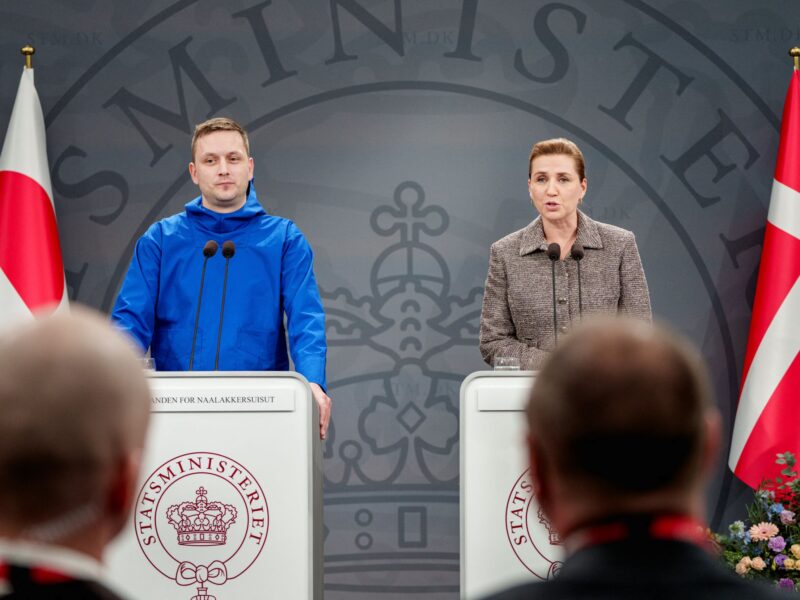
COPENHAGEN, Denmark (CN) — Greenland’s Prime Minister Jens-Frederik Nielsen fronted the press in Copenhagen with crystal clear messages likely to reach Washington on Tuesday.
“There’s one thing everyone must understand: Greenland does not wish to be owned by the U.S. Greenland does not wish to be controlled by the U.S. Greenland does not wish to become part of the U.S. We choose the Greenland we know today, which is part of the Kingdom of Denmark,” Nielsen told reporters, accompanied by his Danish counterpart Mette Frederiksen.
Tuesday’s news conference follows a week of increasing pressure from the United States over President Donald Trump’s interest in acquiring Greenland, a self-governing Arctic territory within the Danish Commonwealth.
It was initially announced that only U.S. Secretary of State Marco Rubio was scheduled to meet Danish Foreign Minister Lars Løkke Rasmussen and his Greenlandic counterpart, Vivian Motzfeldt, on Wednesday to discuss the situation that has put the EU and NATO on edge. Trump has refused to rule out using military intervention to take over the world’s largest island from long-term ally Denmark.
Now, Vice President JD Vance will lead Wednesday’s talks, moving the meeting into the White House, Rasmussen told the press early Tuesday.
“We stand together in the Kingdom of Denmark,” Nielsen said before addressing the upcoming discussions with the U.S. “We enter the room together, we exit together and we talk with the Americans together."
Trump has repeatedly stated that the U.S. needs to obtain Greenland for security purposes. The Arctic Island obstructs the shortest Russian missile path to Washington. Additionally, melting ice in the region creates opportunities for efficient shipping lanes and the extraction of rare minerals, which China also eyes.
Agreements between Denmark and the U.S. already ensure access for stationing American bases in Greenland, as long as the Danish Commonwealth is briefed. Denmark and other EU countries already agreed on upscaling defense in the Arctic region, partly to meet American security concerns.
“It has not been easy to stand against this unacceptable pressure from our closest ally,” Frederiksen said. “But it seems like the toughest challenge still lies ahead of us.”
The prime minister noted that the situation reached beyond just “insults” to the Danish Commonwealth.
“It’s about a world where you can’t rearrange borders with power. Of which you can’t buy other people, and that small countries should not fear big countries,” she said.
It’s been around a year since Trump intensified his pursuit of acquiring Greenland. At that time, Frederiksen and her government were hesitant about how to respond to the approach, opting for a soft strategy to deescalate tensions — not just with the U.S., but also Greenland, which had demanded more respect from Denmark due to its colonial legacy.
This time around, Frederiksen’s rhetoric against Trump has taken another direction, said Troels Bøggild, lecturer at the Institute of Political Science at Aarhus University, in an email to Courthouse News.
“Mette Frederiksen has changed the strategy, as she now categorically refuses Trump’s takeover talks. Before, she tried talking the conflict down by highlighting cooperation with the U.S., but she now exhibits her direct opposition and even says that Trump jeopardizes the entire NATO alliance,” Bøggild said.
Additionally, Frederiksen’s stance against any U.S. takeover has attracted a boost of European support.
Europe pledges support, won’t detail plans
European leaders pledged Tuesday to defend Denmark’s sovereignty over Greenland but declined to specify what actions they would take if Trump follows through on threats to seize the territory by force.
“We stand firmly behind the territorial integrity and sovereignty of the Kingdom of Denmark, including Greenland,” German Defense Minister Boris Pistorius said at a press conference with EU foreign policy chief Kaja Kallas in Berlin.
When asked what Europe would do if Trump acted on his threats, Kallas said the situation would be “unprecedented in the history of NATO” but refused to discuss preparations publicly. “We are preparing, we are discussing, and we discuss the alternatives and the different options, but nothing in public.”
NATO Secretary General Mark Rutte, speaking at the European Parliament earlier Tuesday, similarly declined to address whether one ally threatening another would be acceptable. Asked the question repeatedly, Rutte refused to comment on “discussions between allies,” saying only that “there is no disagreement within the alliance” on protecting the Arctic. He echoed Trump’s claims about Russian and Chinese activity in the region and praised the president for pushing European defense spending increases.
The Greenland crisis has accelerated a broader German strategic shift away from reliance on the United States, according to Marina Henke, a professor at the Hertie School in Berlin. She pointed to Germany’s recent decision to redesign its Taurus cruise missile system to eliminate all American components, despite added cost and delays.
“They no longer want to depend on the United States, like nothing at all,” Henke said. “It’s not that we don’t want to end this relationship, but they’re ending it with us.”
While Europeans lack the military capacity to defend Greenland against U.S. action, Henke said any response would be “on the diplomatic, political, economic level” rather than military. She noted the EU treaty’s mutual defense provision “is frankly a joke” because the bloc has no real military capabilities of its own.
The EU’s top defense official, Andrius Kubilius, warned Monday that any U.S. military takeover of Greenland would mean “the end of NATO.” He called for Europe to create a permanent 100,000-strong military force, describing current EU armies as “27 bonsai armies” that are small, fragmented and poorly equipped.
Wednesday’s meeting in Washington between Vance, Rubio and the foreign ministers of Denmark and Greenland will provide the first direct diplomatic engagement on the dispute.
Courthouse News correspondent Lasse Sørensen is based in Copenhagen, Denmark.
Courthouse News correspondent Yuval Molina is based in Brussels, Belgium.
 Follow @LasseSrensen13
Subscribe to our free newsletters
Our weekly newsletter Closing Arguments offers the latest about ongoing trials, major litigation and rulings in courthouses around the U.S. and the world, while the monthly Under the Lights dishes the legal dirt from Hollywood, sports, Big Tech and the arts.