
 Search Articles


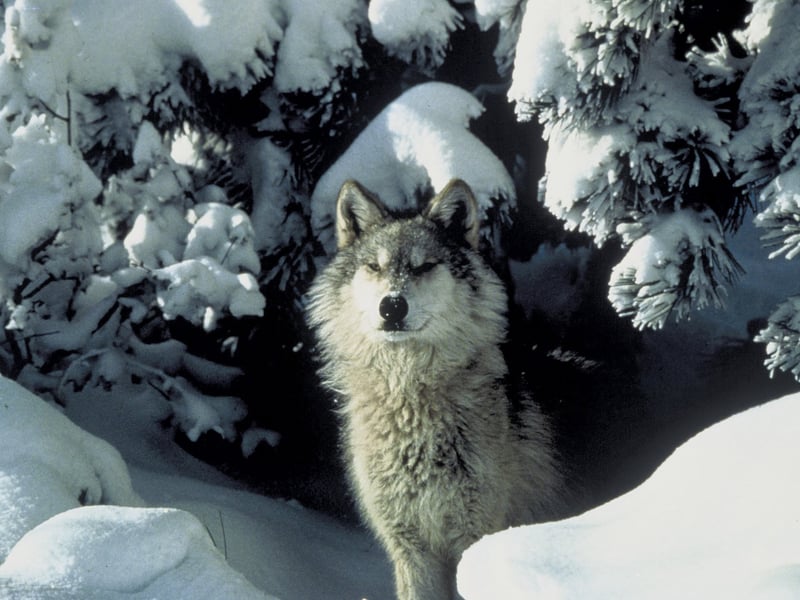
(CN) — Conservationists applauded a Tuesday ruling by a federal judge in Montana that struck down a U.S. Fish and Wildlife Service decision that denied Endangered Species Act protections for gray wolves in the West.
“With this court ruling comes the hope of true recovery for wolves across the West,” Collette Adkins, carnivore conservation director at the Center for Biological Diversity, said in a statement. “The judge rightly found that the Fish and Wildlife Service’s unambitious view of recovery violates the Endangered Species Act."
In a 105-page opinion issued Tuesday, U.S. District Judge Donald Molloy tossed U.S. Fish and Wildlife Service’s conclusion that the gray wolf in the Western United States doesn’t meet the definition of an endangered or threatened species.
“The service made numerous important assumptions regarding the future condition of the gray wolf without considering what would happen to the species if these conditions, either cumulatively or in isolation, were to change,” the Bill Clinton appointee wrote. “That decision was arbitrary and capricious given the outsized reliance on these assumptions to offset reduced wolf abundance in the future, which is a certainty.”
In 2009, the U.S. Fish and Wildlife Service removed the Northern Rocky Mountain’s gray wolf population from the Endangered Species Act’s list of threatened and endangered wildlife.
The Center for Biological Diversity, joined by Humane World for Animals, Humane World Action Fund and the Sierra Club, sued the U.S. Fish and Wildlife Service in 2024 over its denial of their petition to restore the federal protections. The court consolidated the case with two similar lawsuits from other conservation group coalitions, led by Western Watershed Project and Animal Wellness Action, both seeking federal protections for gray wolves.
The ruling represents a hopeful step toward protecting wolves, said Montana Director for Western Watersheds Project Patrick Kelly.
“These native carnivores have been subject to years of brutal, unscientific anti-wolf hysteria that has swept legislatures and wildlife agencies in states like Montana and Idaho,” Kelly said in a statement. “With Montana set to approve a 500 wolf kill quota at the end of August, this decision could not have come at a better time. Wolves may now have a real shot at meaningful recovery.”
The service had denied two 2021 petitions to restore protections for gray wolves in the Northern Rockies, covering Idaho, Wyoming, Montana, north-central Utah, and eastern Oregon and Washington.
Molloy found that, in denying the petitions, the service didn’t consider the historic range in its assessment of whether the Western distinct population segment of gray wolves meets the definition of endangered or threatened through a “significant portion of its range.”
Under the Endangered Species Act, the service is required to consider historical range, not just a species’ current or occupied range.
“While defendants may be correct that the [Endangered Species Act] does not protect the general wellbeing of a species, the [Endangered Species Act] is not a routine solution for ruinous wildlife management,” Molloy wrote.
The service also made “numerous unfounded assumptions regarding the future condition of the gray wolf despite recognizing either limitations on those conditions or bias in the population estimates utilized,” Molloy said.
The service erred when it relied on the assumption that Idaho and Montana would maintain wolf populations at 150 wolves per state, which Molloy said failed to consider what could happen if the state commitments were breached.
Plus, the service relied on Montana and Idaho’s population estimates without addressing criticism of those estimates, especially since the service was relying on those states’ promises to stop public harvest if the population dropped below 150, Molloy wrote.
“The service’s consideration of Idaho’s population estimates presents a mixed scientific bag,” Molloy said, later writing that Montana’s weren’t much better.
“We feel vindicated by today’s ruling. Anti-wildlife politicians in the Northern Rockies are managing wolves back to the brink of extinction, and it has to stop before the wolf population collapses under state management,” Lizzy Pennock, carnivore coexistence attorney at WildEarth Guardians, said in a statement.
A representative from the Fish and Wildlife Service declined to comment.
Subscribe to our free newsletters
Our weekly newsletter Closing Arguments offers the latest about ongoing trials, major litigation and rulings in courthouses around the U.S. and the world, while the monthly Under the Lights dishes the legal dirt from Hollywood, sports, Big Tech and the arts.