
 Search Articles


EDGARD, La. (CN) — A palpable relief rippled through a packed courtroom in Louisiana’s St. John the Baptist Parish on Thursday after a state judge ruled from the bench that descendants of slaves can move forward with their lawsuit challenging a zoning ordinance that would allow a $400 million massive industrial grain complex to be built along the Mississippi River.
Greenfield Louisiana LLC, a company that owns the land in question between New Orleans and Baton Rouge, had asked the court to dismiss a lawsuit brought by the Descendants Project, which is suing over the rezoning of land decades ago during deals that landed the then-president of the St. John the Baptist Parish council in jail on corruption charges.
“I believe there is a basis for plaintiffs’ claims,” Judge J. Sterling Snowdy said at the end of Thursday’s brief hearing.
Snowdy did not immediately issue his written judgment but said it would come in the next 10 days. He said one issue of concern is whether the statute of limitations on the claim has already passed.
Perhaps some of the relief that circulated through community members who were seated in the gallery of the courtroom came from the fact that throughout the hearing, Snowdy’s position on the suit was difficult to read.
At the outset, the judge asked attorney Louis Buatt of Liskow & Lewis, representing Greenfield, an intervenor in the suit siding with defendant St. John the Baptist Parish, not to give him any more background on the case.
“I am well aware of the arguments at hand,” Snowdy said, raising his hand to stop Buatt from continuing. “I don’t really need the background.”
“Well, the background is that the parish clearly has legal authority,” Buatt said, to rezone the tract of formerly residential land in question as industrial.
In response to Buatt’s insistence that the ordinance is not illegal, Pam Spees, senior staff attorney with the Center for Constitutional Rights representing the Descendants Project, said, “It doesn’t have to be that the ordinance is violating the law. It’s that the process itself is in violation of the law.”
Citing precedent, Spees said other courts including the U.S. Supreme Court would be able to see the fraud in allowing a zoning ordinance that was changed under fraudulent pretexts to stand.
The lawsuit stems from the 1996 rezoning of a large tract of rural land to industrial use in the small, mostly Black and mostly residential town of Wallace, Louisiana. The town of 755 people lies 40 miles west of New Orleans in the heart of a fertile area along the Mississippi River once filled with plantations and now called Cancer Alley because of the heavy industrial presence and high cancer rate among residents.
After the changes in zoning were made, former St. John the Baptist Parish Council President Lester Millet Jr. was sentenced to almost five years in prison for taking large sums of money to force residents from their land to help the Taiwanese company Formosa. The plastics company is known among local residents for its attempts to build a massive plastics complex in Cancer Alley. In the 1990s, prior to being convicted, Millet sought to help Formosa build a rayon pulp factory next to Wallace.
Even after Millet went to prison, the zoning ordinance remained in place and the land in question, owned at the time by Formosa, was leased to an agricultural company that has primarily used it for sugarcane, until recently when Colorado-based Greenfield bought it to build a massive heavy industrial grain terminal.
The Descendants Projects was formed by two sisters, Jo and Joy Banner, residents of Wallace who are descendants of slaves.
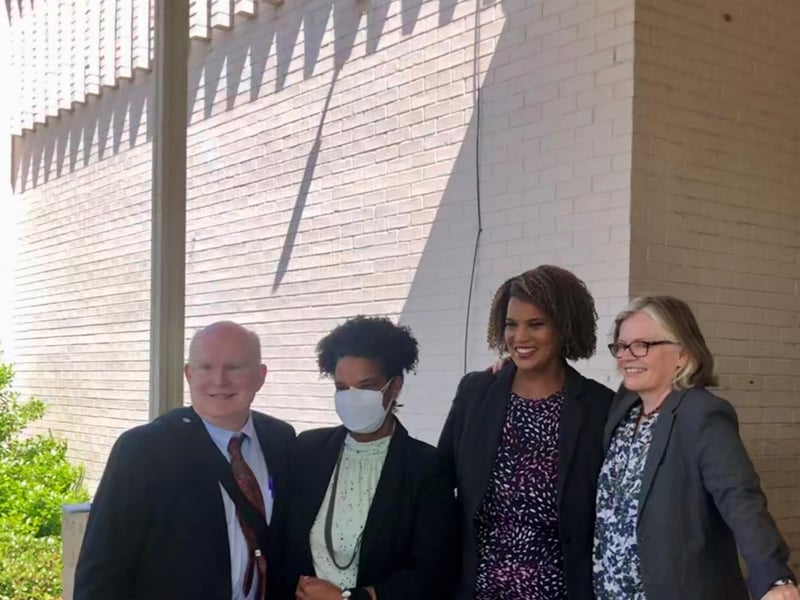
The Banners and around 30 others gathered outside the courthouse Thursday after the hearing to celebrate what local counsel Bill Quigley called a “huge victory, a tremendous step forward.”
“We’re very happy that we can move forward,” Joy Banner said. “This was a huge win… a huge step in our process.”
The ruling means the plaintiffs can begin deposing employees from Greenfield and raise their concerns over the project’s environmental risks and challenges, especially as they relate to the proposed site’s proximity to homes that have been there for generations.
Greenfield purchased the land in July 2021. The roughly $400 million project would include a loading terminal and 54 silos, court documents say. The company also says it will provide 100 jobs.
The plaintiffs say the grain terminal would make air quality even worse for residents, whose houses would be as close as 300 feet from the complex. Grain dust frequently contains insect parts, rodent feces, bacteria, and pesticides and is proven to exacerbate health conditions, court documents say.
Buatt, the attorney representing Greenfield, said during a telephone interview following the hearing that company officials would review the judge’s ruling once it is issued and will likely appeal.
The company also issued this statement: “Greenfield is moving forward with our project after earning overwhelming support from the community, the port and public officials on our efforts to bring clean jobs and tax support for the residents. These procedural attempts to hold up immense benefits to the community will not have a central impact on our opinion.”
A representative for the parish said it cannot comment on pending litigation.
 Follow @SabrinaCanfiel2
Subscribe to our free newsletters
Our weekly newsletter Closing Arguments offers the latest about ongoing trials, major litigation and rulings in courthouses around the U.S. and the world, while the monthly Under the Lights dishes the legal dirt from Hollywood, sports, Big Tech and the arts.