
 Search Articles


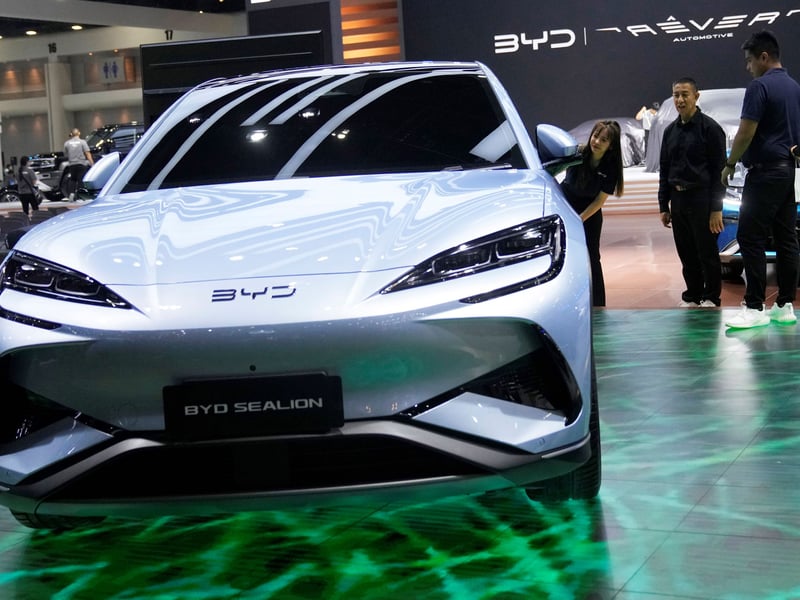
WASHINGTON (CN) — Congressional Democrats on Tuesday hailed President Biden’s new plan to raise tariffs drastically on Chinese-made electric vehicles. Republicans urged the White House to expand its protectionism to all cars imported from China.
The new trade policy, unveiled by the president during a speech at the White House, would increase import duties on Chinese EVs from 25% to 100%. Biden argued that tougher import barriers would help ensure that American companies aren’t pushed out of the market for electric cars.
“We’re not going to let China flood our market,” the president said, “making it impossible for American auto manufacturers to compete fairly.”
Any Americans who want to buy Chinese EVs are free to do so, Biden added, arguing that the new tariffs simply would put U.S. automakers on a level playing field.
On Capitol Hill, Democrats lauded the White House announcement.
Senate Majority Leader Chuck Schumer said in a statement Tuesday that hiking import duties on Chinese EVs was “vital to protect American workers, American manufacturers, American innovation and our national security.”
“The Chinese Communist Party has shown they will stop at nothing to steal our intellectual property and undermine the American economy, including providing deep subsidies to their companies,” he wrote. “Because the CCP does not compete fairly, imposing new tariffs is a necessary step towards addressing the unfair imbalance of China’s trade relationship with the United States.”
Michigan Senator Gary Peters concurred in a statement posted Tuesday to X, formerly Twitter, writing that an influx of cheap Chinese EVs would undercut his state’s auto industry,
“Today’s announcement is a necessary response to combat the Chinese government’s unfair trade practices that endanger the future of our auto industry,” Peters wrote. He added that clamping down on vehicles built in China would also address what he positioned as security concerns posed by Chinese cars collecting data on Americans.
Congressional Republicans, meanwhile, argued that Biden should have taken more forceful action to crack down on what they see as the Chinese auto industry’s efforts to suck the oxygen out of the U.S. market.
In a Tuesday letter to the White House, Florida Senator Marco Rubio said the “half-baked” new tariffs address only part of the threat posed by Chinese auto imports.
“It is imperative that any updated tariff regime adequately address the extinction-level threat that Chinese vehicles — both internal combustion engine and electric — pose to American automakers and the workers they employ,” Rubio wrote.
While the administration is right to raise trade barriers and prevent Chinese EVs from flooding the American market, the Florida Republican contended, gas-powered vehicles built in China also enjoy a price advantage over U.S. autos thanks to government subsidies and unfair trade practices.
Rubio pointed as an example to China’s influence on Mexico’s auto market, pointing out that Chinese companies have assumed 20% of the country’s market share in less than a decade by offering vehicles at much lower prices than competitors.
Washington should be concerned about this trend for all types of vehicles, he said, because most Americans still drive cars with internal combustion engines.
“[A] future, prosperous American EV industry depends on U.S. automakers continuing to profit from gas-powered cars today, so they can invest in new EV technology and increase profit margins in that sector,” Rubio wrote. “All Chinese autos deserve a decisive response.”
In addition to the new tariffs on Chinese EVs, the White House on Tuesday announced import hikes on Chinese goods from other critical sectors, including raising tariffs on lithium-ion batteries for automotive and non-automotive use to 25% and increasing duties on semiconductors to 50%.
The changes to tariff policy also come as the Biden administration has decided to maintain existing duties imposed on China under former President Donald Trump. The White House has been reviewing the Trump administration’s tariff regime since 2022.
In a statement Tuesday, Missouri Representative Jason Smith, chair of the House Ways and Means Committee, slammed the Biden administration for taking two years to review the Trump tariffs.
“That it took President Biden’s team so long to review the tariffs is inexcusable,” Smith wrote, “particularly given the fact that it took the Trump administration a mere eight months to conclude its investigation that prompted the tariffs in the first place.”
The office of the U.S. Trade Representative announced in May 2022 that it would review the Trump-era tariffs, a process that according to statute is supposed to take four years.
 Follow @BenjaminSWeiss
Subscribe to our free newsletters
Our weekly newsletter Closing Arguments offers the latest about ongoing trials, major litigation and rulings in courthouses around the U.S. and the world, while the monthly Under the Lights dishes the legal dirt from Hollywood, sports, Big Tech and the arts.