
 Search Articles



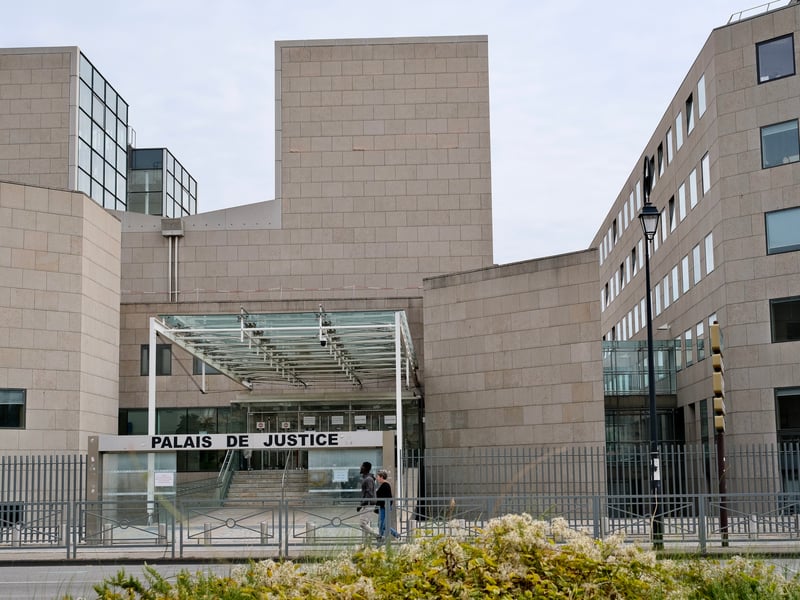
AVIGNON, France (CN) — Almost every day, Gisèle Pelicot sits in a courtroom in the Avignon Judicial Court to listen to testimony from the 51 men on trial for raping her. The rapes were orchestrated by her ex-husband, who sits directly across the room in a glass box flanked by two policemen.
On Wednesday, when Gisèle Pelicot walked through the lobby, the room erupted in applause. Dozens of people crowd into the courthouse every day in a show of solidarity.
Pelicot, 71, has been lauded for her strength and bravery since the trial began Sept. 2. She waived her right to anonymity in hopes of bringing attention to survivors of sexual abuse, and to shift the shame from the victim to the perpetrator.
The case has shocked France. Investigators say her ex-husband, Dominique Pelicot, 71, systematically drugged her over roughly 10 years, and invited strangers to rape her while she was unconscious. The abuse happened mostly in their family home in Mazan, a southern French town with a population of 6,000.
He was caught while under investigation for filming under women’s skirts in a supermarket. Police found thousands of photos and videos of the rapes on a USB drive connected to his computer.
The open trial has not only brought attention to survivors of sexual abuse. It has given widespread exposure into how rape trials function, and is shedding light on why many victims may hesitate to come forward.
Anne Bouillon, a prominent French lawyer for survivors of domestic and sexual abuse, told Courthouse News that the criminal trial for rape victims is “a difficult exercise that is rough, that is sometimes violent.”
“What is perhaps most disturbing are insinuations that would aim to make the complainant bear responsibility,” Bouillon said. “And questions that would be directed to undermine or cast doubt on the credibility of the complainant.”

On Wednesday, Gisèle Pelicot sat against a wall on the right-hand side of the courtroom, behind her two lawyers, Stéphane Babonneau and Antoine Camus.
Husamettin D. entered the room wearing a surgical mask, baseball cap and glasses, the collar of his button-down shirt flipped up to cover his neck. He sat with his lawyer a few feet away from Gisèle Pelicot. When called to the stand, he uncovered his face and limped; he said that the stress of the trial has made him disabled.
Husamettin D. met Dominique Pelicot on coco.fr, a site that has since been taken down, in 2019. He testified that Dominique Pelicot said that he and his wife were swingers, and that she would be sleeping if he joined them, since that was their kink.
After having a few whiskies with friends, Husamettin D. got a text from Dominique Pelicot, inviting him to come over. He hopped in the car and drove roughly 40 miles to Mazan.
Husamettin D. said that Pelicot instructed him to take off his clothes before entering the house and to remove the condom he had put on. As the defendant spoke, Gisèle Pelicot exhaled and lifted her head and eyes up to the ceiling.
Once in the bedroom, Husamettin D. explained, he saw Gisèle Pelicot passed out on the bed.
“I saw this woman like this, I started to caress her skin, and I thought ‘oh, I’ll stop, she’s dead,” he told the courtroom.
He said that Dominique Pelicot told him that she was alive and jostled her so she moved slightly, to prove the point. Husamettin D., then convinced that she wasn’t dead, proceeded to rape her, he said.
Husamettin D. would not say whether he believed Gisèle Pelicot was in a state to give consent or not, and continuously dodged questions on her state of consciousness from the judges and her lawyers.
Gisèle Pelicot watched intently while Husamettin D. pleaded to the head judge, Roger Arata, and as he broke down in tears. He begged the judge to consider how embarrassing it was for him to be taken into custody.
“I was humiliated … not a man … . They put me in a cell, I was treated like an animal in a cage,” Husamettin D. shrieked between sobs. He said that he was stripped naked and felt violated.
Gisèle Pelicot watched from a few feet away.
Béatrice Zavarro, Dominique Pelicot’s lawyer, asked if Husamettin D. saw himself as a victim.
“Yes!” he replied, as if someone had finally understood. “I am a victim.”
Gisèle Pelicot looked on.

Last week, defense lawyers showed the courtroom 27 photos taken while Pelicot was unconscious, including close-up photos of her crotch. Pelicot had asked her daughter to leave the room as the photos were shown. The lawyers then tried to imply that she was an alcoholic and was somehow complicit in sex “games” with her husband.
“Between ‘I baited,’ ‘I was drunk,’ ‘I was an accomplice,’ now they’re trying to distribute photos taken by Mr. Pelicot to make me look guilty — who is the guilty party in this courtroom?” Gisèle Pelicot asked. “I understand why rape victims don’t press charges.”
Though there were over 80 people in the photos and videos, only 51 were caught, and only 18 are still detained. The rest of the men enter and leave the trial with the public, and will leave freely until the verdict is delivered on Dec. 20.
“It’s difficult, because [the victims] have to testify about their love life, emotional or sexual, which will be revealed to the public,” Veronique Le Goaziou, a sociologist and researcher specializing in sexual violence at the Mediterranean Sociology Laboratory, told Courthouse News. “They will be pushed to their limits, because the defense lawyers will try to deconstruct the story of the facts.”
“It is long, it is arduous, and they’re not sure to come out a winner — their entire intimate life will be revealed, they must return to violence that they want to forget, they must justify their words,” Le Goaziou added.
Bouillon said that although it’s normal for the defense to ask questions, nothing dictates that they be aggressive, leading or indicative.

Pelicot has said that the people supporting her — at the courthouse and beyond — give her the strength to continue. Nationwide demonstrations have been organized in solidarity with her. She will continue to attend the trial until it comes to a close.
“There are others like Ms. Pelicot who stand up to it, so it really depends on the people and who they’re surrounded by — by family, by lawyers,” Le Guaziou said. “But in any case, you have to be damn strong.”
 Follow @lilyradz
Subscribe to our free newsletters
Our weekly newsletter Closing Arguments offers the latest about ongoing trials, major litigation and rulings in courthouses around the U.S. and the world, while the monthly Under the Lights dishes the legal dirt from Hollywood, sports, Big Tech and the arts.