
 Search Articles


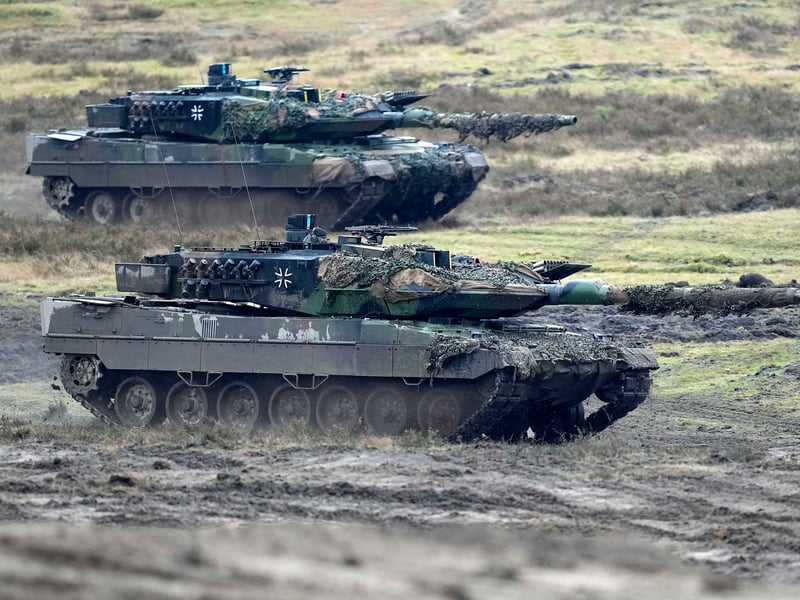
BERLIN (CN) — With war raging in Ukraine and the U.S. an ever less reliable and predictable partner, German politicians have made bolstering the military a priority. With billions of euros allocated for weapons and infrastructure, one of the biggest challenges could be manpower.
“We need to ask ourselves, what will threats look like in 10 years? We’ve got to think outside of parliamentary legislative periods and develop a long-term plan,” said Defense Minister Boris Pistorius earlier this year.
Incoming chancellor Friedrich Merz amended Germany’s constitutional debt brake to enable near-unlimited borrowing for defense and earmark hundreds of billions of euros for military spending before even forming his new government.
Merz has made the case that this will push Germany to return to a leading role in global politics, saying “Germany will retake responsibility — in Europe, and the world. Not loudly, but dependably,” in a recent public address.
What precisely this responsibility entails remains open to interpretation. The purse strings are open, but debates about how Germany’s military of the future will look — and what it will be used for — are ongoing. That includes discussions about who will make up the new-look military, as Germany weighs bringing back mandatory conscription to boost stagnant recruitment.
Outdated and understaffed
Following the Cold War, reunified Germany focused on building a military with a leaner footprint and providing limited support to NATO-led missions.
“Germany participated in operations in Afghanistan and Mali. The German armed forces mainly focused on peacekeeping missions, and were trimmed towards that,” Lukas Mengelkamp, a researcher at the University of Hamburg’s Institute for Peace Research and Security Policy, told Courthouse News.
“There was a society-wide disinterest in the armed forces and what exactly their purpose was,” he continued.
Russia’s invasion of Ukraine changed that, sparking greater scrutiny in Germany’s lack of military investment and a wider discussion on the country’s defensive capabilities. In 2022, Chancellor Olaf Scholz committed 100 billion euros (about $114 billion) to rebuilding Germany’s military.
Much of the focus has been on updating weapons systems, such as replacing Germany’s 1980s era Tornado fighter jets with a multi-billion euro order of American made F-35s, or bolstering ammunition reserves with 8.5 billion euros (about $9.7 billion) in spending.
According to the German military’s annual report, physical infrastructure is also in dire need of repair. Roughly 67 million euros ($76 million) would be needed just to renovate all of the country’s barracks.
While modernizing Germany’s defense capabilities is broadly popular, there is some worry that it will cut into potential funding for domestic programs.
“The situation in Ukraine is absolutely horrible. But I don’t think our support should come at the cost of education or other social projects,” Lisa, a 35-year-old educator, told Courthouse News. “I’m worried there will be cuts in all the wrong places and it will hurt us in the future.”
Drafting up recruitment plans
With administration, wages and pensions making up about half of the current defense budget, plenty of the spending spree will go to personnel. In 2011 Germany scrapped its mandatory conscription program to save cash and reduce what it then saw as a bloated fighting force. Now, Germany’s stagnant recruitment is ringing alarm bells — its 181,000 troops are a slight dip from last year, and reaching its goal of 203,000 soldiers by 2031 seems unlikely.
Germany’s Christian and Social Democrats have initially settled on maintaining a professional volunteer military “for the time being” in ongoing coalition talks, but have maintained that reintroducing conscription may be a necessary step if recruitment doesn’t pick up and are continuing to debate potential conscription plans.
“In recent years so many things have happened that we long thought unlikely that I would definitely not rule out conscription’s return. I think there’s a plausible case it will be reintroduced, it’s more a question of in what form,” said Mengelkamp.
According to recent polling, a majority of Germans support reintroducing conscription. Unsurprisingly, the proposition is less favorable to 18-29 year olds, nearly 60% of whom are against conscription.
“I would try anything to get around it, to be honest,” Max, a 17-year-old student in Berlin told Courthouse News. “I will say conscription hasn’t been that widely discussed yet among my peers, many of whom don’t follow politics that closely. I think that will change once there is a plan,” he said.
Mengelkamp believes the lack of popularity among young people for conscription is tied to unclear goals for boosting German defense spending more broadly.
“If we want to talk about conscription, we have to make a very convincing case. It’s not enough to just say, ‘oh, we have these commitments to NATO.’ We need to ask what does freedom actually mean to us, what does a defense organization of the future look like and do, and why should we make these sacrifices?” said the researcher.
“We need to start with these very basic questions, and in Germany, as well as most of Europe, we haven’t really asked them in a long time,” he continued.
“It would be nice if we could focus more on politics of de-escalation. I have the feeling that we’re headed toward history repeating itself. It’s really horrible, I can barely stand to watch the news anymore,” said Lisa, who opposes conscription.
While a major war in Europe has shattered expectations of regional stability, the possibility of serving in the military or being dragged into war remains difficult to imagine for many. “I’ve got a bit of an issue saying I want to defend my country. I think this entire concept of being proud of my country is fairly abstract to me,” said Max.
And though he is against conscription, he is hopeful that any new iteration would differ from the country’s earlier rendition, which ran from 1957-2011.
“I think it’s important for me that there would be equality within conscription. In the past only male identifying people were drafted, and I think that’s definitely something that would have to be changed,” Max said.
Work in progress roadmap
Germany is prepared to step up on the global stage and spend the euros needed to do so, but what exactly this means will dictate how much defense spending and troops are actually needed. Strategies aimed at deterring further Russian aggression in Europe, defending Germany itself against attack, or helping to step into the global void left by a teetering United States will all look pretty different.
“The debate currently goes that Europeans have to be able to replace the U.S. and invest and rearm until they can basically do everything the U.S. is already doing,” said Mengelkamp.
“But until recently, at least, the U.S. was a global superpower that wanted to project power all over the world at a moment’s notice. But do we want to do that too? Is that necessary for us? Or do we predominantly focus on our doorstep, and what the European forces of the future might look like?”
 Follow @braneck
Subscribe to our free newsletters
Our weekly newsletter Closing Arguments offers the latest about ongoing trials, major litigation and rulings in courthouses around the U.S. and the world, while the monthly Under the Lights dishes the legal dirt from Hollywood, sports, Big Tech and the arts.