
 Search Articles


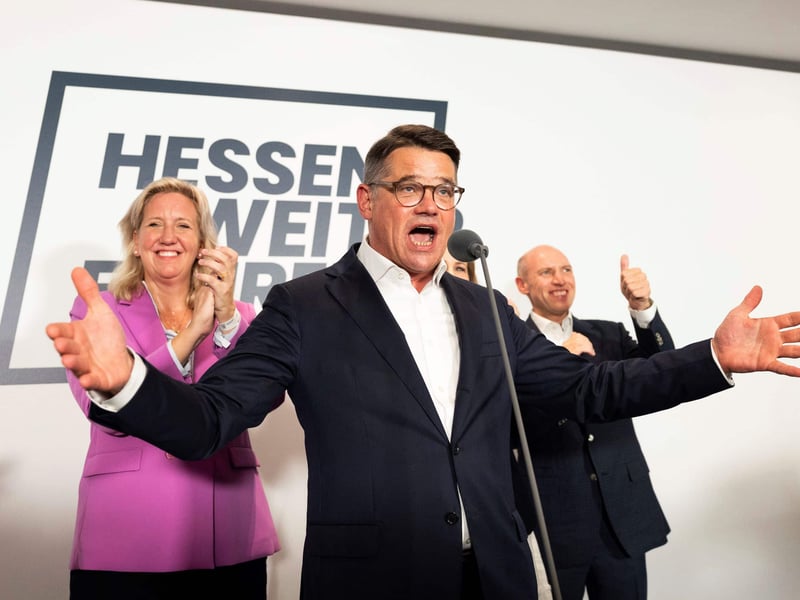
(CN) — State elections on Sunday in Bavaria and Hesse saw a turn to the right in Germany as voters in both West German regions backed the country’s far-right party, the Alternative for Germany, in record numbers and renewed conservative-led governments.
The elections in these two large states, where more than 20% of Germany’s population lives, were seen as a mid-term referendum on Germany’s ruling three-party coalition of Social Democrats, Greens and Free Democrats. The verdict was a strong rebuke to Chancellor Olaf Scholz’s fractious and unpopular government.
Combined, the three ruling parties lost nearly 19% of the votes they received in previous elections in Bavaria and Hesse in 2018.
In the past year, the three parties in power have been squabbling over policy differences, with the biggest spats taking place between the Greens and Free Democrats, a liberal pro-business party in rebellion against the government’s push to make the country a leader on renewable energy. Their poor performance on Sunday may lead to an even more infighting.
They formed Germany’s first post-war three-party coalition after triumphing in national elections in September 2021, the first to take place following the 16-year reign of former Chancellor Angela Merkel, a conservative who was seen as a steady hand for Germany and the European Union.
Going into these elections, Scholz’s government was in a deep crisis as Germany’s economy loses steam and totters on the brink of a deep recession due to inflation, high energy costs, the loss of Russian natural gas supplies, trade conflicts with China and costly efforts to move away from nuclear energy and fossil fuels.
In Sunday elections, Germany’s mainstream conservatives retained their grip on power in both Bavaria and Hesse. In Hesse, the Christian Democratic Union, the party of Merkel, got 34.6% of the vote while in Bavaria, its sister party, the Christian Social Union, picked up 37%. Conservatives have been in power in Hesse, the region of Frankfurt, Germany’s financial capital, for 25 years, and in Bavaria since 1957.
But arguably the biggest winner was the Alternative for Germany, a far-right party that has seen its support surge in recent months as Germans express frustration with illegal immigration, the war in Ukraine and costly green transition policies. The party is known by its German initials, AfD.
In Bavaria, AfD picked up 14.6% of the votes, an increase of 4.4% from 2018. It did even better in Hesse, where it won the second-most votes, collecting 18.4% of the ballots, an increase of 5.3%. It outperformed all three of the ruling coalition parties in both elections.
Its success in Hesse was its best-ever result in a West German state, a sign that its support is extending beyond former communist East Germany, where it has long been a major force. Next year, the East German states of Thuringia, Saxony and Brandenburg hold elections and AfD is ahead in polls in those regions.
“AfD is no longer an eastern phenomenon, but has become a major all-German party. So we have arrived,” said Alice Weidel, the AfD’s co-leader, after Sunday’s elections.
Robert Lambrou, the AfD’s parliamentary group leader in Hesse, said voters “feel that a change in policy is needed. We have high inflation, high energy prices, high rents. We have completely unchecked mass immigration. There is a lot to be done here.”
The rise of AfD is a source of deep concern for many in Germany because of its associations with the country’s Nazi past.
In 2021, the party was put under surveillance by Germany’s domestic intelligence service, the BfV, on suspicion of trying to undermine the democratic constitution and in April the BfV labeled its youth wing as “extremist.” Germany has even considered outlawing the party.
AfD was founded in 2013 amid the EU’s crippling debt crisis and grew in strength in 2015 after Merkel welcomed more than 1 million refugees into Germany. The party first entered the Bundestag, Germany’s parliament, in 2017.
Since this spring, the AfD has surged in national polls and it is now the second-most popular party at 22%, behind the center-right CDU-CSU, which stands at about 27% in surveys. In the 2021 federal elections, AfD won 10.3% of the vote.
Meanwhile, Scholz’s center-left Social Democrats trail at about 17%, nearly 9 points behind its victorious 2021 election tally. The Greens and Free Democrats have seen their popularity decline too, but not as steeply as that of the Social Democrats.
Other parties refuse to work with AfD, but Weidel argued that keeping up a “firewall” against AfD is “deeply undemocratic.”
“I predict that disdain and contempt for Alternative for Germany, excluding it from government responsibility, won’t be tenable in the long run,” she said, as reported by the Associated Press.
Germany’s main parties trade blame for the rise of AfD, and its surge adds pressure on the government to find a strategy to counter its growing popularity.
At the end of September, Scholz took a step in that direction by ordering police to begin conducting checks at the borders with Poland and the Czech Republic to stop illegal immigration, a move that undermines the EU’s open borders policy.
“The increased performance of the AfD can only worry every democrat in this country,” Ricarda Lang, a co-leader of the Greens, said on public television, as reported by Politico. “I would like to see us move away from finger-pointing and for every democratic party to now consider what we can do to make [the election results] look different again in the future.”
Courthouse News reporter Cain Burdeau is based in the European Union.
 Follow @cainburdeau
Subscribe to our free newsletters
Our weekly newsletter Closing Arguments offers the latest about ongoing trials, major litigation and rulings in courthouses around the U.S. and the world, while the monthly Under the Lights dishes the legal dirt from Hollywood, sports, Big Tech and the arts.