
 Search Articles


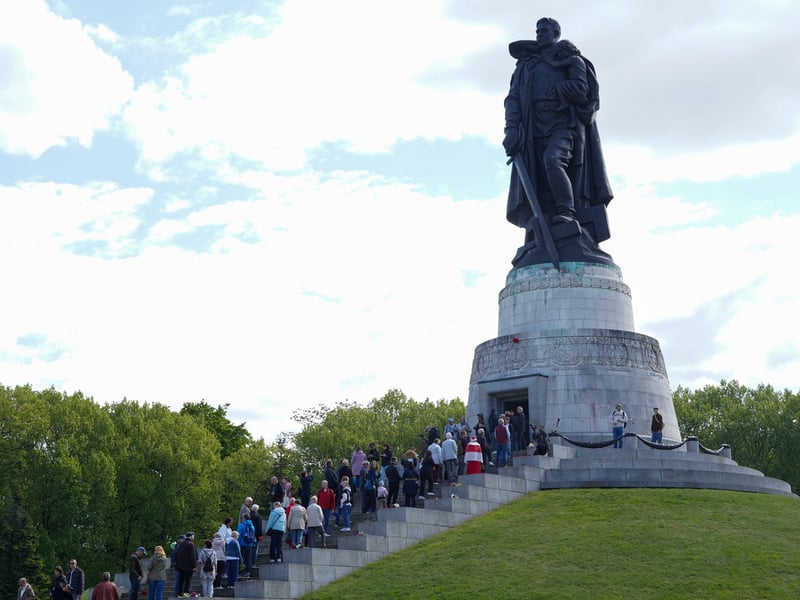
BERLIN (CN) — The horrifying history of World War II doesn’t just hang over Berlin — it’s chiseled into the city’s foundation, from bullet-pocked facades, to preserved graffiti scribbled by Soviet soldiers in the Reichstag, to the countless memorials lining the German capital’s streets.
World War II and the Holocaust have left equally deep scars on the German national psyche.
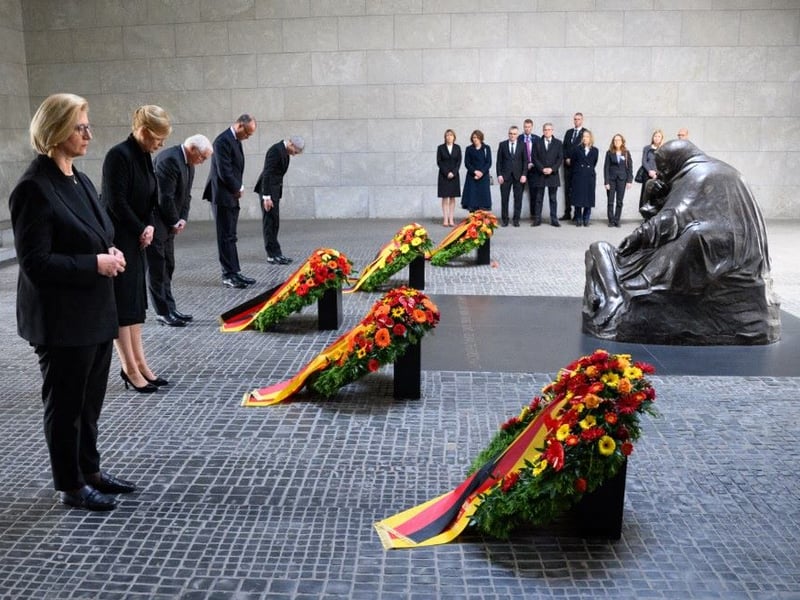
“Do we want to become a nation that only remembers its supposedly glorious past and downplays or entirely denies the darkest chapters of its history?” asked German President Frank-Walter Steinmeier at a ceremony in Berlin marking the 80th anniversary of the end of World War II.
“We are all children of the 8th of May. Let us protect our freedom, let us protect our democracy,” he said.
Germany’s historical responsibility for the atrocities of the Holocaust and war is vital to its modern national identity. But the nation’s tumultuous political present threatens to redefine this past, as strained relations with former adversary-turned-postwar partner Russia and a growing domestic far-right threat make the end of the war’s 80th anniversary the most complex yet.
Celebrating a ’liberatory’ defeat
In Germany, Victory in Europe Day is frequently called Liberation Day. That Germany celebrates the Allied Forces’ overthrow of the Nazi regime both speaks to its lauded ability to confront its past while indicating a framework that can abdicate guilt to a certain degree.
“May 8th cannot be a day of liberation in a superficial sense for Germans. Rather, it’s an incontestable fact that the Germans did not manage to liberate themselves from Nazi tyranny,” Andreas Wirsching, a historian at Munich’s Institute for Contemporary History, told Courthouse News.
“This is an essential part commemorating the end of the World War II, which cannot be separated from when Hitler came to power in 1933,” he said.
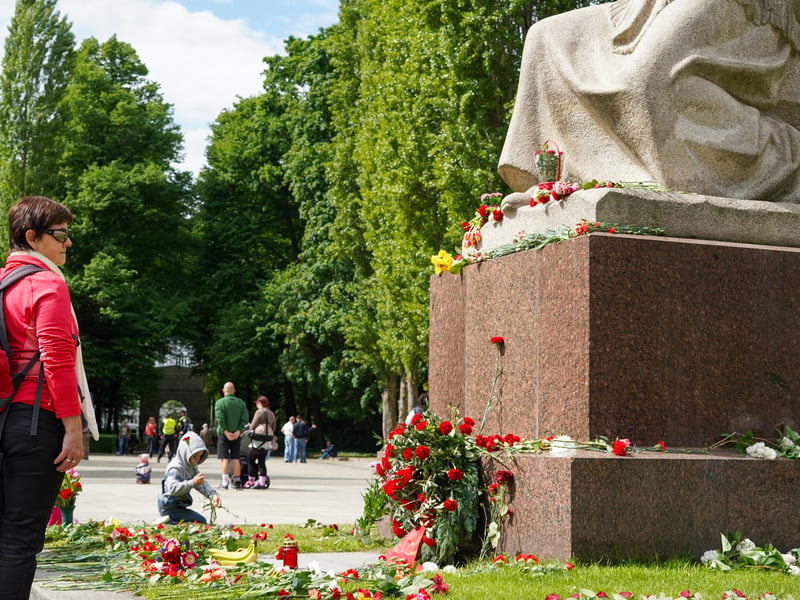
Lorenz Blumenthaler is part of the Amadeu Antonio Foundation, a nationwide organization fighting racism, antisemitism and the far right. He argues that while a broad perception of Germans being “liberated” from Nazism may provide some with distance from atrocities of the past, most take this history seriously.
“The general narrative is often personalized, ‘my own relatives had nothing to do with this — it was this evil force that somehow took over the country’ and that Germany was then liberated from Nazism, even though they happily helped murder 6 million Jews,” said Blumenthaler.
“But on the other hand, it still means a strong sense of responsibility exists within that broader population,” he went on.
For many Berliners, May 8 is a day to commemorate a dark and meaningful past while informing what a brighter future should look like.
“It’s a day worth honoring,” said Frank, a 66-year-old born in Dresden. “I see it as a day of liberation. My mother survived Dresden’s firebombing. From then on, my grandmother and family all said, whatever comes, we never want war again.”
“It’s such an important day in German history,” said 74-year-old Berliner Rainer. “Germany was freed of National Socialism, and the Soviet Union sacrificed the most for that to happen. Other allies had important sacrifices as well, not to mention all those murdered in the Holocaust. It’s a day for reflection and one to never forget.”
Modern Russia complicates Soviet history
The oversized sacrifice of Soviet soldiers is clear throughout Berlin, where sprawling monuments to heroic soldiers dot the city. Frank and Rainer were among many Berliners paying respect at the city’s largest Soviet memorial, tucked away in a leafy waterfront park.
Until recently, towering Soviet memorials signified close Russian-German postwar relations as much as their brutally adversarial past. Russia’s invasion of Ukraine has strained those ties, and a heavy police presence now forbids the once common display of Russian and Soviet flags and military paraphernalia at May 8th commemorations.
“After the fall of the Berlin Wall, building good relations was a core element of German foreign policy,” said Wirsching. “There were a significant number of initiatives to build cultural and political ties, not to mention economic projects like the Nord Stream 2 pipeline. This largely continued even after the 2014 annexation of Crimea,” the Ukrainian peninsula occupied by Russia.
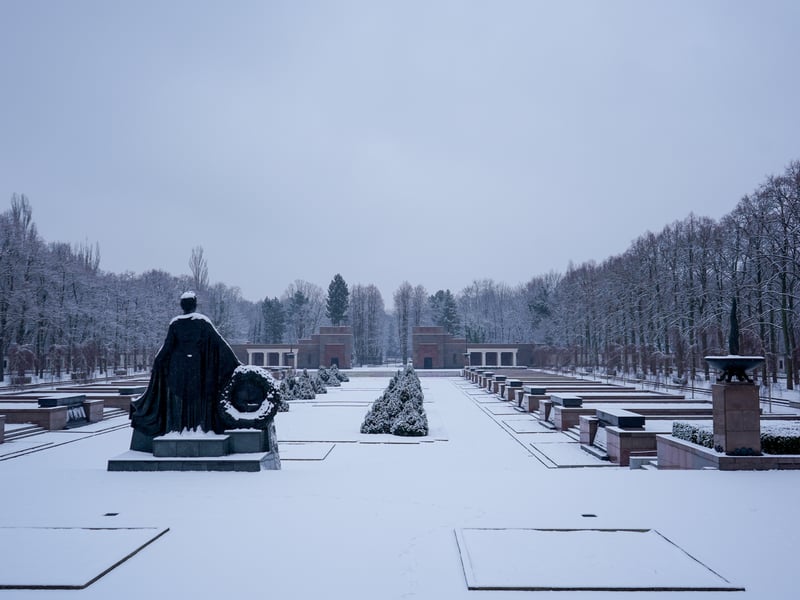
The invasion of Ukraine finally forced an about-face in German policy, leading to what Wirsching calls “a fundamental disillusionment and feeling of being deceived.” Still, efforts like those in the Baltics to remove Soviet war memorials would be unthinkable in Berlin.
“The status of the Soviet Union as winning power in World War II is not disputed in Germany, and Soviet monuments remain a symbol for the end of the war. Calls to remove them are extremely rare and have no public influence,” said Wirsching.
Remembering isn’t as straightforward as it sounds
Germany’s remembrance culture, which prioritizes public displays of history and education around the country’s dark past, has long drawn international plaudits. But the ascendance of the far-right Alternative for Germany party, now leading many national polls, has called into question just how effective the focus on remembrance has been. Challenging Germany’s historical narrative and minimizing the role of the Holocaust has long been a major goal of Germany’s right.
“German right-wing extremists can’t really deny the Holocaust as a historic fact. Instead, those looking to stoke nationalism seek to decouple National Socialism and the Holocaust from German history. This can also serve a fairly widespread desire among Germans to have a ’normal’ national history,” said Wirsching.
Blumenthaler says the argument that Germans are tired of hearing about their past regularly reappears in public discourse. While he believes remembrance culture has greatly improved awareness and sensitivity around history, it is not sufficient to prevent the ascendance of the right.
“For a very long time, people in Germany thought that if we remember the Holocaust and work through our past, we can protect ourselves from a far right that has been on the rise in other parts of Europe. But now we’re seeing Germany is having a delayed reaction to these global trends,” he said.
Rainer said, “Part of why we pay tribute today is so that criminals like Hitler can never attain power again. Of course, that’s really difficult at critical junctures like today. There are right-wing nationalists back on the scene in Germany, although I do think that part of this is down to establishment parties failing to manage the various crises we’ve faced in recent years.”
In addition to challenges from the far right, German memory culture has been publicly reevaluated and complicated by recent global events. In public discourse, “never again” has been used by different factions as a justification for German rearmament and military support for Ukraine, for unequivocal support for Israel, and as the moral backing for why Germany should support a ceasefire in Gaza.
Frank has experienced just how easy it is to draw drastically different lessons from the same historical event.
“My wife and I believe that German history means there should never be war again. For us, that means finding a diplomatic solution in Ukraine so that the killing stops. But my daughters have a totally different view and believe it’s Germany’s responsibility to support Ukraine,” he said.
Even reckoning with Germany’s past can prove perplexing. Recent debates about where the Holocaust stands within a wider historic context of violence and colonization — and the extent to which it can be compared to Germany’s own much-less-discussed, brutal and genocidal colonial history — have been highly contentious.
Germany’s demographic shift into a nation of immigrants has also deeply complicated a national identity based around collective responsibility for the Holocaust.
“Those with an immigrant background, who make up 20-25% of the population, have personal histories that don’t necessarily have much to do with German history,” said Wirsching. “That has important consequences for remembrance culture, and might mean that the crimes of the Holocaust have to be ’translated’ into an exemplary commemoration that raises general awareness of the possibility of inhumanity and mass crimes in the context of modern nationalism.”
WWII won’t be a living memory for long
For Blumenthaler, Germany’s commitment to remembering its history is fundamental to the country’s democracy. “Never again doesn’t just mean not repeating the Holocaust. It’s also more broadly about how Germany deals with minorities, and that everyone is protected in the same way,” he said.
“That’s why the Alternative for Germany attacks this narrative, because it’s not just about how we look at the past, but also how we want to be as a country in the future.”
Blumenthaler stated his concern that Germany’s remembrance culture will continue to shift as it fades from living memory. Rainer, commenting on the advanced age of most of the visitors to Berlin’s Soviet memorial, believes history needs to be made appealing for younger generations.
“Young people see history differently, with more distance. And they just have different attitudes generally. We need things that they can connect with, and maybe less of a focus on those eternal rituals that used to be so important,” he said.
 Follow @braneck
Subscribe to our free newsletters
Our weekly newsletter Closing Arguments offers the latest about ongoing trials, major litigation and rulings in courthouses around the U.S. and the world, while the monthly Under the Lights dishes the legal dirt from Hollywood, sports, Big Tech and the arts.