
 Search Articles


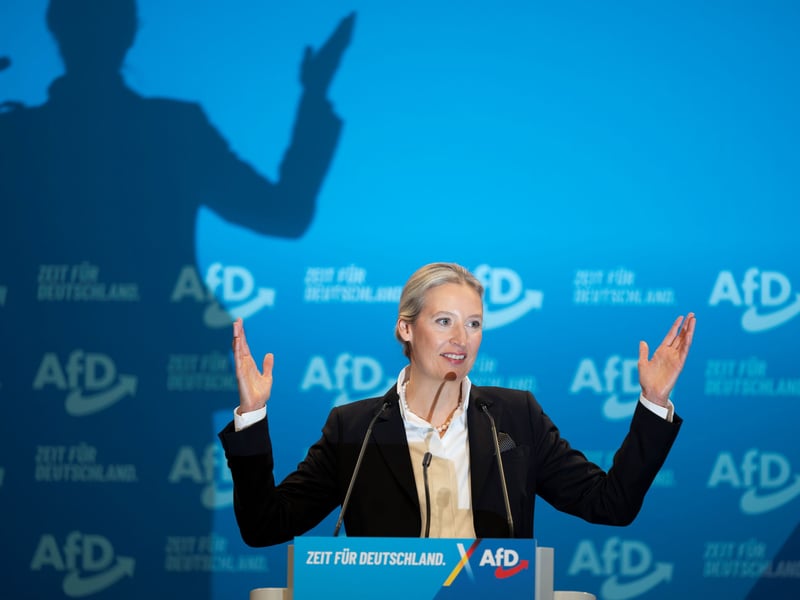
(CN) — Alternative for Germany, a far-right anti-immigrant party that now tops opinion polls only two months after it scored historic gains in national elections, was classified as a threat to democracy on Friday by the country’s domestic intelligence agency.
The Federal Office for the Protection of the Constitution said it designated the party, best known by its German initials AfD, as a right-wing extremist group because of its anti-immigrant and anti-Muslim rhetoric.
Friday’s decision deepens Germany’s political divisions as the AfD’s opponents, especially those on the left, call to ban the party from politics. Meanwhile, AfD leaders and their supporters argue that the new extremist designation is the real attack on democracy.
The Bfv, the German initials for the domestic spy agency, reportedly submitted a 1,100-page report with its findings to Nancy Faeser, Germany’s outgoing interior minister and a member of Germany’s Social Democratic Party. A conservative-led government takes over next Tuesday.
The report was classified as secret, though German media published some leaked parts of it.
“Decisive for our assessment is the AfD’s ethnic-based understanding of the [German] people, which devalues entire population groups in Germany and violates their human dignity,” the Bfv said in a news release. “This understanding of the [German] people is reflected in the party’s overall anti-immigrant and anti-Muslim stance.”
The Bfv said the party’s “prevailing understanding” of who should be defined as German “is incompatible with the free democratic basic order.”
“It aims to exclude certain population groups from equal participation in society, subject them to unconstitutional discrimination, and thus assign them a legally devalued status,” the agency said. “Specifically, for example, the AfD does not consider German citizens with a migration history from predominantly Muslim countries to be equal members of the German people, as defined ethnically by the party.”
The agency cited “numerous xenophobic, anti-minority, anti-Islamic and anti-Muslim statements” made by party leaders, which it said contributed to animosity toward immigrants.
The agencybegan its probe of the AfD in 2021, when it classified it as “under suspicion of right-wing extremism.” The agency had already designated branches of the AfD in Eastern Germany, where the party is strongest, as extremist. AfD members have long been accused of harboring neo-Nazi sentiments and they have been linked to extremist groups, including to an event in November 2023 at a Potsdam hotel where far-right figures discussed plans to deport masses of people.
Friday’s designation makes it easier for Bfv to monitor AfD members’ communications and use undercover agents to infiltrate the party.
AfD leaders Alice Weidel and Tino Chrupalla released a statement criticizing the extremist label as a “heavy blow” to democracy. They vowed to fight the agency’s finding in court.
“The AfD as an opposition party is now being publicly discredited and criminalized,” they said.
The party, known in German as Alternative für Deutschland, has steadily grown since its founding in 2013.
In national elections in February, it came in second behind the traditional conservatives, picking up about 21% of the vote. Recent polls have shown it even ahead of Germany’s Christian Democrats, who will lead the incoming government.
Katrin Göring-Eckardt, a high-ranking member with the Greens, called for the AfD to be banned.
“A confirmed right-wing extremist party with aspirations against the free democratic order is a threat to democracy in our country,” she said on social media. “A ban on the AfD should be reviewed by the Federal Constitutional Court.”
Germany’s decision to target the AfD as an extremist group adds to an increasingly tense political atmosphere in Europe, in which supporters of hard-right parties argue that mainstream parties and government institutions are using ever more drastic means to exclude them from electoral politics.
Generally, centrist parties in Germany and elsewhere have kept far-right forces out of government by vowing to not enter coalitions with them — atactic known as firewalls. But cracks have appeared in such firewalls recently, as far-right parties continue to gain strength.
Now, the far right says their political leaders are being persecuted due to their success.
Many point to the February indictment of Călin Georgescu, a far-right contender who was leading in the race to become Romania’s next president. He stands accused of undermining Romania’s democratic order and unlawfully boosting his TikTok-run campaign with help from Russia. He was barred from running in the election.
Even more striking was a judge’s recent decision to ban far-right French leader Marine Le Pen from running for office. Le Pen was leading in polls and viewed as France’s potential next president. She was barred from politics for five years after she was convicted of embezzlement in connection with the misuse of European Parliament funds.
On Friday, Matteo Salvini, the leader of Italy’s far-right League, described the AfD extremist label as “very serious.”
“After France and Romania, [is this] another theft of democracy?” he said on social media.
In Washington, White House officials excoriated Germany. U.S. President Donald Trump and his team have grown very close to the AfD and other far-right parties in Europe, which they see as political kindred spirits.
Vice President JD Vance wrote on social media that German “bureaucrats” are trying to “destroy” the AfD, which he called “the most popular party in Germany.”
“The West tore down the Berlin Wall together. And it has been rebuilt — not by the Soviets or the Russians, but by the German establishment,” he said.
His comments echoed a speech he made in February at the Munich Security Conference that offended and spooked many European leaders. The speech is viewed as marking a breaking point in transatlantic relations. In Munich, Vance accused European leaders of betraying democratic values by refusing to allow far-right nationalist parties into government and for seeking to curtail the spread of far-right viewpoints, which he called censorship.
Secretary of State Marco Rubio also blasted Germany.
“Germany just gave its spy agency new powers to surveil the opposition. That’s not democracy — it’s tyranny in disguise,” he wrote on social media. “What is truly extremist is not the popular AfD — which took second in the recent election— but rather the establishment’s deadly open border immigration policies that the AfD opposes. Germany should reverse course.”
Courthouse News reporter Cain Burdeau is based in the European Union.
 Follow @cainburdeau
Subscribe to our free newsletters
Our weekly newsletter Closing Arguments offers the latest about ongoing trials, major litigation and rulings in courthouses around the U.S. and the world, while the monthly Under the Lights dishes the legal dirt from Hollywood, sports, Big Tech and the arts.