
 Search Articles


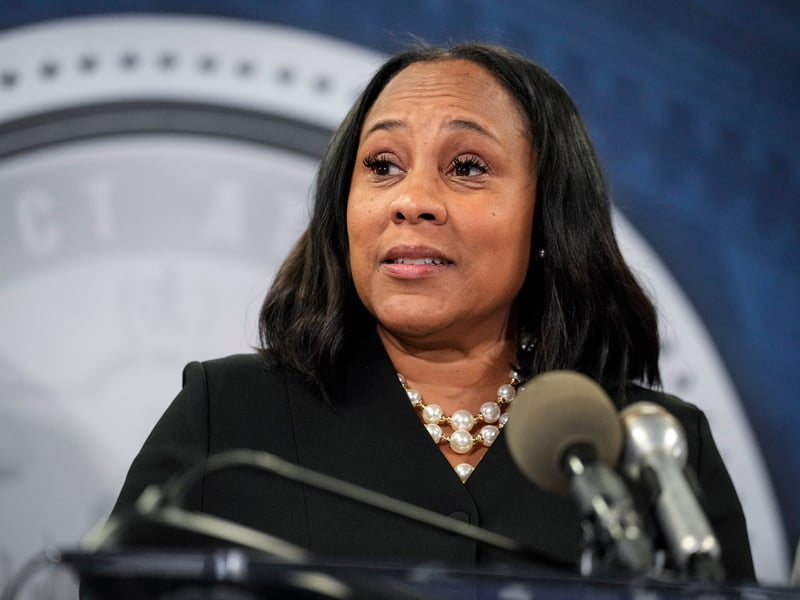
ATLANTA (CN) — Fulton County District Attorney Fani Willis on Tuesday lost an effort to remain overseeing her prosecution of President Donald Trump in the state’s 2020 election interference case.
In a 4-3 order, the Georgia Supreme Court declined to take up Willis’ appeal of a December lower court decision that removed her and her office from the case.
The ruling leaves the last remaining criminal prosecution of Trump in limbo, as a nonpartisan state agency is now in charge of determining whether to proceed with the sweeping racketeering case and find another prosecutor willing to do so.
“Willis’ misconduct during the investigation and prosecution of President Trump was egregious and she deserved nothing less than disqualification,” Steve Sadow, Trump’s lead Georgia attorney said on social media. “This proper decision should bring an end to the wrongful political, lawfare persecutions of the president.”
Georgia’s highest court was asked to determine whether Fulton County Superior Court Judge Scott McAfee abused his discretion in ordering either Willis or her special prosecutor, Nathan Wade, to step down as a remedy to his finding of “an appearance of impropriety,” related to the pair’s reported personal relationship.
In the majority’s opinion, Willis and the state’s appeal focused on a narrow, case-specific dispute that was resolved by the Georgia Court of Appeals, without raising a broader question that gravitates the high court’s review.
“The root of the problem is the state’s approach to litigating this issue on appeal,” Justice Andrew Pinson wrote in the denial of certiorari. He was joined in his concurrence by Justices Sarah Hawkins Warren and Charles Bethel.
Pinson noted that the state did not appeal the “appearance of impropriety” finding, just the narrow finding that either Willis or Wade must be disqualified. The justice called Willis’ case and its surrounding circumstances a “poor vehicle” for addressing how the state should handle the appearance of impropriety standard for public prosecutors.
However, in the minority’s view, the justices should have intervened and considered whether a prosecutor may be disqualified “based solely upon on appearance of impropriety and absent a finding of an actual conflict of interest or forensic misconduct.”
In a dissenting opinion, Justice Carla Wong McMillian wrote that although this particular case is politically charged, the legal issue should be decided because it affects every single active lawyer in the state and is likely to recur in a wide variety of situations.
“But this court left open the possibility that the appearance of impropriety based on conduct could justify disqualification when the interest of the public at large outweighs the client’s interest in choice of counsel,” McMillan wrote.
In December, the Georgia Appeals Court concluded that Wade’s removal from the case was not a sufficient remedy. In a 2-1 opinion, a panel ruled that Willis should also be removed, writing “this is the rare case in which disqualification is mandated and no other remedy will suffice to restore public confidence in the integrity of these proceedings."
Precedent from the Court of Appeals appears to have repeatedly held that there must be an “actual” impropriety or conflict of interest to warrant disqualification of an attorney, though that rule has yet to be announced in a case before the high court, McMillan wrote.
Joined by Justices John Ellington and Verda Colvin, McMillan added that the recent passage of a state law — entitling a defendant to recover reasonable attorney’s fees and costs in a felony or misdemeanor case that is dismissed due to the prosecuting attorney’s disqualification from improper conduct — adds even more gravity to the issue.
“As such, there is now a financial incentive to move to disqualify prosecutors. Indeed, a review of the legislative history of that bill shows that although opponents’ primary concern centered on the partisan politics surrounding the bill and the prosecution underlying the specific cases on certiorari review here, one of the concerns expressed was that the law would be abused in future cases, having a chilling effect on criminal prosecutions,” McMillan wrote.
“And the Court of Appeals’ opinion adds to that incentive to assert an appearance of impropriety to disqualify prosecutors because that standard is amorphous and likely easiest to meet,” she added.
In 2023, Willis charged Trump and 18 of his associates in a 97-page indictment with racketeering and other crimes for conspiring to unlawfully change the outcome of the 2020 presidential election.
Nine defendants in the case, including Trump, called for Willis’ removal, arguing that Willis received a “material financial benefit” from hiring Wade, and from being temporarily romantically involved with him.
But McAfee found that there was not enough evidence to show that, nor that Willis purposefully pursued the prosecution for financial gain, nor that her conduct affected the case to their detriment. The judge did however, note the issue created an “appearance of impropriety” and allowed Willis to stay on the case only if Wade resigned, which he did just hours after the order’s release.
 Follow @Megwiththenews
Subscribe to our free newsletters
Our weekly newsletter Closing Arguments offers the latest about ongoing trials, major litigation and rulings in courthouses around the U.S. and the world, while the monthly Under the Lights dishes the legal dirt from Hollywood, sports, Big Tech and the arts.