
 Search Articles


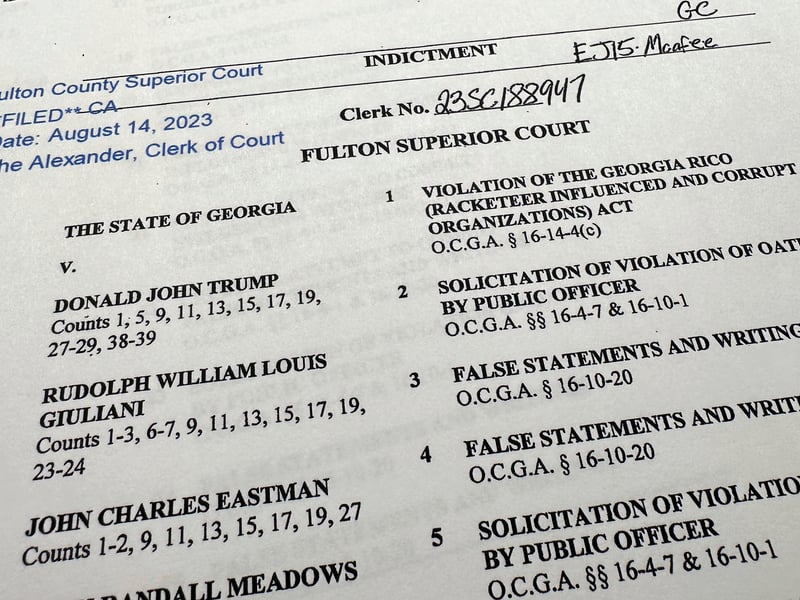
ATLANTA (CN) — The last standing criminal prosecution against President Donald Trump over attempting to overturn the 2020 election results came to an end Wednesday.
In a one-page order, Fulton County Superior Court Judge Scott McAfee dismissed the entire sprawling racketeering case first brought by Fulton County District Attorney Fani Willis over two years ago.
Executive director of the Prosecuting Attorney’s Council of Georgia, Peter Skandalakis, who agreed to take on the case earlier this month following Willis’ removal from the case, filed a motion to drop the charges “to serve the interests of justice and promote judicial finality.”
In his view, this case is best pursued at the federal level rather than by an individual state.
After reviewing the massive investigative file surrounding the 19 defendants, Skandalakis explained his reasonings for dismissing each of the charges and reiterated that “it is not illegal to challenge election results.”
Skandalakis wrote that nothing in the evidence suggests that David Shafer, former chairman of Georgia’s Republican Party, Shawn Still, the former state GOP finance chair, Cathleen Latham, the former chairwoman of the Coffee County Republican Party, or any other electors conspired to overturn the election. The three faced charges for signing certificates falsely claiming Trump won in Georgia.
“On the contrary, the record overwhelmingly demonstrates that the electors believed their actions were legally required to preserve Georgia’s electoral votes in the event President Donald J. Trump prevailed in the then-pending lawsuit in Fulton County challenging the election,” Skandalakis wrote.
He added that he has grave constitutional concerns with several of the overt acts listed in indictment concerning public statements the electors made regarding the election.
Shafer was also charged with making two false statements during an interview with prosecutors. After reviewing the interview transcripts, Skandalakis wrote that he found no false or misleading statements made by Shafer that were material to the investigation.
Trump’s former attorney and onetime New York City mayor Rudy Giuliani, and Atlanta attorneys Ray Smith and Robert David Cheeley were also indicted for giving false statements about election fraud to committees of the Georgia General Assembly.
Skandalakis acknowledged that these statements were “wrong and baseless.” However, he said their testimony was “unsworn” and that he could not find any precedent of a prosecutor using unsworn statements to state lawmakers as predicate criminal conduct.
He added that the charges against federal officials Jeffrey Clark and Mark Meadows are also unjustified.
“The charges brought against Clark are especially concerning,” Skandalakis claimed. “They plainly fall short of the far more rigorous standard of proof beyond a reasonable doubt required to sustain a criminal conviction.”
Clark, a former senior Justice Department official was charged for making a “false writing” by asserting that the Department of Justice had “identified significant concerns that may have impacted the outcome of the election in multiple states, including the State of Georgia.”
However, Clark’s proposed letter was never approved, never signed by any Justice Department official and never sent to any Georgia officials.
As for Meadows, Skandalakis said the former White House chief of staff never “explicitly solicited” Georgia’s Secretary of State to violate his oath of office during the infamous phone call on Jan. 2, 2021, in which Trump pressured Brad Raffensperger to “find” enough votes to overturn Biden’s victory in the state.
“While the call is concerning, reasonable minds could differ as to how to interpret the call,” Skandalakis wrote. He claimed the call could be interpreted as Trump instructing Raffensperger to produce more votes in his favor, while it could also be viewed as Trump genuinely believing fraud had occurred and asking the Secretary of State to investigate.
“When multiple interpretations are equally plausible, the accused is entitled to the benefit of the doubt and should not be presumed to have acted criminally,” Skandalakis wrote.
Three individuals, including Giuliani, were indicted for harassing and threatening Ruby Freeman, a Fulton County election worker they falsely accused of pulling fraudulent ballots from a suitcase. Skandalakis said these crimes must be prosecuted in Cobb County where Freeman resided at the time.
He added: “Because the three people accused of the activity involving Ms. Freeman were so far removed and unrelated to the goal of the ‘organization,’ to unlawfully change the results of and to stop the Vice President’s certification of the 2020 election results, I find that these charges are too tenuous to be part of the RICO Count.”
Skandalakis also noted the case is now over two years old and nearly five years removed from Trump’s phone call with Georgia’s Secretary of State, one of the most critical acts of the indictment.
“There is no realistic prospect that a sitting president will be compelled to appear in Georgia to stand trial on the allegations in this indictment. Donald J. Trump’s current term as President of the United States of America does not expire until January 20, 2029; by that point, eight years will have elapsed since the phone call at issue,” Skandalakis wrote.
He added that an immediate jury trial would be impossible as litigating such issues would require months, if not years, assuming the state could even prevail on the vigorously contested questions of presidential immunity.
Even if Trump was severed from the remaining defendants and separate trials were conducted, Skandalakis said this would “be both illogical and unduly burdensome and costly for the state and for Fulton County.”
“In my professional judgment, the citizens of Georgia are not served by pursuing this case in full for another five to ten years,” he wrote.
Instead of prosecuting attorneys for providing flawed legal advice to the president, Skandalakis said “these lawyers should be accountable to their respective state bars for any violations of professional conduct.”
He added that Special Counsel Jack Smith’s now-dismissed federal investigation would have been the most appropriate avenue to determine whether efforts by Trump and his legal advisors to obstruct the counting of electoral votes on Jan. 6th, 2021 were crimes that could be proven beyond a reasonable doubt.
 Follow @Megwiththenews
Subscribe to our free newsletters
Our weekly newsletter Closing Arguments offers the latest about ongoing trials, major litigation and rulings in courthouses around the U.S. and the world, while the monthly Under the Lights dishes the legal dirt from Hollywood, sports, Big Tech and the arts.