
 Search Articles


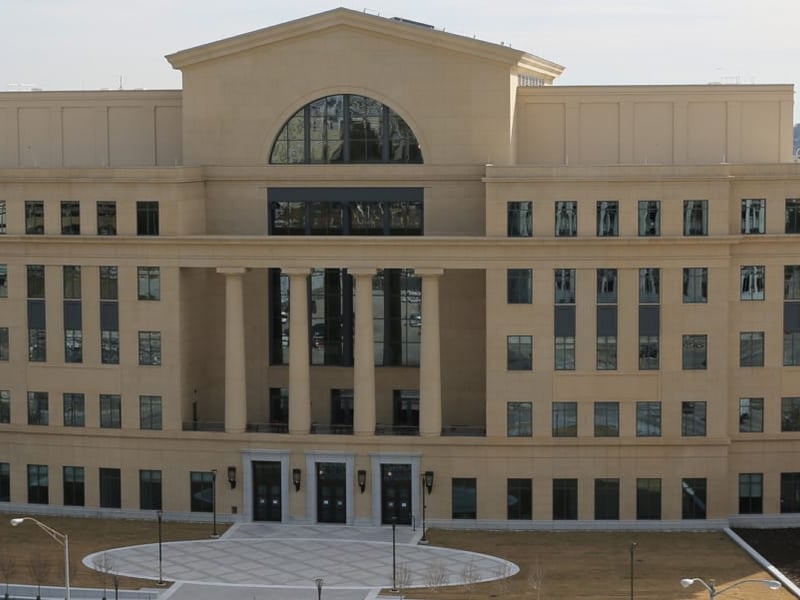
ATLANTA (CN) — Georgia argued before its Supreme Court Wednesday against an order prohibiting it from seeking executions for nine death row inmates based on an agreement with the capital defense bar.
Georgia’s capital defense bar, including the Federal Defender Program, sued the state in 2022 after the attorney general’s office obtained an execution order for inmate Virgil Delano Presnell Jr.
The capital defense bar claimed the state breached an agreement from the 2020 pandemic, in which the attorney general’s office stated it would not pursue execution orders for certain inmates until three Covid-related conditions had been met, including that a vaccine is “readily available to all members of the public.”
A lower court sided with the Federal Defenders, ruling that the vaccine condition had not been satisfied, as there is no FDA-approved vaccine for infants under 6 months old.
“The attorney general could have used a word different than all,” Justice Benjamin Land told the state’s attorney.
Wednesday marked the second time the case has come before Georgia’s highest court. In December 2022, the justices concluded the trial court did not abuse its discretion by stopping the attorney general’s office from proceeding with Prenell’s execution.
In its second appeal, Georgia’s attorney general’s office contends the trial court’s interpretation of the agreement renders it “indefinite and therefore terminable at will.”
“We’ve already decided in the first Federal Defenders case that all means all,” Justice Carla Wong McMillian said.
The state asked the court to reverse the permanent injunction barring the executions, noting that it’s been years since the judicial emergency expired in 2021 and that the state has safely resumed executions for inmates not covered by the agreement.
Additionally, the lack of FDA approval does not render a person unable to get the vaccine, the state’s solicitor general, John Henry Thompson, said.
While the state argued that there is “off-label” use and the FDA does not prohibit a doctor from giving a vaccine to someone under 6 months old, Thompson said there is no evidence in the case record of this occurring.
“What makes a vaccine ‘readily available to the public’ is that its administration is subject to the responsible practice of medical providers in this state,” Thompson said.
The justices appeared to agree with the state’s logic but grappled with the contradicting language it used in its agreement and whether the contract’s lack of a foreseeable end date makes it terminable.
Attorney Sarah Brewerton-Palmer argued the contract is of definite duration under Georgia law and cannot be terminated until the state satisfies its conditions. She noted that an RSV vaccine was recently approved for newborns, making the vaccine requirement realistically satiable.
“The overwhelming amount of vaccines that have ever been approved by the FDA were not for under 6 months,” Justice Charles Bethel said.
“Would a reasonable person reading that language in 2021, who had passing knowledge of vaccine protocols for the U.S., expect that to mean from birth to death?” he added.
Bethel recognized the state’s argument that it is also not advised for certain individuals with allergies or severely compromised immune systems to receive certain vaccinations.
The justices further pondered whether the terms of the agreement prevent the state as a whole, not just the attorney general’s office, from carrying out execution warrants for the nine sentences.
“The agreement says the district attorney maintains sole authority to seek execution warrants. So, how does this argument prevent a district attorney from obtaining an execution order?” Justice Land asked.
Chief Justice Nels S.D. Peterson, Presiding Justice Sarah Hawkins Warren and Justice Andrew A. Pinson were recused from the case. The others did not signal when a ruling will be released.
 Follow @Megwiththenews
Subscribe to our free newsletters
Our weekly newsletter Closing Arguments offers the latest about ongoing trials, major litigation and rulings in courthouses around the U.S. and the world, while the monthly Under the Lights dishes the legal dirt from Hollywood, sports, Big Tech and the arts.