
 Search Articles


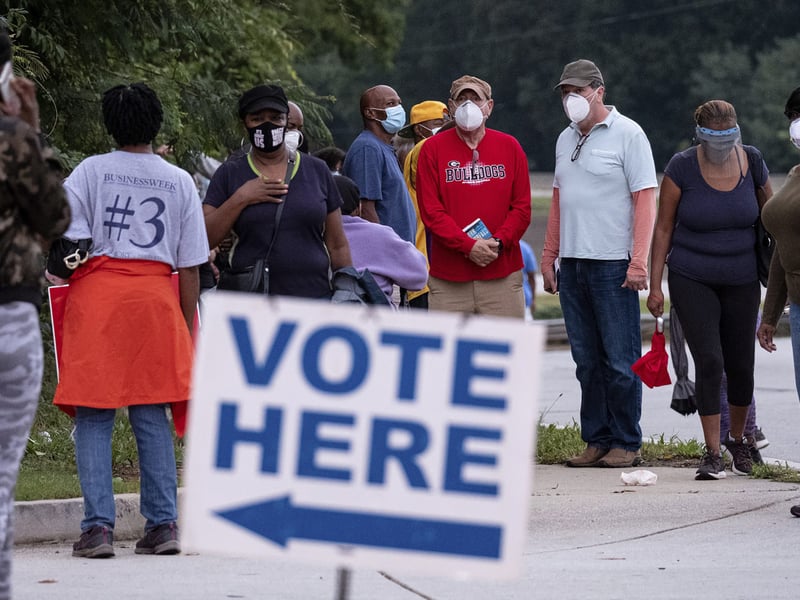
ATLANTA (CN) — In a blow to President Donald Trump’s nationwide efforts to scrutinize sensitive voter data and root out supposed election fraud, a Georgia federal judge has dismissed a lawsuit brought by the U.S. Justice Department against the Peach State’s top election official after finding that the feds were not suing in the right court.
The Justice Department sued Georgia Secretary of State Brad Raffensperger, a Republican, in December after he refused to release an electronic copy of data on all Georgia voters — including full names, birth dates, addresses, driver’s license numbers and the last four digits of Social Security numbers.
The Justice Department claimed in the lawsuit that it needed Georgia’s unredacted voter registration list as part of an ongoing investigation into “Georgia’s compliance with federal election law.” Raffensperger said Georgia law prohibited the disclosure and instead provided a voter list which excluded sensitive information. That refusal, the attorney general claimed, was a violation of Title III of the Civil Rights Act.
On Friday, Senior U.S. District Judge C. Ashley Royal ruled that the case had been filed in the wrong court. The Macon-based court lacks subject matter jurisdiction over the lawsuit because the requested voting records are located in Atlanta.
“The attorney general’s demand was not made, and the demanded records are not located, in the middle district of Georgia,” the George W. Bush appointee wrote.
Royal rejected the federal government’s arguments that an electronic copy of the voter registration list could be accessed in the secretary of state’s Macon office. The judge found that the U.S. District Court for the Northern District of Georgia — where the state elections division’s principal office is located — had jurisdiction over the case.
“I will always follow the law and follow the Constitution," Raffensperger said following the decision. “I won’t violate the oath I took to stand up for the people of this state, regardless of who or what compels me to do otherwise.”
A spokesperson for the Justice Department declined to comment on the ruling.
Raffensperger penned an op-ed in the Atlanta Journal-Constitution last week rebuking a resolution co-sponsored by state senators urging his office to comply with the lawsuit. A Georgia Senate panel approved the resolution Thursday in a vote along party lines.
“This resolution isn’t about election integrity or clean voter rolls,” Raffensperger wrote. “It’s an obvious attempt to shame, intimidate and smear the secretary of state’s office for doing exactly what the law requires.”
Democratic lawmakers had objected to the resolution, expressing concerns that it could result in identity theft if voters’ private information is shared by the federal government with outside organizations.
The lawsuit was one of 24 filed by the Justice Department seeking voter information as part of an effort to collect detailed data nationwide. Other states sued by the Justice Department include Wisconsin, Illinois, Colorado, Hawaii, Nevada, Massachusetts, Michigan, Minnesota, New York, New Hampshire, Pennsylvania, Delaware, Maryland, New Mexico, Rhode Island, Vermont and Washington. Additional cases filed in California and Oregon have been dismissed.
The Trump administration has said the lawsuits are part of an attempt to root out supposed voter fraud and ensure election integrity.
The president has repeatedly made baseless claims about large scores of immigrants without legal status voting in U.S. elections. The voter information obtained through these probes will likely to be shared with the Department of Homeland Security to aid in its widescale immigration crackdown.
In fact, noncitizen voting in federal elections is extremely rare. A study of the 2016 election by the Brennan Center for Justice found that just 0.0001% of the 23.5 million votes cast in 42 jurisdictions surveyed were suspected incidents of noncitizen voting.
The Justice Department also sued Fulton County last year for refusing to turn over copies of ballots and other election records from the 2020 election. Trump has long made unfounded claims that his 2020 election loss stemmed from rampant voter fraud in Fulton County, a Democratic stronghold in the Atlanta area.
 Follow @KaylaGoggin_CNS
Subscribe to our free newsletters
Our weekly newsletter Closing Arguments offers the latest about ongoing trials, major litigation and rulings in courthouses around the U.S. and the world, while the monthly Under the Lights dishes the legal dirt from Hollywood, sports, Big Tech and the arts.